
An Advent Storybook and Study: Seeking Truth, Goodness, and Beauty
Copyright 2025 by Lūminé Press, Written by Elsie Lungren, Illustrated by Nicoleta Dabija
Day 21
“Yesterday,” said Mormor, “we ended by talking about the importance of spending time with Jesus every day so that we know His voice well. That is where we are going to begin today.
“If God is at the center of our life, then we want Him to be part of everything we do and everything we talk about. We don’t want to relegate him to some compartment in our mind. If we are hanging out with Christians, we can talk about God at any time for any reason. We are free to be our true self. But if we are with a non-Christian, we might feel like we can’t. We might tell ourselves that we don’t want to offend them, or make them uncomfortable, or sound holier-than-thou, or risk losing their friendship.
“So what do we do? Do we find ourselves acting one way when we are with classmates, friends, or coworkers who are not Christ-followers, and a different way when we are with people who are Christ-followers? This is what we are going to talk about today, and we are going to connect it to the problem of loneliness. But don’t I always say that for every problem, there’s a solution? Doesn’t the Bible say that nothing is impossible with God (Luke 1:37)? So, never fear! We will end with some wisdom because we, being philosophers, are lovers of wisdom!
“But first, let’s check in on how Finn is doing with the shepherds.”
Shepherds in the Field Part 2
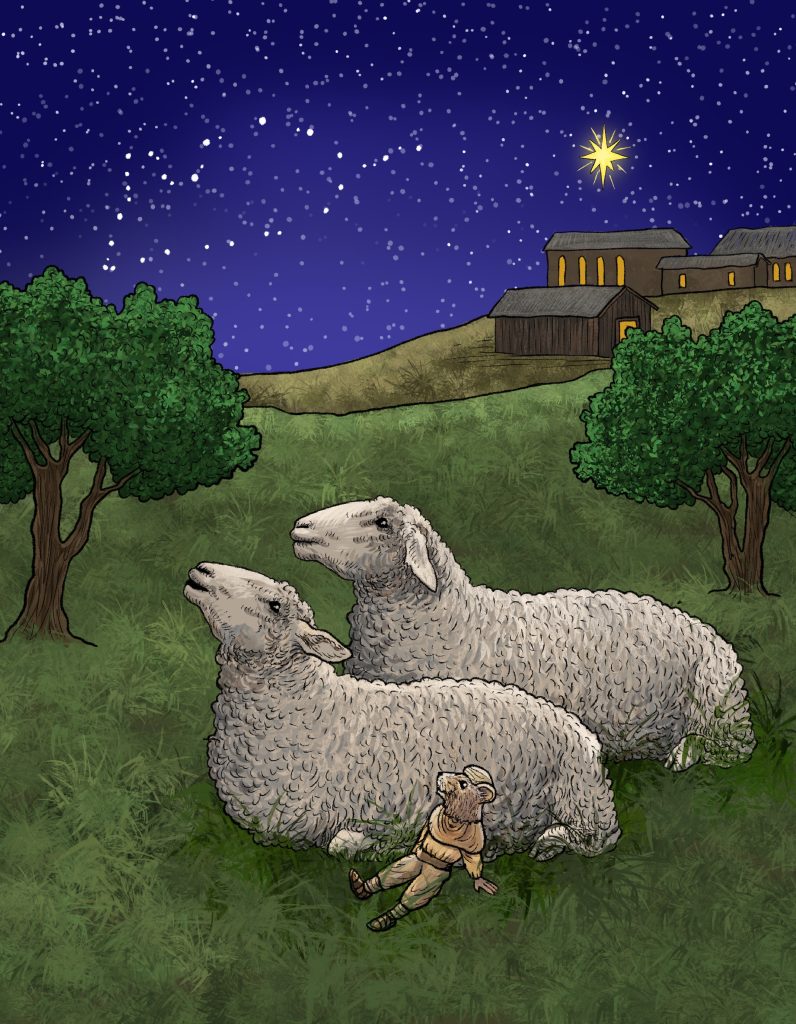
Finn was doing what he loved to do. Lying on his back, staring at the clear, starry sky overhead, and chatting with his friends, Asher Sheep and Shiloh Sheep, while searching for new constellations that they could name.
“Is that a sheep?” asked Asher. “It looks like a sheep. I think we should call that The Big Asher.”
“No,” bleated Shiloh. “That doesn’t look anything like a sheep. It looks more like a mouse. Hey, Finn, what do you think? Should we call it The Big Mouse?”
Finn twirled the flower he had in his hand, and then he twirled it again. He was thinking. Finally he said, “I don’t think it’s a mouse. I think… wait a minute! Do you see that bright star over Bethlehem? Where did that come from?”
Shiloh and Asher turned to look at where Finn was pointing, and they both said, “Whoa… that is bright.”
Finn tilted his head to listen to what the shepherds were talking about, and he heard them talking about the star, too. It was dazzling. They had never seen anything like it before.
Finn turned back to his friends and said, “I’m so glad you’re here with me. It’s much more fun to talk about the stars with two great friends. If I had seen that beautiful star all by myself, and had no one to share it with, I think maybe I would have felt a little sad.”
“Finn makes a good point,” said Mormor. “Loneliness is very powerful. God created people to be social beings, to be part of a family and to have friends. Spending time with friends should be a normal part of everyone’s life, but for some people, it’s not. If someone is not used to having friends, they may begin to think something’s wrong with them that makes others not want to be their friend. That can create self-doubt and insecurity. And then, if the day comes that someone expresses interest in being their friend, there might be a feeling of such euphoria that all they can think about is getting that feeling more and more. Euphoria can feel like a happiness that one has never experienced before. In fact, holding onto that feeling might become more important to them than all of the other things in their life that used to be priorities. For example, it could become more important than doing one’s homework, or practicing one’s instrument or sport, or even spending time with God each day. And to hold onto that feeling, they might think that they need to do and say whatever this new ‘friend’ is doing and saying. They might think that as long as they don’t look or sound different, then this new friendship will continue.
“Friends can have more power over a person than many other things in this world. And since everyone wants to be accepted, and no one wants to be judged or criticized, it can be very hard to go against a friend’s recommendation, request, or example. Even without peer pressure, it can be hard. Add in peer pressure, and it’s even harder.
“The question is this: Does it make a difference if our friends are Christian or not?
“We need to realize there is a spiritual battle going on in this world for the souls of all people. Satan will try every trick in the book to steal us away from God.
“Most of us are unaware of how devious, sneaky, determined, clever, and subtle Satan is in his ways of pulling us away from our faith or at least weakening it. He tries to make us too busy to think about it. He gets us to question ourselves. He plants seeds of doubt. He tempts us with things we don’t have but that we discover bring us unexpected happiness. He whispers in our ears that it’s the others who are ‘normal’ and not us, and so we should change and be like them. It’s a daily onslaught. It’s hard for us to stand against that if we are on our own, without having people in our lives who have a strong faith, who normalize having faith, and who encourage us in our faith.
“One of the things we might be tempted by, especially if we are lonely, is the opportunity for friendships with people who don’t know or follow God. Just because someone doesn’t know or follow God doesn’t make them a bad person, nor does it mean we shouldn’t be friends with them. They could be a very good person who is kind, fun, and funny, and who seems to accept us and appreciate us just as we are. The question is: Are we really being our true selves around that person? Our true self includes the Holy Spirit living inside of us. Do we share that part with our new friend, or do we hide it from them? We might want to avoid giving that new friend any reason to judge us. As we spend more and more time with this new friend, do we find that we are too busy to have time for church or youth group or personal devotions?
“It is not likely that these friends are intentionally pulling us away from God. They probably don’t even know God is in our heart unless we told them.
“We don’t often think about how Satan rules this world (2 Cor. 4:4), and he is in a spiritual battle for all the souls in this world, and he is happy about anything in a person’s life that is not drawing that person closer to God. He takes advantage of every opportunity to plant seeds of doubt. For example, if our new friend is very cool, successful, kind, interested in us, and fun, the thought might occur to us: ‘If this person can be so good and not have God in their life, then why should I have God in my life?’ Where did that thought come from? C.S. Lewis wrote The Screwtape Letters about this. Imagine it is Satan whispering that doubt in your ear.
“As we spend time with non-Christian friends, or with people who say they are Christian but it doesn’t seem to be much more than a word to them, we may start compartmentalizing God without realizing it. What does that mean? We might think about God at certain times of the day or week, but only during those times. During the rest of our life with people who do not know or care about God, we might hide that part of ourselves. If we do this, it is easy to start going in the wrong direction without even realizing it.
“This is the challenge of living in a secular world. Secular means to be without God. In this world, as we try to fit in, we can convince ourselves that we are not being polite or respectful if we talk about God to people who are not believers, or that we are not being respectful of their culture. That is what Satan wants us to think. He whispers to us that we don’t want to offend or worse, be accused of being arrogant, judgmental, or self-righteous. So, we tuck our relationship with God down into the hidden recesses of ourselves. And we think we can handle it, but we don’t realize how it’s changing us. We also don’t realize how that makes Jesus feel.
“There is this famous little booklet called My Heart, Christ’s Home. It was written by Robert Boyd Munger in 1954. He describes our heart as being a home for Jesus. We think of a home as being a house, so he compares our heart to a house with different rooms in it. Imagine how Jesus would feel if, when you’re by yourself, Jesus has free reign of the house. He can go into any room he wants. He can be with you wherever you are. But, if the doorbell rings, and someone is there to visit you, you tell Jesus that He has to go into a different room and close the door. That is a good description of compartmentalizing, and it means that we are not letting Jesus be with us wherever we are and with whoever else may be there. We are telling Him when He is welcome and when He is not.
“Your Uncle Caleb, my nephew, keeps Jesus welcome in every part of his life no matter where he is, what he is doing, or who he is with. He has such confidence, courage, and strength of faith to be able to talk about God with anyone, including his friends who don’t know or follow God. He decided that if they couldn’t handle it, he wouldn’t hang out with them anymore. They couldn’t handle it, so he moved on. That takes incredible confidence and courage. He doesn’t ever hide his faith. He doesn’t feel embarrassed about it. He reminds me of the song, ‘This little light of mine; I’m going to let it shine.’ It comes from the Bible verses, Matthew 5:14-16.
“Being a person of faith in a secular world is not easy. You will make decisions that affect the rest of your life, such as decisions about college, career, and even marriage. These are BIG decisions. They can affect your finances, your independence, your freedom, and how happy you are with what you are doing and who you are doing it with. If the friendships we intentionally make are with people who bring us closer to God rather than further away, we might find that having a strengthened faith allows us to hear the voice of our Good Shepherd and guide more clearly than if we haven’t been spending much time listening, or if we’ve been compartmentalizing God into smaller and smaller parts of our lives.
“Let’s think about this as a problem that has a solution. If the problem is that we are living in a secular world and will meet good people who don’t know God or follow God, and who we enjoy spending time with even though they are not strengthening our faith, and being with them keeps us from feeling lonely, then what is the solution?”
“This is really helpful, Mormor,” said Annika. “I wonder about things like this. I think the solution is not to compartmentalize God, but that’s all I know. And that’s hard. It takes courage.”
“I like what Uncle Caleb does,” said Theo, “but he has so much courage. He is willing to walk away if his friends don’t want to hear him talk about God. He doesn’t change who he is in front of them. He doesn’t hide his light under a bushel.”
“The great thing about what Uncle Caleb does,” said Lukas, “is that it gives his friends a chance to hear about God.”
“I agree,” said Mormor. “I remember one time, when your mother and I were visiting some missionaries in another country who we were friends with, I got to know a young woman who lived there. One day, she said to me, ‘What is it about you that lets you love your daughter so much?’ I had never been asked that question before! How do you think I answered?”
“I bet you told her that you know what love is because God first loved you,” said Linnea.
“You are right, Linnea!” said Mormor. “When people who don’t know God see us, and they know we are Christian, and they are impressed by our character, they might become curious. They might want to know who this one true God is that we believe in. They might want to have that in their own life.
“If we have the courage to say that we believe in Jesus and live a life seeking to follow Him, which has us seeking the True, the Good, and the Beautiful, then people may find themselves impressed and want to know more. They might want to follow our example rather than have us follow theirs! And if they can’t accept the part of us that is the most important part of who we are, being a child of God, being a temple for the presence of God, then they aren’t being honest when they say that they like us just as we are. And if they’re not being honest, then they are not trustworthy. And then Uncle Caleb is right. We should just move on.
“But while being in a group of non-Christian people, whether they are friends or classmates or teammates or coworkers, can be helpful for them as they have a chance to see an example in us of what it’s like to be a seeker and follower of Jesus, it may not meet the spiritual needs that we have. What kind of needs are those? We need encouragement and fellowship with other seekers and followers of Jesus. I say ‘seekers and followers’ because just because someone says they are a Christian does not mean they are actively seeking to have a relationship with Jesus and to follow His example. But if they are, they can lift us up, encourage us, set a good example for us, pray for us, and share in the joy of having Jesus in our lives. They can help us remember that what we do and say is part of making a good home, a temple, for the Holy Spirit to live in.
“So, I think the solution, as it is with everything, is to pray and talk to God about it, and trust that He will help us and guide us and protect us just as a Good Shepherd does. Psalm 23:1 says, ‘The Lord is my Shepherd, I shall not want.’ That means that with God guiding us and caring for us, we will not want for anything. We can trust God to provide for all our needs, to protect us, to be with us always. If we are lonely, we can tell that to God, too. We can pray and ask God to bring us a group of friends who like to talk about their faith and help each other draw closer to God.
“God has a plan for each one of us, and as it says in Jeremiah 29:11, it is a plan to prosper us and not to harm us, a plan to give us hope and a future.”
Hymn:
The First Noel
This is a traditional English folk carol that dates back to at least the 15th century. The original author is unknown. In 1823, Davies Gilbert published its text in Some Ancient Christmas Carols. In 1833, William Sandys published it, along with additional verses by Gilbert, in Christmas Carols Ancient and Modern.
