
An Advent Storybook and Study: Seeking Truth, Goodness, and Beauty
Copyright 2025 by Lūminé Press, Written by Elsie Lungren, Illustrated by Nicoleta Dabija
Day 24
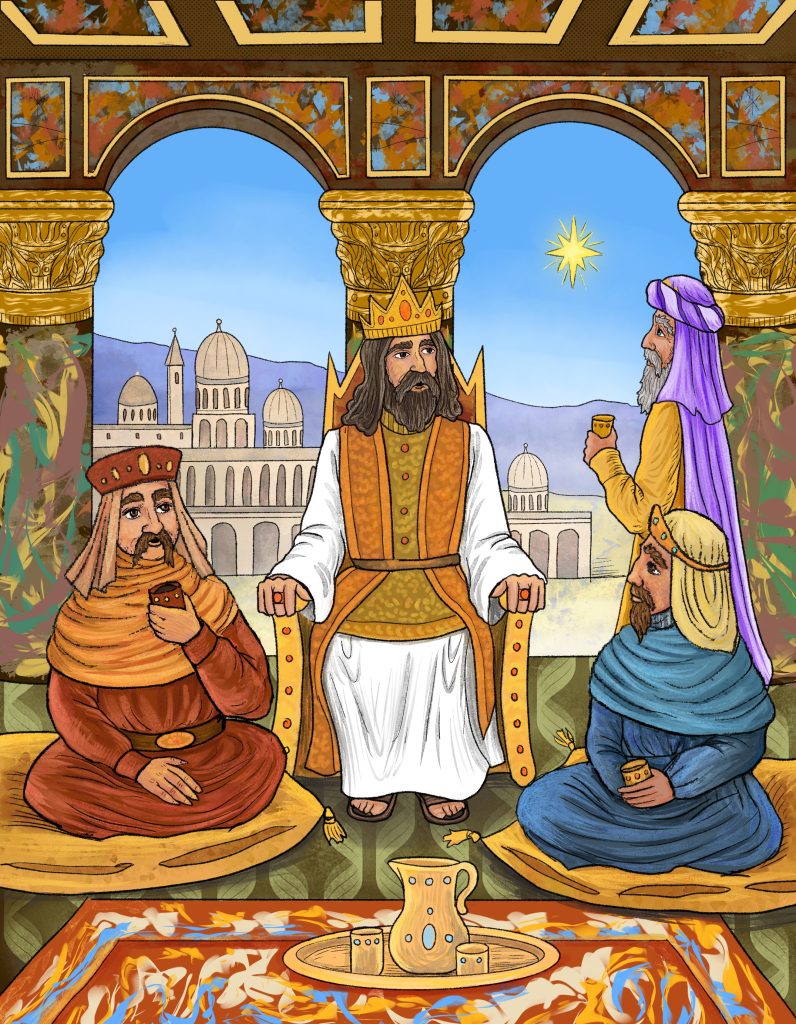
“Today is Christmas Eve!” announced Mormor. “And today, we will see how the wise men are doing on their journey. Let’s remember that we don’t know for sure when the wise men arrived in Bethlehem, other than the Bible says it was after Jesus was born and during the time of King Herod. Some people celebrate that day on January 6, which they call Three Kings’ Day. In our story, we have them arriving at the same time as the shepherds.”
The Wisdom of the Wise Men: Trust and Obey
Ethan was wide awake. In fact, he was bouncing up and down in May’s saddle basket. They were just entering Jerusalem, and he was looking everywhere at once. He was curious about everything. What did the people do all day? Was there a library? What was that person laughing about? Who was hiding behind that barrel?
“Excuse me,” said Melchior to a merchant. “We have been traveling a long time. Is there water available here for our camels?”
“Of course,” said the merchant, pointing. “Turn here and you will soon come to a well. Tell them that Bart sent you.”
“Thank you, sir,” said Melchior. “By the way, do you know ‘where is the one who has been born king of the Jews? We saw his star when it rose and have come to worship him’ (Matthew 2:2).”
Bart was not surprised to see strangely-dressed men saying strange things. But, he could also tell that these were important men, maybe kings from a distant land. He thought it best to choose his words carefully. “We Jews have been waiting 400 years for a Messiah. He will be our king. But now? There is only a Roman king. His name is Herod.”
Melchior thanked him, and the three wise men continued on to find the well.
Bart, meanwhile, told other merchants about the strange words of the foreigner, and soon everyone was talking about it. Before long, even King Herod had heard. This made King Herod very nervous. If the Jews had their own king, then what would happen to him? Since the Jews had been waiting 400 years for a Messiah, there must have been prophecies about it written that long ago. He called on the experts who had read the ancient Scriptures to tell him more about where this king was supposed to be born. They read to him the words of Micah 5:2 which are said again in Matthew 2:6.
6 “‘But you, Bethlehem, in the land of Judah,
are by no means least among the rulers of Judah;
for out of you will come a ruler
who will shepherd my people Israel’ (Matthew 2:6).”
Now that he knew the location was Bethlehem, he wanted to know the time. The foreigners had mentioned the appearance of a star. He needed to talk directly to them. He sent out messengers to find them and invite them to meet him.
When the three wise men, who were kings themselves, visited King Herod, they received the royal treatment. King Herod was very polite and friendly. He told them to look for the new king in Bethlehem. He said, ‘Go and search carefully for the child. As soon as you find him, report to me, so that I too may go and worship him’ (Matthew 2:8).” That sounded very friendly and polite, but it was a lie. King Herod wanted to make sure that there wasn’t any new king, and so if there was one, he wanted the child to be killed. But, he kept that a secret!
As they were leaving Jerusalem, Caspar said, “Something’s not quite right about that Roman king. Do you think he would really want to worship a new king if the new king would replace him as king of the Jews?”
Balthazar replied, “We will have to think wisely about that.”
“But for now,” said Melchior, “let’s go to Bethlehem and find this new King we have been seeking!”
With a twinkle in her eye, Mormor said, “Even though the rest of their story happens after they meet baby Jesus, let’s read it from the Bible now. We hear the rest of the wise men’s story in Matthew 2:9-12.”
‘9 After they had heard the king, they went on their way, and the star they had seen when it rose went ahead of them until it stopped over the place where the child was. 10 When they saw the star, they were overjoyed. 11 On coming to the house, they saw the child with his mother Mary, and they bowed down and worshiped him. Then they opened their treasures and presented him with gifts of gold, frankincense and myrrh. 12 And having been warned in a dream not to go back to Herod, they returned to their country by another route.’
“That last verse is very interesting,” said Mormor. “It says that after the wise men met Jesus, they were ‘warned in a dream not to go back to Herod’ (Matthew 2:12). King Herod had told them to return to him and tell him exactly where Jesus was.
“So, they were told one thing by Harrod, and something else in a dream. One said to return to Herod, and the other said not to. They could not follow both sets of instructions at the same time. They had to decide which one to trust. Did they trust what the king said or what they heard in a dream? Did they trust that the dream came from God? And after deciding who they trusted, they had to decide if they were going to be obedient or not. Would they obey the king, or would they obey the message in their dream? Did either of the instructions come from someone who had authority over them?
“These are very interesting questions, and it is one of the reasons I find the wise men so interesting. Of course, another big question is why they even came on the journey at all! They were not Israelites so they did not belong to the group known as ‘God’s people.’ They represented other cultures that had other traditions, beliefs, and gods. Yet, they dropped everything they were doing, put all their own activities and goals on hold, and set off on a long journey to follow a star and seek to find Jesus, the new King. That takes faith. It reminds me of when Abraham up and left his country, without any idea where God was leading him, simply because God told him to (Genesis 12:1,4). That takes faith. One advantage that Abraham had is that God actually spoke to him, and God told him that He was going to make him into a great nation. With the wise men, we don’t know if God had spoken to them, perhaps in a dream, before they decided to make the journey, or if they made the decision on their own after reading the prophecies. The decision of the wise men to make this journey also reminds me of Matthew 16:24 in which Jesus tells His disciples, ‘If anyone would come after me, he must deny himself and take up his cross and follow me.’ Do any of you know what is meant by the idea of taking up your cross?”
Theo said, “I think people are used to thinking about what they want for themselves and how they want their own life to be. Their focus is on themselves. They want to be comfortable. They want to set their own goals, make their own plans, and be successful. They might be trying to get money, power, or respect. If they think of anything they want in their life, they want to be able to get it. But, when Jesus says ‘take up your cross,’ He’s saying that following Him is a daily commitment of letting Him be the one leading our life. It means changing the focus from what we want for ourselves, and instead focusing on what Jesus wants for us.”
“You explained that well, Theo,” said Mormor. “Doesn’t it seem like the wise men did exactly that? Life on the road, or on a dusty path with camels, can’t be as comfortable as what life had been like for them before they started on their journey. They weren’t even sure where they were going other than they had a star to follow and the mention of Bethlehem in a prophecy. Even then, when they got to Jerusalem, they needed to ask for directions. They needed Herod to tell them they were going to Bethlehem. Maybe the wise men hadn’t seen the mention of Bethlehem in Micah 5:2. Whether they had seen it or not, they showed a lot of faith in a God who they didn’t even know when they dropped everything and started to follow that star on their quest to find and worship Jesus.
“So, let’s get back to this dilemma they had when God spoke to them in a dream after they met baby Jesus. First, how do you think they knew the message in the dream was from God?”
Annika said, “Well, all three had the same dream. That must have shocked them. They must have thought, ‘How is it possible that we all had the same dream?’ Probably the only reasonable answer they could come up with, since it seemed so impossible, was that it must be from God. Back in the days of the Old Testament, one of the ways God would talk to people was in dreams. He even talked to people this way who didn’t know Him. Some examples included the Pharaoh, Pharaoh’s butler and baker, Nebuchadnezzar, Abimelech, and Pilate’s wife. (see Genesis 41:1-7, 40:5-19, 20:3-7; Daniel 2:1, 4:5-17; Matthew 27:19). God also spoke to His people in dreams, such as Jacob, Jacob’s son Joseph, Solomon, Daniel, Mary’s husband Joseph, and more. (see Genesis 28:12, 31:10-13, 37:5-10; 1 Kings 3:5-15; Daniel 7:1-28; and Matthew 1:20-24).
“Even though we don’t usually hear about God talking to people in dreams today, it does seem pretty impossible for all three wise men to have exactly the same dream. And, we know that God specializes in the impossible! Luke 1:37 says, ‘For nothing is impossible with God.’ So I think they figured out that it was a message from God.”
“I agree, Annika,” said Mormor. “Once they decided the dream was from God, they had to decide who was more trustworthy: God or King Herod. And, they had to decide if either of those two had authority over them. Obedience is usually to the person who has authority over you. They couldn’t obey both because the instructions were to do opposite things.
“Let’s start with King Herod. Do you think the wise men trusted him? Did King Herod have any authority over them?”
Linnea said, “Since the wise men were foreigners, Herod was not their king. He was not in charge of them. So, they did not have to do what King Herod said. They could have chosen to go back to Herod if they wanted to. After all, since King Herod had given them directions to Bethlehem, and since they had no reason to think Herod was lying about wanting to worship the new king, maybe they thought that would be the polite thing to do. But even if they had not gotten the dream from God, they had a problem. They did not know King Herod. They did not know if he was trustworthy or not. It didn’t really make sense that a king would want to worship his replacement. So, they probably didn’t trust him, and they didn’t have to be obedient to him.”
“Good points, Linnea,” said Mormor. “What about God? Why do you think they trusted God, and why do you think they wanted to be obedient to God? They hadn’t even known God before this trip.”
“Well,” said Lukas, “God just gave them proof that He can be trusted!”
“What do you mean, Lukas?” asked Mormor.
“They started out on this journey to find this super important King that we think they’d only read about in prophecies, and they rode on their camels for days and days, maybe even weeks or months, without knowing for sure if they would even find this new King. And then, they find Him. Right under the star! There He is. Just like what the prophecy said. That proved the prophecy was true, and for a prophecy to be true, it must come from God. That means everything the prophecies said about this new King must be true, and that includes His being the Son of God!”
Astrid added, “When everything someone says is true, then that person is trustworthy. That’s what mom says.”
“Your mom is right,” said Mormor. “Trust is a tricky thing. We all want to trust everyone. We don’t want to believe that anyone would lie to us. We want to believe that everything people say to us is true. But, what happens if one of your friends says something to you that isn’t true, or is a little true but not completely true? Can any of you think of an example?”
“I can!” said Linnea. “I loaned my favorite doll to my friend. When she gave it back to me, one of the eyes was missing. I asked her what happened, and she said that she had no idea what happened. She said it must have been that way when I loaned it to her. She said that it’s my fault not to remember correctly. But, I knew that wasn’t true.”
“That’s a good example,” said Mormor. “Have you forgiven your friend? How do you feel now?”
“Yes,” said Linnea. “I forgave her. I’m not angry at her. I’m sure it was an accident. But the thing is… the next time I ask her a question, I’m not sure she will tell me the truth.”
Mormor said, “Yes, that’s the tricky thing about trust. Trust is easiest when a person is honest 100% of the time. If they have never lied to us before, we have no reason to think that they ever will. It is easy to trust them. But if someone says, ‘Well, I tell you the truth 99% of the time,’ then we will never know, when they talk to us, if it is part of the 99% or part of the 1%! Our trust in them is not as complete as it once was.
“When they lied to us that one time, it opened a door for a little doubt to creep in. It can be really hard, and take a lot of time, to get that doubt kicked back out so that our trust in the person is complete again. Trust depends on evidence. If there is evidence of a person lying, it is hard to trust that person. They may say, “You can trust me. I tell the truth most of the time.” But, whenever they speak, we won’t know if their words are from the ‘most of the time’ bucket or from the “not very often’ bucket!
“This is why, if we want to be a trustworthy person, which means others can trust us, we need to be honest all of the time. This is why honesty is so important. It lets us be trustworthy. If we want to have trustworthy friends, they also need to value honesty. But, we are all people. We are not perfect. There is only one who is perfect, and that is God. God is completely trustworthy because He is always honest. That means anything we read in the Bible, which is His Word, is trustworthy. So if prophecies say that Jesus is the Son of God, the Messiah, the Savior, the King of kings, the Prince of Peace, the Mighty God, the Everlasting Father, and the Wonderful Counselor (Isaiah 9:6), we can trust it to be true. We can believe it!
“Since the wise men just saw evidence that God’s Word is true and therefore trustworthy, and they have figured out their dream came from God, and they know they can trust God, they decided it was better to obey God’s instructions than Herod’s.
“Does that mean that they believed God had authority over them? And if so, what does the Bible say about obedience? Do you think obedience to God is that important? Think about it. If our forgiveness has already been given, if atonement for the sins of all people has already been made, if we are already saved, if our salvation is by faith and not by having to do anything to earn it… then is obedience that important? What’s the point of it? Couldn’t we just say that the Bible is there as a guide if we want it, as inspiration and encouragement if we want it, as a storybook if we’re interested, but not as something that we really need to follow?”
“God has authority over everyone,” said Lukas. “He’s the Creator of the world.”
“Lukas is right,” said Linnea, “Psalm 100:3 says, ‘It is He who has made us, and we are His.’”
“But what if they didn’t know that God was the Creator of the world?” asked Mormor. “Or, what if they believed God created people in His own image, and that means that people have free will? How can someone have free will, which means they are in charge of their own choices, but be expected to be obedient, which means they respect that someone has authority over them and should do what that person tells them to do? How can those two things happen at the same time?”
Theo said, “Free will means we can make the choice to be obedient if we want to. It means we are not robots controlled by a programmer. We are not puppets controlled by a puppet master. We can choose to respect authority and be obedient or not.
“The wise men were called wise for a reason. Being lovers of wisdom, they were philosophers. They liked to read, to think, and to reason. They had read about God, and they had sought God, and now God’s existence had been proven to them. In fact, the truth of God’s Word had just been proven to them. They had even experienced God speaking to them in a dream! Having met baby Jesus in person, they had experienced being in the presence of God. Being in God’s presence means experiencing indescribable joy and peace that passes all understanding. They must have been transformed by this experience. I bet that experience made them realize that God is not of this world but is the Creator of this world. From the prophecies, which had just been proven to them, they knew that baby Jesus was the Son of God who had come to save people from sin because of His great love for us. This knowledge must have been so wonderful, so much bigger than anything they had ever known.
“Knowing that God was the Creator of the world and everything in it, I think the wise men reasoned that God created people to have free will just as He does because God would want people to believe in Him, worship Him, follow Him, and be obedient to Him because it was their own free choice to do so, and not because they were programmed to do so. If someone loves you because they are programmed to love you, that doesn’t feel as special as if someone chooses to love you. I think God created people so He could have a relationship with them, and that’s why He created people in His image. That meant people could have feelings, could think and reason and make choices, and would have free will so that they were in charge of their own thoughts, words, and actions. It would make their relationship with Him more meaningful.
“I think the wise men would have reasoned that since God was the Creator of the world, He automatically has authority over everything in it. I think they would view free will as a gift that God gave to people out of love, and that God hoped people would use it to choose to have a relationship with Him. But if a person has a relationship with God, there is not equal power on each side. We are not equal to God. God is our Creator, and as Linnea quoted from Psalm 100, we belong to God. That gives Him authority over us. But rather than resent that, I bet the wise men found that exciting. I bet they felt honored and humbled to be in the presence of baby Jesus, the Son of God. And as they experienced indescribable joy in the presence of Jesus, they probably wanted to hold onto that feeling forever. That would mean following God wherever He wanted to lead them. Instead of feeling sad about letting go of their own ideas about what they wanted to do and gain in life, I bet they felt so much excitement and joy at the thought of being with Jesus all the time, wherever He might lead them.”
“Thank you, Theo,” said Mormor. “I couldn’t have explained that better! It makes me think that I bet the wise men would have stayed with Mary, Joseph, and Jesus if God had told them to. But, God told them in the dream to go home using a different route. Why do you think God sent them away? When they left, do you think they lost the joy that comes with God’s presence?”
Annika said, “The Bible doesn’t tell us if God filled the wise men with the Holy Spirit, but God did tell Zechariah, the father of John the Baptist, that John the Baptist would be ‘filled with the Holy Spirit even from birth’ (Luke 1:15). Since God had already provided the presence of the Holy Spirit in at least the life of John the Baptist, maybe He did it again with the wise men. Either way, I bet the experience that the wise men just had, being in the presence of the Son of God, transformed them forever. Maybe after they went back home, they became like early missionaries and told people in their home country about the birth of the Son of God!
“Knowing that Jesus was God’s Son, and having had experienced the indescribable joy of being in God’s presence, I think the wise men wanted to be obedient to God. I don’t think they resented it. I think it made them feel honored. They saw the Son of God as the King of kings, and they were honored and excited and full of joy to worship Him. That was their choice, and it reflected what was in their heart. In their mind they believed that Jesus was the Son of God and the King of kings. That was perfect truth. In their heart they believed that the indescribable joy they felt was from being in the presence of God. That was perfect beauty. And from this knowledge and feeling, they freely chose the actions of obedience, of worship, of following Jesus wherever He told them to go. That was goodness.”
“Well said, Annika,” agreed Mormor. “We still haven’t really answered, though, why obedience is important if our salvation and forgiveness is freely given. Ephesians 2:8 says, ‘For it is grace you have been saved, through faith – and this not from yourselves, it is the gift of God – 9not by works, so that no one can boast.’ So if we don’t have to earn salvation by doing good things, then why do you think obedience is so important?”
Theo said, “Romans 6:15 answers that question. It says, ‘What then? Shall we sin because we are not under the law but under grace? By no means!’ Also, remember what Jesus said to His disciples in John 14:15-17.
15 “If you love me, you will obey what I command. 16 And I will ask the Father, and He will give you another Counselor to be with you forever— 17 the Spirit of truth. The world cannot accept Him, because it neither sees Him nor knows Him. But you know Him, for He lives with you and will be in you.
“That is the moment when Jesus tells His disciples that the Holy Spirit, the Spirit of truth, will be with them forever. Knowing that the presence of God would be with them forever must have filled them with such indescribable joy. Their salvation was a gift given to them because of their faith in God. Having faith means they believe Jesus is the Son of God, and that means they recognize He is the King of kings, their Lord and Savior, their Creator, the one and only God. So of course they will want to obey His commands. Their choice of actions (goodness) is just a reflection of the joy in their heart (beauty) and the knowledge and trust in their mind (truth).”
“Thank you, Theo,” said Mormor. “When you see how seeking God connects to seeking Truth, Goodness, and Beauty, I know how much thinking you have done!
“Both Matthew and Luke tell of the time that Jesus told His disciples to ‘take up their cross and follow Him.’ That is in Matthew 16:24 and Luke 9:23. Jesus is telling them that actions matter. If they want to have Jesus in their life, they will be following Jesus rather than Jesus following them. Jesus will be the guide. That means going where Jesus says to go. It requires trust.
“Again and again in the Bible we see people that obeyed God even though it seems unbelievable that they would do so. Think about when God told Abraham to sacrifice his son, Isaac. Really? God would tell a father to kill his own son? Think about when God told Noah to build a huge ark because, He said, ‘I am going to put an end to all people, for the earth is filled violence because of them. I am surely going to destroy both them and the earth. So make yourself an ark… (Genesis 6:13-14). Really? God was going to destroy the earth and the people on it? Think about when God appeared in the flames of a burning bush and said to Moses, ‘So now, go. I am sending you to Pharaoh to bring my people the Israelites out of Egypt’ (Exodus 3:10). Really? Go up against the most powerful person in all of Egypt and think you’ll be fine?
“Isn’t it hard to understand why Abraham, Noah, and Moses would have obeyed God in those situations? What do you think?”
Annika said, “I think it is easy to be obedient if we have complete trust in the person who is telling us what to do. The one who we can have complete trust in is God. He is God. He is perfect. He is our Creator. And, if we trust Him, we know that He has a plan. We don’t have to know what the plan is.”
“You’re right, Annika,” said Mormor. “If Abraham or Noah or Moses had said no, that would mean that they thought God was wrong. It would mean that they thought they knew better than God. It would mean that they didn’t trust God to be perfect, to be right all the time, to have a plan, and to know what He was doing. If every time God speaks, we decide that we need to evaluate for ourselves if it is a good choice or not, trustworthy or not, then we are not believing that God is perfect Truth, perfect Goodness, and perfect Beauty. We are not believing that God is God. If we think that we only need to be obedient to God when we agree with Him, then we are thinking that we are smarter than God. We should use the T.H.I.N.K. acronym when evaluating the words of other people, but we don’t need to do that with God. He is not ‘other people.’ He is the Creator of all of Earth and everything on it! He is sovereign. That means there is no one who has authority over Him.
“Abraham, Noah, and Moses did not need to understand why God was telling them to do. They only needed to trust Him. And they did. For Abraham, being obedient to God would mean giving up the one thing He had been waiting for and wanting his whole life. His son. But, he knew God, walked with God, and trusted God. God spoke directly to him. And God had made him a promise. God had promised to make a great nation from Abraham, and that would require children. Isaac was Abraham and Sarah’s only son. For God to keep His promise, it seemed like Isaac was needed! Abraham trusted that God would keep His promise. Abraham’s trust in God was bigger than anything else. It was bigger than his fear of losing Isaac, someone he had been waiting years to have in his life. For Abraham’s trust to be that big, it tells us how much he experienced the presence of God in his life. Abraham actually got to talk to God and have conversation with him! Imagine walking and talking with the Creator of the universe! We can see how Abraham’s trust in God must have been so complete!
“Today, when we read that story about Abraham and Isaac in Genesis chapter 22, it is easy to wonder why God would have tested Abraham in that way. Something we don’t know very much about is what life was like back in the time of Abraham. During some parts of the Old Testament, there were some cultures in which people made their own gods and sacrificed their children to those gods. Abraham may have been aware of this. While we don’t know exactly how much, if at all, this was happening during the time of Abraham, we do know of at least two places in the Old Testament, in Deuteronomy 12:30-32 and Jeremiah 19:4-5, where God says that child sacrifice is something that He finds ‘detestable” and that He hates.
“When we read the story of God telling Abraham to prepare to sacrifice Isaac, we have to remember that we know something Abraham didn’t know. We know that God was not going to let Isaac be sacrificed. God was testing the faith of Abraham by telling him to do something which Abraham may have heard of others doing for their manmade gods, and that would show how much Abraham trusted God and prioritized Him in his life. Abraham did not question God. He trusted and obeyed. It reminds me of the children’s song, ‘Trust and Obey!’
“Imagine being Noah when God announces that He is going to wipe out all that is on the Earth except for his family and start over. Wouldn’t you think, ‘Are you crazy? That makes no sense at all. Why don’t you consider a less radical plan?’ Yet, Noah trusted God completely. He didn’t question or argue.
“Moses, interestingly, had a little more trouble with trusting. When God told him to go to the Pharaoh, Moses actually came up with four excuses about why he would not be the best man for the job, and then after that he begged God to send someone else (Exodus 3:11, 13; 4:1, 10, 13). God patiently answered every one of Moses’s questions, and He even arranged for his brother, Aaron, to help him. Finally, Moses obeyed!
“When we read the stories of real people in the Bible who were obedient to God even in circumstances that made no sense, or that were dangerous, or that seemed morally questionable, or that took great courage, we learn how important obedience to God is. It shows that we believe He is God. It shows our trust in Him is complete. It shows that we accept that we don’t have to understand His reasoning or His plan. We don’t tell Him that we’re right and He’s wrong. We don’t say, ‘Defend your position, and I’ll see if I agree or not.’
“In Psalm 119:57b, the psalmist writes, ‘I have promised to obey your words.’
“Obedience to God shows that we trust Him completely. Complete trust means we don’t need Him to explain His reasoning or His plan to us. Obedience to God also shows that we respect Him as the Creator of this world to be sovereign and the ultimate authority over all the world. Obedience to God also shows that we love Him with all of our heart, all of the time, no matter what.
“There is a deep joy that comes from knowing God is always present in our heart because the Holy Spirit is there, and from knowing that God’s love for us is unconditional. Imagine having the Creator of the universe love you so much that He lets His Spirit be in your heart always! As David says in Psalm 139:6, ‘such knowledge is too wonderful for me.’ Being obedient to God brings us even more joy because we feel honored to have the King of kings being at home in our heart! We do not feel resentful when we are obedient to God. Instead, we rejoice that we have the freedom to choose obedience. If we did not have free will, we would not be able to choose obedience. When it is our choice, it is so much more meaningful. Both to God and to us.”
Application:
The wise men’s story provides us with a great example of trusting God and being obedient to God. While God does not usually speak to us through dreams today, He does speak to us through the Bible. That is His Word. It is true and it is trustworthy. One of the ways that God teaches and instructs is through stories. There are stories of real people throughout the entire Bible. There are also parables told by Jesus. When we listen to these stories, we learn what is important to God. If something is important to God, it should be important to us. If God gives us instruction in the Bible, He wants us to be obedient. He does not want us to question how we feel about it, to reason that it may be right for some people but isn’t right for us, or to consider it optional – like if we’re looking for words of wisdom or for a guide.
“Some things did change for God’s people after Jesus was born on Earth. Since Jesus made permanent atonement for all the sins of humanity, it is no longer necessary for a high priest to make that atonement every year. Some of the customs and cultures of biblical time periods are different today, and so comments about some details are not relevant to our lives today. But, even if the instruction is about a specific ritual, custom, article of clothing, or type of meal preparation that doesn’t pertain to us today, there is likely still a bigger point being made that does apply to us. Maybe it is a point about character, or choices, or seeking God. Maybe it is clearly defining examples of sin or examples of virtues. Maybe it is being prophetic, or poetic, or a voice of wisdom.
“Some people want to sum up the entire Bible by saying that it’s just a big book of stories from thousands of years ago, and that all the stuff about sin and instructions were for a different time and place than what we are in now, and that the only message for us is to love our neighbors as ourselves. People who summarize the Bible like this might have sin in their life that they are trying to say is not sin. When it says that God created all people in His image, and that He wants us to love everyone, He is not saying that there are no sinners. He is not saying that everyone is okay just as they are. He is not saying that everyone can be however they want to be.
“Being in God’s image means that people can think critically about things. They can discern right from wrong; they can evaluate and prioritize; they can understand cause and effect; they can use reason and logic; they can identify and solve problems. People can feel a wide range of emotions. People can seek that which is true, good, and beautiful. People have control over their own words, thoughts, and actions. They are free to make choices and decisions.
“Loving everyone means that we love and respect the humanity of each person. It does not mean that we love and respect their behavior and attitude, their actions and words. There’s an expression that goes like this: ‘Love the sinner; hate the sin.’
“The Bible contains wisdom, promises, encouragement, instruction, and so much more. It is 100% trustworthy and true. It is God’s Word. When we read it, we should be thinking about trusting God, about being obedient to God, and about the joy there is in having God’s presence and love in our lives all the time, no matter what. What an honor!
“When we read the Bible, we should not be thinking about how to ignore or rationalize the parts that don’t fit with our life right now. Instead of saying, ‘Oh, that doesn’t have anything to do with me. That was just how it was thousands of years ago.’, we should pray and ask God to help us hear and understand what it is He wants to tell us, and what it means for our life right now.
“And finally, as it says in 1 Timothy 4:12, “Don’t let anyone look down on you because you are young, but set an example for the believers in speech, in life, in love, in faith and in purity.
Hymn options:
Trust and Obey written in 1887 by John H. Sammis (lyrics) and Daniel B. Towner (music).
We Three Kings of Orient Are written by John H. Hopkins, Jr. in 1857.
Silent Night, Holy Night was written in 1816 by Joseph Mohr (lyrics), and the tune was composed in 1818 by Franz Xaver Gruber.
O Holy Night
In 1847, French poet Placide Cappeau wrote the poem “Minuit, chrétiens” and Adolphe Adam composed the music for it. The English version was translated by American minister John Sullivan Dwight in 1855.
