
An Advent Storybook and Study: Seeking Truth, Goodness, and Beauty
Copyright 2025 by Lūminé Press, Written by Elsie Lungren, Illustrated by Nicoleta Dabija
Day 23
“Christmas morning will soon be here!” said Mormor. “We know that two different groups will arrive at the stable on Christmas morning. These are the shepherds and the wise men. Today we will check in with Finn of the Fields to see how the shepherds are doing, and tomorrow we will see how Ethan of the East and the wise men are doing on their journey.”
Shepherds in the Field Part 3: Angels and Influences
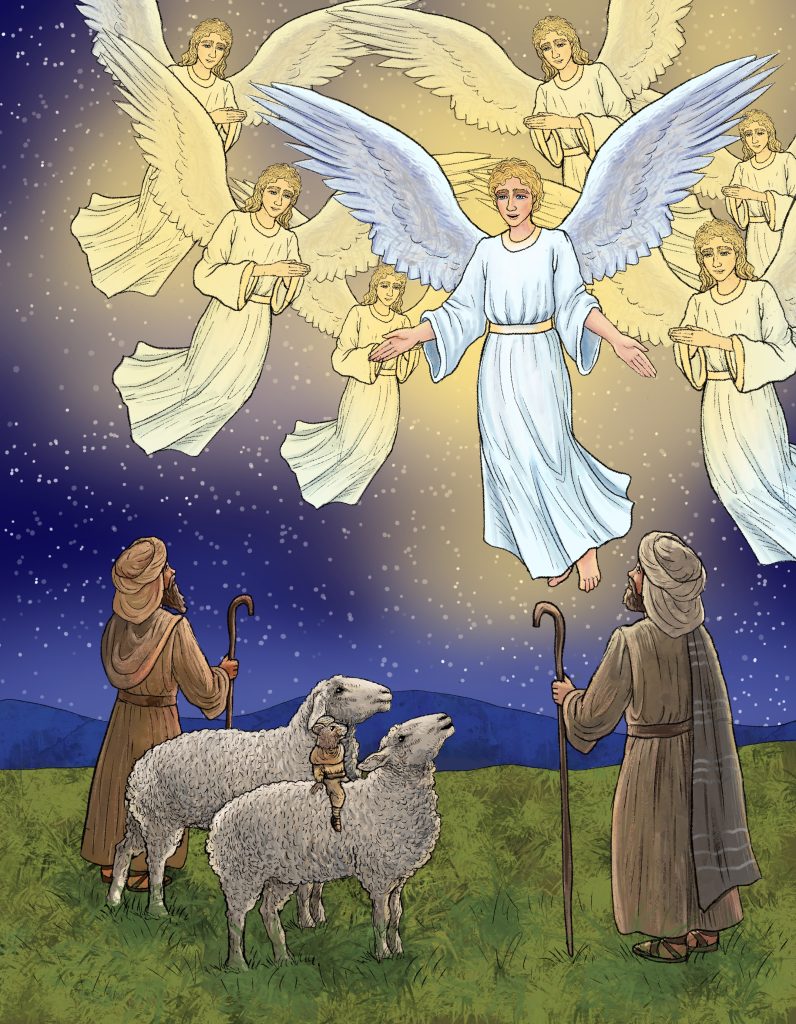
It was a clear and starry night, just the way Finn liked it best. The soft wool of his friend, Shiloh the Sheep, was a comfortable place on which to lie back and gaze at the sky above. Life was good. Then, out of nowhere, an angel appeared in the sky above and said, ‘Do not be afraid. I bring you good news that will cause great joy for all the people. Today in the town of David a Savior has been born to you; he is the Messiah, the Lord. This will be a sign to you: You will find a baby wrapped in cloths and lying in a manger’ (Luke 2:10-11).
Not only did Finn jump up, but so, too, did the shepherds! As they all stood and stared at this amazing sight in the sky above, a choir of angels joined the first angel and sang, ‘Glory to God in the highest heaven, and on earth peace to those on whom His favor rests’ (Luke 2:14).
The shepherds looked at each other.
“What should we do?” asked one.
“We should go find this baby!” said the other.
And so, taking two of their sheep, Asher and Shiloh, with them, and with Finn along for the ride as he was still on the back of Shiloh, they headed down the hill to Bethlehem, the town of David.
“This is getting exciting,” said Mormor. “The shepherds are on their way! I am curious, though, about three things. Why do you think they just got up and left their field and headed to Bethlehem? And how did they know exactly where the stable was? And why do you think God chose shepherds to be the ones who heard the angels?”
“I think God must have helped them find baby Jesus,” said Linnea. “Maybe the star was right over the stable, and maybe God gave one of them the idea to follow that star.”
“Maybe they went into town and talked to Ian the Innkeeper,” said Lukas. “Maybe that is how they learned about Mary and Joseph arriving on a donkey, and about Mary looking like she was about to have a baby.”
“Those are two possibilities,” said Mormor. “Good thinking. We don’t actually know because the Bible doesn’t tell us.
“About my other questions, any thoughts on why they decided to just get up and go in search of this baby, or why God picked shepherds to hear this good news? We don’t know much about the shepherds. We don’t know what they were thinking or what things they cared about.”
“It must have been shocking to them,” said Theo, “to see the angels appear in the sky like that. Could you imagine if that happened to us? That’s in the miracle category. Seeing something like that might change a person. It might wipe their mind free of all the things they would normally do, and make them realize something bigger is going on.”
“I agree,” said Annika. “The angels appeared in the sky. That means that the shepherds had to look up instead of around them. When we look at what is around us here on Earth, we see our own little circle of life and how everything in it affects us. But when we look up into the sky, off of planet Earth, we see a much bigger picture. We see the same thing that everyone else on Earth is seeing even if they aren’t in our own little circle. So maybe, instead of thinking about their own life, they thought about something bigger than them.”
“Those are some good thoughts,” said Mormor. “I usually think of shepherds as leaders because they know how to guide and care for their sheep. But, it occurs to me that they are still people. Do you think we could say that all people, even the ones who have leadership skills, are influenced by someone or something when they make decisions in their life?”
“Sure,” said Theo. “I think the choices people make, and the plans they come up with, are influenced by their goals and values.”
Annika added, “And I think those goals and values are influenced by everything they experience in their life, by everything that goes into their brain. That includes the lyrics of songs they listen to, the characters and plot of books they read and movies they watch, and the things they hear and see others say and do. When they see the cause and effect of what a person says or does on others, they decide if it is good or bad and that has influence on their future decisions. They are also influenced by their friendships, culture, traditions, and teachings. What people are taught in school by teachers and textbooks, as well as by their parents at home, will have an influence on them.”
“That’s true,” said Mormor. “Now let’s think about leaders. We could say a leader is anyone who wants to have a positive influence on others, guide them in what they do, and maybe protect them from harm. With that definition, a parent is a leader of the family. A shepherd is a leader of their sheep. We usually think of a leader as the opposite of a follower. But, can you think of how leaders are also followers?”
“Well,” said Annika. “Every leader or parent is a person, and every person has become the person they are because of how their experiences in life have influenced them. In a way, we could say that every person, including leaders and parents, is a follower because they are following a set of beliefs, values, ideas, and goals that grew out of all those experiences and relationships in life that had an influence on them.”
“What about the rebel?” asked Theo. “Isn’t that someone who says that they don’t go along with what is expected of them because they are going to forge their own path?”
“Good point, Theo,” said Mormor. “But if a rebel wants to say that they don’t conform to the ideas of others, then their decisions are based on doing the opposite of those ideas. But to do the opposite, they have to first know what those ideas are. So, in a way, their decisions are still influenced by the ideas of others.
“When we wonder why the shepherds, who are leaders of their sheep, are willing to follow the message of an angel who they don’t even know, and who isn’t even of this world, we have a question worthy of philosophers! I think it tells us that everyone but God is following someone or something, even if that ‘something’ is a set of goals, beliefs, and values that have arisen from our experiences in life. And if we are going to be following something, which means letting our decisions be influenced by something or someone, do you think it’s a good idea for us to pick those influences carefully?”
Astrid said, “Do you mean that if we want to choose our words wisely, as mom and dad say, that we should pick TV shows and books that have people in them who choose their words wisely too?”
“Yes, Astrid,” said Mormor. “In the stories that we read or see, there will probably be what we call protagonists and antagonists. The protagonists are the good guys. They are usually the main characters, and if they make good choices, choose kindness over meanness, are willing to forgive when others are being unfair or unkind, show perseverance and determination and never give up, have courage, and things like that, then they are probably having a good influence on us. If we really like the character and are rooting for them, then we might want to be like them. Stories also often have at least one antagonist. These are the bad guys, the ones who are trying to make life difficult for the good guys. Their goal is to prevent the good guys from being successful. If we recognize them as antagonists, then we do not want to be like them.
“So in the TV shows and books you pick, Astrid, we hope there are some characters who choose their words wisely. They will show good character traits that will set a good example for us. If we try to be like them, we will be showing those same good character traits, too. But, the stories will also have characters who are not making good choices. Our job is to figure out who’s making good choices and who is not. We call that discernment. Discernment is being able to see the difference between right and wrong, between good and evil.
“Let me give you an example. Let’s say you are reading a book, and the main character is a fun, funny, kind, courageous, and adventuresome person. They are just the kind of person who we want to be like. They make us laugh. They are smart and clever. We are impressed by them. But, let’s say that this person is also someone who makes fun of the Bible, or says that the Bible should not be taken too seriously because it’s old and outdated, that times have changed. Or, maybe they say that the main message of the Bible is just to love everyone but not worry about all the details. Maybe they say that the Bible can mean different things to different people, and everyone can decide for themselves what it means to them. That sounds good, right? If the main character believes this, and the main character is someone who we really like because they are so cool, witty, exciting, and brave, then we aren’t going to want to disagree with them on any of their specific ideas or beliefs about the world or about God. We might not even realize that this story is planting seeds of doubt in our mind, getting our faith to become just a little less strong.
“Do you think Satan knows that is happening? I bet he does. Satan is more than happy to use anything in this world that he can to get our faith to weaken, to get us to start doubting, to take our mind off of God, to give us another way to look at something. He is very subtle and clever. Do you know that he even knows every word in the Bible, probably better than we do, and will try to use those very words to make us confused? He did this both with Eve and with Jesus!
“In Genesis 3:1, the serpent, who was Satan, said to Eve, ‘Did God really say, ‘You must not eat from any tree in the garden?’’ He knew very well that God hadn’t said that. He knew that God had said, ‘You are free to eat from any tree in the garden; but you must not eat from the tree of the knowledge of good and evil’ (Genesis 2:16-17). So why did Satan change God’s words when he asked Eve that question? He did it to confuse Eve and to start a debate with her. He wanted to give her another way to look at it, but he was basing it on a lie because he purposefully changed God’s words.
“This is one method of deception. The deceiver takes words that we believe are true, changes them just enough to still sound good but no longer be true, and then gives us a logical-sounding perspective that we can’t argue with but we don’t realize that they are based on words that were changed enough to no longer be true. When someone is deceived, they think that what they know is true, but they don’t realize that it’s not. One of Satan’s nicknames is the Deceiver because he’s so good at it. Here’s another example, in Luke 4:9-13, of how Satan tried to use his knowledge of the Bible to tempt Jesus:”
9 The devil led him [Jesus] to Jerusalem and had him stand on the highest point of the temple. “If you are the Son of God,” he said, “throw yourself down from here. 10 For it is written:
“‘He will command his angels concerning you
to guard you carefully;
11 they will lift you up in their hands,
so that you will not strike your foot against a stone.’”
12 Jesus answered, “It is said: ‘Do not put the Lord your God to the test.’”
13 When the devil had finished all this tempting, he left him until an opportune time.
“First,” said Mormor, “it’s worth noting that Satan knows the Bible well enough to quote it. Second, by using God’s own Word against Jesus, Satan thought he could win. He used the words of Psalm 91:11-12 which say that the angels would not let Jesus fall. Then, he basically said to Jesus, if you want to prove that Your Word is true, then jump off the temple and prove that the angels will catch you. If you really trust Your Word to be true, then prove it. If You don’t prove it, then You don’t trust Your own Word to be true.
“Doesn’t that sound tricky? What makes it so tricky is that it sounds logical.
If A (God’s Word is true), then B (You can and do prove it).
If not B (You can’t or won’t prove it), then not A (God’s Word is not true).
“There’s a problem with Satan’s trickery. It’s written in Deuteronomy 6:16, and Jesus quotes it right back to Satan in Luke 4:12. “Jesus answered, ‘It is said: ‘Do not put the Lord your God to the test.’”
“What did we just learn here? We learned that one way to defeat Satan’s attempt at using God’s Word against us is to know God’s Word so well ourselves that we can see how he’s twisting it, changing it, or trying to confuse us with it.
“If we go back to that example about a book with a charming main character who misrepresents the Bible or the teachings of the Bible, and ask ourselves if this book would be a good influence on us, the answer is no! It might be a fun and exciting book with great characters, but the beliefs and opinions that the author gives to the protagonist will have an influence on us. Even if we don’t realize it. It’s very subtle and clever. The fact is that we don’t want to disagree with people we like and respect, even if they are fictitious characters in a story!
“Let’s go back to our question about the shepherds and why they are so quickly willing to be influenced by the angels. The angel didn’t even tell the shepherds to go, although he did tell them what the sign would be, and that suggests that he expected them to go. But even then, he didn’t give many clues. He just said that it was a baby who was wrapped in cloths and lying in a manger. The manger is a good clue as that implies a stable. A baby is another good clue because if it’s a small town, maybe there aren’t many babies who were just born, and maybe word gets around town quickly.
“That still doesn’t tell us why they went. If we look at what else the angel said, he said this was good news that would provide great joy to all people. Also, regarding the baby, the angel used the words Savior, Messiah, and Lord. If the shepherds were believers in God’s Word, and knew it was prophesied that a Messiah was coming, and believed the Messiah would rescue them from the rule of the Romans, and this news was being delivered by angels, then maybe that would jar them into action! Having the message delivered by angels would have been a big deal. Not only are angels not of this world, but they just appeared in the sky and their voices could be heard! This is not possible according to the Laws of Nature. It’s not how things work on Earth. Yet, they witnessed it!
“I think it was probably helpful that there was more than one shepherd. If it was only one shepherd who saw the angels appear in the sky, then maybe he would have convinced himself that he was seeing things. Maybe he would think he fell asleep and dreamt it. But he can’t say that if others saw the same thing! I think this is another reason why it is good for us to have Christian friends. When something happens in our life that feels like God is pointing us in a certain direction, being able to talk about it with someone else who also believes in God can be helpful.
“Lastly, the angel said that it was good news, and that it would bring everyone great joy. We talked about joy yesterday. We said that the kind of joy that we read about in the Bible is the kind that comes from being in God’s presence and knowing that He will never leave us. Both His presence and His love are trustworthy, forever and ever no matter what. When we think about what the angel said, does that definition of joy make sense?”
“Yes,” said Lukas. “The birth of Jesus meant that God would be present with all the people on Earth. And that would give them joy.”
“I agree,” said Mormor. “I think there is a lot we can learn from the shepherds. Can you give some examples?”
“We should think about what influences our ideas, values, beliefs, and decisions,” said Theo. “We should pay attention to what we want going into our head because anything we see or hear can influence us in subtle ways, even if we don’t realize it or think it will.”
Linnea added, “We should try to have people in our life who trust and follow Jesus so that we can talk with them about things we experience, especially if we’re wondering whether God is encouraging us to go in a certain direction.”
Annika spoke up. “We should be willing to look up, away from ourselves, to see how big God is, and how He brings good news, great joy, and salvation for those who seek to be in His presence. If we only look right around us at the things in our own life, then we are only thinking about ourselves, what we’re doing, and how everything affects us. What we see is centered on ourselves. We could be so focused on our own plans and how we think things should be, that we miss seeing what God is telling us or how the Holy Spirit is trying to lead us. Since God is the Creator of this world, and not part of creation, He is not of this world. The Laws of Nature do not pertain to Him. If He wants to send angels to appear in the sky with a voice heard by the shepherds, then He can do that. If He has something to tell us and we are willing to look up and listen, He will tell us.”
“And,” said Theo, “if we hear God speak, we should listen, trust, and act. That is what the shepherds did.”
Astrid said, “Being with Jesus means having joy.”
“This is good news indeed,” said Mormor! “Before we close, we haven’t talked about why it might be that God chose the shepherds as the one to hear this good news. The Bible doesn’t tell us so we can only come up with ideas. What do you think?”
Lukas said, “Even though the shepherds were leaders of their sheep, I don’t think people saw them as very important. But since God told them first, maybe He’s making a point that everyone matters to him, including the people who are not seen as very important.”
Theo added, “I agree with Lukas. I also think about the job that the shepherds did. Their job required them to be very vigilant. That means they could not go to sleep on the job. They had to be constantly paying attention to everything around them. They wanted to make sure that none of their sheep wandered away, and that no thieves or wolves would come after the sheep. And if they saw something, they had to react quickly. In other words, they were the type of person who would notice the angels and react quickly to their message.”
Annika said, “Also, shepherds and sheep were significant to God because David had been a shepherd, and Psalm 23 tells us that Jesus is our Shepherd, and Jesus was called the Lamb of God when His death on the cross was seen as a blood sacrifice that atoned for the sins of all people. In the Old Testament, when the high priests used lambs for the blood sacrifice, it was the shepherds that cared for those lambs. Maybe Jesus, knowing that He was going to be like the lamb, thought of shepherds as important because their job was to take care of lambs.”
“These are all great ideas,” said Mormor. “Today we talked about three questions that we don’t have answers for, but it is fun to share our ideas with each other. Tomorrow we will see what is going on with the wise men!”
Application:
- Let’s not be so focused on our own plans and how we think things should be that we miss seeing what God is telling us or how the Holy Spirit is trying to lead us. And if we hear God speak, we should listen, trust, and act.
- Let’s read the Bible so we can know it better than anyone who tries to use it against us. That will help protect us from being deceived by others.
- Let’s have people in our lives who know, trust, and follow Jesus so that we have someone to talk with about what we see God doing and saying in our life or in the world.
- Let’s remember that God is always with us no matter what. His presence in our heart, and His unconditional love for us, is a source of indescribable joy. When we seek Him, we are reminded of that joy.
- Let’s care about what goes into our head. Let’s remember that anything we see or hear can influence us in subtle ways, even if we don’t realize it or think it will. It can affect our beliefs, values, ideas, goals, and decisions about what we do and say. For things we can control, like our choices about books, songs, movies, TV, social media, source of news, and even the friends we want to trust the most, we can be discerning. We can decide if they are a good influence on us or not, if they encourage our faith and our beliefs or weaken them.
For things we can’t control, like what people in authority over us say to us, or what is written in our school textbooks, we can learn how to discern if it is fact or opinion or a mixture of both. We have to be especially careful when it’s a mixture of both because their goal might be to blur the line between fact and opinion, to make the opinion sound like a fact. That is a powerful way to have influence on a person without them realizing it.
If it is opinion or a mixture of fact and opinion, the speaker or writer probably has an agenda or a hidden purpose. What does that mean? Having an agenda means they want to influence us in a specific way. They may want to persuade us to change any of our opinions, beliefs, or values that are different from theirs.
We could say that everyone has an agenda. Everyone wants to convince us that they are right. We can’t just believe everything that everyone says, but we can decide who we trust. For example, parents have an agenda, but parents should be trustworthy. Their agenda is probably to raise their kids to have good character. That means to be trustworthy, to have integrity, to be discerning, to make good choices, to have courage, to persevere and not give up, to be responsible, to have a positive attitude, and to be kind and loving. They may also want their kids to discover and develop their gifts and talents, to be a positive influence on others, and to know and trust and follow Jesus.
Parents, or the people who are responsible for taking care of us, should be trustworthy. If they are, then we want their influence in our lives. On the other hand, we probably don’t know the author of a book or a textbook and that person doesn’t know us. We don’t know if they are trustworthy or not. We don’t know what their agenda is. We don’t know what influence they want to have on us. This is where we have to be the most discerning.
There are questions we can ask ourselves that help us be discerning. There is an acronym that is frequently used as a guide for what to say or post to others, and that same acronym can be used to help us evaluate what we are told by others. T. H. I. N. K. Is it true? Is it helpful? Is it inspiring? Is it necessary? Is it kind?
We can also ask: Is it true? Is it good? Is it beautiful? When we ask that question, we need to remember the difference between what is subjective, meaning it depends on a person’s point of view, and what is objective, which means it applies to everyone. And when we think about perfect truth, perfect goodness, and perfect beauty, we are describing attributes of God. What He says, what He does, and who He is.
Something else that helps us to be discerning is to read and study the Bible because that is God’s Word. The more we know what is in God’s Word, the more we can know if what we hear and read contradicts anything in God’s Word.
Reading: Luke 2:8-16
Hymn Options:
It Came Upon a Midnight Clear
The song was written by Edmund Sears in 1849. Richard Storrs Willis set it to music in 1850.
Angels from the Realms of Glory was written by James Montgomery in 1816.
While Shepherds Watched their Flocks by Night was written by Nahum Tate in 1700.
Hark! the Herald Angels Sing
The original lyrics were written by Charles Wesley in 1739. His first line was “Hark! how all the welkin rings.” Later, in 1753, George Whitefield changed it to “Hark! the herald angels sing.” The music we are most familiar with today was composed in 1840 by Felix Mendelssohn. William H. Cummings adapted the lyrics to the music.
God Rest Ye Merry, Gentlemen
This is a traditional English carol dating back to the 16th century or earlier. The author is unknown. It is in the Public Domain.
