
An Advent Storybook and Study: Seeking Truth, Goodness, and Beauty
Copyright 2025 by Lūminé Press, Written by Elsie Lungren, Illustrated by Nicoleta Dabija
Day 19
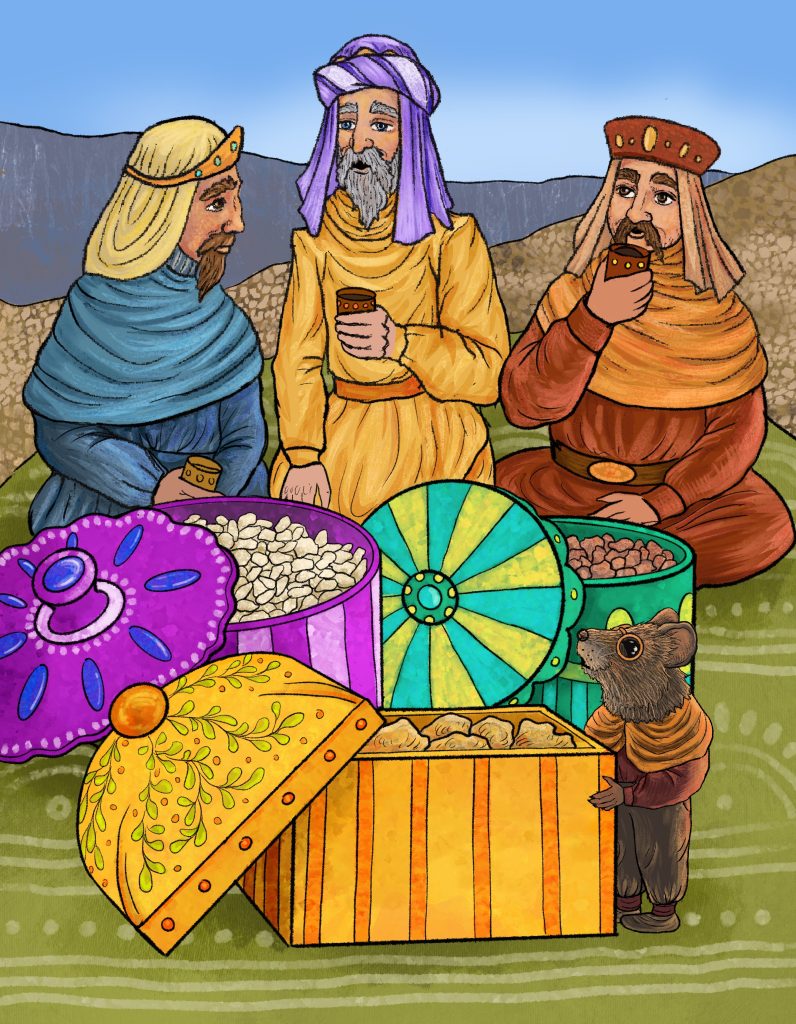
“Welcome, my dear ones,” said Mormor. “Yesterday we talked about gifts that keep on giving, and today we will talk about the gifts of gold, frankincense, and myrrh that the three wise men are bringing to Jesus. Matthew 2:11 says that the wise men ‘presented Him with gifts of gold and of frankincense and of myrrh’ (Matthew 2:11).
“When we jump into our story with Ethan, remember that they haven’t yet gotten to Bethlehem, so the wise men haven’t presented these gifts to Jesus yet. But, let’s listen in on their conversation and learn more about why the three wise men chose these gifts.”
Gifts Part 2: Gold, Frankincense, and Myrrh
Ethan had been thinking. He knew that the wise men had read the prophecies and put a lot of thought into choosing their gifts of gold, frankincense, and myrrh for the new King. But, he wanted to know more.
“Melchior, can you tell me more about why you chose gold as your gift for the new King?” he asked.
“That question shows you are a good thinker, a lover of wisdom, a philosopher at heart,” said Melchior to Ethan. “This is not an ordinary king. From the prophecies we read in the Hebrew Bible, this baby being born in Bethlehem is the Son of God, and He will be the King who rules forever. Remember these words:
“Isaiah 7:14 says: ‘Therefore the Lord himself will give you a sign: The virgin will be with child and will give birth to a son, and will call him Immanuel.’ Immanuel means ‘God with us.’ That verse tells us that the baby’s mother is human, yet there is no human father. And the name of the baby tells us that God is now with us. This tells us that while a baby is completely human, the baby is also completely God. This is a mystery, but it must be true.
“Isaiah 9:6 says: ‘For unto us a child is born, unto us a son is given, and the government will be on his shoulders. And he will be called Wonderful Counselor, Mighty God, Everlasting Father, Prince of Peace.’ This also tells us that the child is completely God. The texts refer to Him as the Son of God.
“Psalm 72, we decided, was partly about Solomon, but it is completely about this baby being born in Bethlehem. It begins in the first verse by calling Him a King, and then it talks about how this King will judge, will bring prosperity, will defend and rescue the needy, will endure forever, and will ‘rule from sea to sea’ (verse 8). It says that ‘all kings will bow down to Him and all nations will serve Him (verse 11). That means He is a King of kings.
“So what do we know? This child is completely human and is a King. This child is also completely God and therefore is all-powerful, without beginning and without end, and without sin. He will rule forever and ever, and all other kings will bow down to him. That is what the prophecies tell us. We don’t know when they will be fulfilled, but the birth of this child is an important part.”
Caspar continued, “We chose gifts that show His royalty, His divinity, and His mortality.”
Ethan asked, “Mortality means He can die. If He is God who has no end, then how can He die?”
Balthazar answered, “Because He is also fully human. Humans can die.”
Caspar added, “But since He is also fully God, death cannot hold Him. In Psalm 16:10, it says, ‘Because you [God] will not abandon me to the grave [Sheol], nor will you let your Holy One see decay.’ The Hebrew word for grave was Sheol. That is what they called the underworld where they thought all of the dead were located. Other versions of that verse say, ‘For you will not leave my soul in Sheol’ (NKJV) and ‘For thou wilt not leave my soul in hell’ (KJV). This tells us that while this King, being human, could enter Sheol, He will not stay there. Who can come back from the land of the dead? Only God could do that.”
Melchior said, “Isaiah 53 is a prophecy about the one who is perfect and without any sin at all (verse 9). It says that this person will be sacrificed as a guilt offering (verse 10) for the sins of everyone else, and then will see the ‘light of life’ (verse 11). That means his death will be atonement for the sins of everyone else. That is what a high priest does, but a high priest has to do it over and over every year. The high priest is the mediator between God and people. He offers the blood sacrifice each year, on the Day of Atonement, to atone for the sins of the people. But the one described in Isaiah 53 sacrifices his own life to atone for the sins of the people, and then death can’t hold him. He comes back to life. Only God can do that.
“Yet, it is because He is human that His blood can be shed and that His pure life can be sacrificed as atonement for the sins of everyone else. And since He is the one offering the sacrifice and making atonement, He is doing what a high priest does. So we want one of our gifts to be fit for a high priest or, better yet, for God. This gift honors the divinity, or divine nature, of the Son of God.”
“And lastly,” said Melchior, “He is not just a king, but the King who will rule forever. So, we want one of our gifts to be worthy of a King. That is why I am bringing gold. Gold is the most precious metal and it is a symbol of kingship and royalty. Our gift of gold shows that we bow before Him as the King of kings.”
“I am bringing frankincense,” said Caspar, “because it is the incense that high priests burn when they are worshiping and honoring God, and we want to show our belief that this child is the Son of God. When the smoke rises from the burning incense, it is a symbol of the people’s prayers to God.”
“I am bringing myrrh,” said Balthazar, “because myrrh is not only used as an anointing oil for a new king, but it is also used to preserve the body after it has died and prepare it for being buried. Since we know from Isaiah 53 that this king will be sacrificed and be in Sheol for a short time, we want this gift to show that we honor and care for His humanity.”
Ethan was listening with rapt attention. “These gifts sound perfect,” he said. “I appreciate your wisdom and knowledge. You have put so much thought into these gifts. I know that God will appreciate them.”
Mormor looked around. “Isaiah was an important prophet. There are many times in the New Testament when Isaiah is quoted. When Isaiah first spoke the words of Isaiah 53, the people probably didn’t know who he was talking about. Prophecies can be confusing because they are about something that hasn’t happened yet.
“In general, the Jewish people thought that Isaiah 53 was either referring to the nation of Israel as a whole, and how it suffers at the hands of other nations, or about the Messiah. They expected the Messiah to be a descendent of King David who would arrive as a powerful human king, rebuild the temple in Jerusalem, free Israel from being under the rule of any other nation, and deliver worldwide peace. They did not believe that Jesus was the Messiah, and so they are still waiting for the Messiah to come.
“At the time that Jesus was on Earth, there were two groups of people known as the Sadducees and Pharisees. They both seemed to focus more on the laws written in the Old Testament than on God’s point about loving one’s neighbor and loving God with all of one’s heart, soul, strength, and mind. These were educated people who knew the words of the Old Testament, but they did not accept that Isaiah 53 was a prophecy about Jesus. They rejected that He was the Messiah. But if we look at Acts 13:32-37, we see that Philip confirms that Isaiah 53 is about Jesus. In 1 Peter 2:21-22, Peter also confirms it.
“The importance of Isaiah 53, which the wise men were very wise indeed to figure out, is that by letting Himself be the blood sacrifice that atoned for the sins of all people, Jesus was taking on the role of the high priest. It was the job of the high priest to perform the sacrifice that atoned for the people’s sins. Remember that the purpose of atonement was to cover up the sins so that people would not have to be separated from God. Sin is what separates people from God because God, being perfect, cannot even look on evil. We saw this the other day when we looked at Habakkuk 1:13 and Isaiah 59:2. In fact, the Holy of Holies was the place in the temple where God was present, and it was covered by a large veil. Only the high priest could go behind the veil, and only once a year on the Day of Atonement.
“But when Jesus died, the curtain or veil that separated the Holy of Holies in the temple was torn in two from top to bottom (Mark15:37-38). That meant that a high priest was no longer needed by the people. There was no more need for a Day of Atonement every year. The atonement provided by Jesus’s sacrifice was permanent, to cover all sins forever and ever. And since a high priest was no longer needed to continue making atonement every year, the veil was no longer needed. There was no more separation from God. The people could now have direct access to God’s presence.
“Jesus entered a world that had this big problem. Sin was separating the people from God. Atonement had to be done over and over, and was only a temporary fix. People needed a high priest to be their mediator with God. They couldn’t go beyond the veil and be in the presence of God. But, enter Jesus as part of God’s big rescue plan! Because of the sacrifice Jesus made, that entire problem was solved. And now we can not only talk to God directly and feel His presence all the time, but His Spirit lives in us, making each of us a temple housing the presence of God!
“Can you think of ways that the gifts of gold, frankincense, and myrrh honored the True, the Good, and the Beautiful in Jesus? There is no right or wrong answer to this question.
“What about truth? Each of the gifts recognize a truth about who Jesus is. The gold recognizes Jesus as being royalty. He is the King of kings. The frankincense recognizes His divinity. He is God’s Son. And the myrrh recognizing His humanity. He is fully human. That is why His blood could be shed to atone for all sin. All of these things are true, and all of the gifts reflect these truths.
“What about goodness? Jesus loved us so much that He allowed His own life to be the blood sacrifice that atoned for our sins. Because of that, sin no longer separated us from God, and we could receive the amazing gift of having eternal life with Jesus in Heaven. That is goodness. Myrrh might be the gift that most makes us think about what Jesus did for us by letting Himself be crucified on the cross.
“What about beauty? Gold is a beautiful precious metal, and if we say it represents the royalty of Jesus, being the King of kings, we might envision beautiful garments, a beautiful throne, and a beautiful gold crown covered in precious jewels. On the other hand, if we think about burning frankincense, we might think of a beautiful aroma that is pleasing to our senses. If those symbolize the prayers of the people going up to God, He might see that as very beautiful. And if myrrh is used to preserve a body so that it does not decay, that could be seen as an attempt to retain beauty. All of the gifts could make us think about beauty.
“What if we think about Truth as what Jesus believes and thinks, Goodness as what He does, and Beauty as who He is?
“What does Jesus believe? Jesus believes that the most important laws, those that should dictate all that we do, are about love. In Luke 10:27, He summarizes the Law as, ‘Love the Lord your God with all your heart and with all your soul and with all your strength and with all your mind,’ and ‘Love your neighbor as yourself.’ He is quoting from Deuteronomy 6:5 and Leviticus 19:18. He is speaking with authority which is what a King has, and what God has. Perhaps gold is a good gift for showing that Jesus is Truth.
“What did Jesus do? Jesus sacrifices His own life because of how much love He has for us. He took on the role of the high priest to make atonement and to restore the relationship between people and God. He even went further than that by getting rid of the veil that separates people from God. Because of His actions, people can now go directly to God and be in God’s presence. These actions are things that He did, and they show He is Good. Perhaps frankincense is a good gift for showing that Jesus is Good.
“Who is Jesus? While Jesus was fully God, He was also fully human. Being human, He could die. Being God, He could come back to life. Perhaps myrrh is a good gift for showing the humanity of Jesus. He suffered and He died, not because He had done anything wrong, but because He loved us so much that He didn’t want us to have to be separated from God any longer. He didn’t want us to have to pay the price for our sins ourselves. Myrrh, used to preserve the bodies of those who died, reminds us of the humanity of Jesus.”
Application:
When we read the Bible and, as it says in Philippians 4:8, ‘think about all that we can praise God for and be glad about’ (TLB), let’s remember to think about what Jesus believes and says, what He does, and who He is. While He gave us the gifts of hope, peace, love, and joy, and the gift of eternal life, we can show Him how much we love and appreciate Him by using the gifts He has given us to the best of our ability!
Reading: Matthew 2:11
Hymn: We Three Kings of Orient Are written by John H. Hopkins, Jr. in 1857.
