
An Advent Storybook and Study: Seeking Truth, Goodness, and Beauty
Copyright 2025 by Lūminé Press, Written by Elsie Lungren, Illustrated by Nicoleta Dabija
Day 18
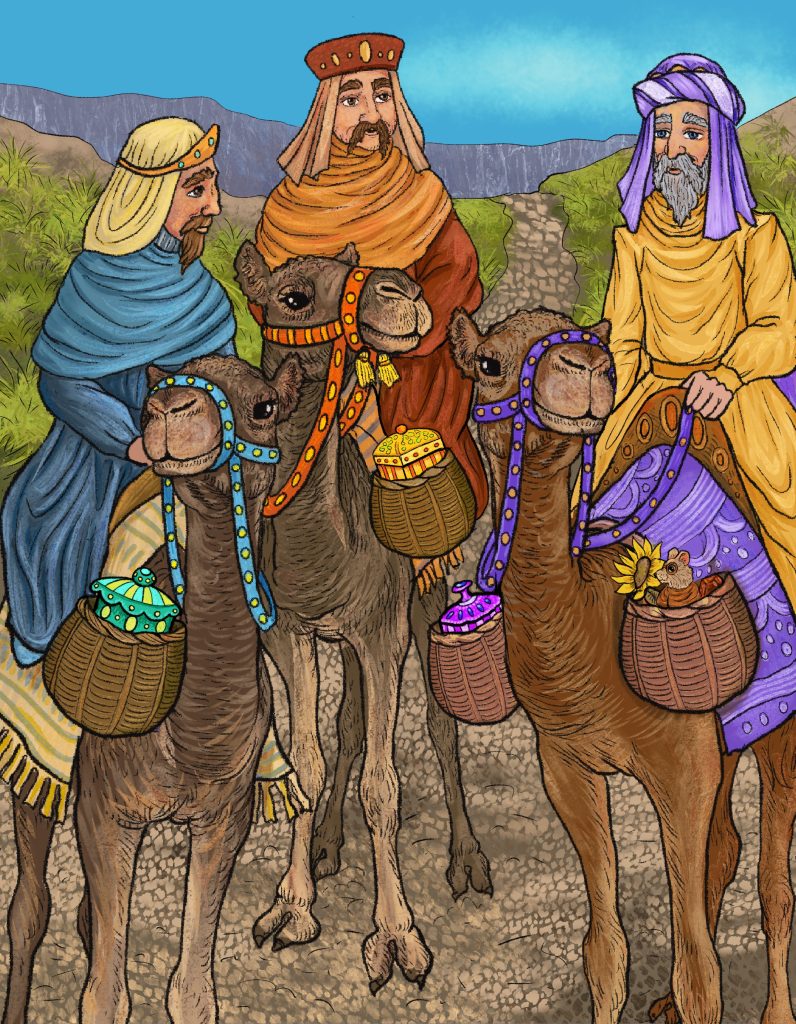
“One week to go until Christmas!” announced Mormor to her five grandchildren. “What are you looking forward to the most?”
“Opening presents!” said Lukas.
“Watching the faces of people who are opening up their gift from me!” said Annika. “I want to see if they are surprised and if they like it.”
“Yes, a big part of Christmas is opening up the gifts under the Christmas tree and in the stockings,” said Mormor. “Today we are going to talk about the gifts, and tomorrow we are going to talk about the gifts that the three wise men are bringing with them to present to Jesus.
“In our story, the three wise men will arrive in Bethlehem in time for Christmas Day. But in many cultures, including here in Sweden, it is thought that the wise men began their journey on Christmas Day, took 12 days for traveling, and arrived in Bethlehem on January 6, the thirteenth day after Christmas. This is why January 6th is known in some cultures as Three Kings Day. Here in Sweden it is called Trettondedag jul which means the 13th day after Christmas. They refer to those twelve days of the wise men’s journey as the Twelve Days of Christmas, and they see the official end of the Christmas holiday as being on the eve of Three Kings Day, called Twelfth night, or on Three Kings Day. That day is also celebrated as the Feast of the Epiphany. Epiphany means the revealing of something. On this day, they celebrate the things that happened in Jesus’s life that revealed him to be God’s Son. Some families celebrate the Twelve Days of Christmas by giving a gift on each of those days!
“This is the second time we’ve heard the number 12!” said Mormor. “Does anyone remember the first time?”
“Twelve days before Christmas is December 13,” said Theo, “and that is St. Lucia’s Day!”
“You’re right, Theo,” said Mormor. “In the Bible, there are many numbers that have special significance. For example, the Bible talks about six days of Creation followed by a 7th day. That was the day God rested. There are 7 days in a week, and God wants us to spend the 7th day, which the Bible calls the Sabbath, as a day for rest and worship. That is what we do on Sundays. Another example in the Bible is the number 3. We see that in the Trinity and when Jesus was resurrected on the third day, and when Jonah was in the great fish or the whale for three days. Can anyone think of any times that the number 12 is mentioned in the Bible?”
“Twelve disciples!” said Linnea.
“Twelve sons of Jacob and twelve tribes of Israel,” said Lukas.
“I know one,” said Astrid. “Jesus was 12 years old when he first spoke to the teachers in the temple.”
Theo added, “In Joshua chapter 4, Joshua took 12 stones from the Jordan river and set them up as a memorial to help people remember that God was powerful enough to dry up the river so that the people could cross, and how God kept His promise to bring them into the Promised Land. The stones remind people of God’s power and promises.”
“Those stones remind me,” said Annika, “of the time that Elijah challenged the people to a test. In 1 Kings 18:21-39, Elijah suggested that he and the prophets of Baal could each build an altar to sacrifice a bull, and each could call on their god or God to light it on fire. He said that whoever answered with fire would be the one true God. The prophets of Baal did this but no matter how many times they called on their god, Baal, no fire came. Then Elijah set up his altar out of 12 stones to represent the 12 tribes of Israel, and he had the people pour water on the altar three times. Then, when he called on the name of the LORD, “the fire of the LORD fell and burned up the sacrifice, the wood, the stones and the soil, and also licked up the water in the trench’ (1 Kings 18:38). And then the people believed!”
“These are great examples,” said Mormor. “Another one is in the design of the breastplate worn by the high priest who would enter the tabernacle or the temple to be in God’s presence. The 28th chapter of Exodus describes that breastplate to have 12 precious stones on it to represent the 12 tribes of Israel.
“When you think of these examples, can you think of anything that the number 12 might be a symbol of?”
Linnea said, “There were 12 sons of Jacob that became the 12 tribes of Israel, and there were 12 disciples. I think the number 12 is how God sees a complete whole. It makes me think of 12 hours on the clock. To make one complete circle on the clock, there has to be 12 hours. And to complete one full year, we go through 12 months. So maybe 12 is a symbol of being complete and whole. The big picture.”
Theo added, “Then there are the 12 stones. Joshua used them after God dried up the Jordan River so they could cross in the promised land. Elijah used them to build the altar in his big challenge to the people that proved to them who the one, true God is. And there are 12 precious stones on the breastplate of the high priest. The 12 stones represented the 12 tribes of Israel, but maybe they are also representing God’s power and faithfulness.”
“This is some great thinking,” said Mormor. “We don’t know that it took the three wise men exactly 12 days to journey to Bethlehem because the Bible doesn’t tell us exactly where they were coming from other than it was in the east. Our story has them coming from as far away as ancient China. If they did, it would have taken a lot longer than 12 days! Let’s jump back into the story and see how Ethan is doing with the wise men and their camels.”
Gifts Part 1: A Talent is a Gift
“Hey Balthazar,” called Melchior. “Do you still have your gift for the new King?”
“I sure do,” said Balthazar. “Myrrh is a precious oil used for anointing new kings, and I have it safe and sound in my saddlebag. How about you?”
“Yes,” responded Melchior. “I brought gold, the most precious of metals for the most precious of kings. I also have it in my saddlebag. And you, Caspar?”
“I brought frankincense,” said Caspar. “Burning this incense will honor the new King as the Son of God.”
Ethan was listening. “Wise kings, why are you bringing such precious gifts for a king who is only a baby?”
Melchior said, “Have you not been listening, Young Librarian? We have read the prophecies about this young King. He is the King of kings. He will rule forever. We are honored to bow before Him, to worship Him, and to present these gifts to Him.”
“Remember what we read in Psalm 72,” said Caspar. “Verse 5 says that this King will ‘endure as long as the sun, as long as the moon, through all generations.’”
“And verses 10 and 11 say that all kings ‘will bring their gifts. Yes, kings from everywhere! All will bow before Him!’ (Psalm 72:10-11 TLB),” said Balthazar.
“I remember,” said Ethan. “I wish I had a gift for this new King.”
“Why don’t you offer the King the memorials you have been collecting on this journey?” suggested Melchior. “Those will let Him know that you have been seeking truth, goodness, and beauty. And that means you have been seeking Him, the Lord Jesus Christ, as He is perfect Truth, perfect Goodness, and perfect Beauty.”
“That is a great idea,” said Ethan. “I will do that.”
Mormor stopped and looked around. “Gifts are a wonderful way to show someone how much they mean to you. In fact, gift giving is one of the love languages! At Christmas, we are excited to receive gifts, but we should also be excited to give gifts, and to remember the meaning of gift giving. It is a celebration of our love for each other. And at Christmas, when we are celebrating the birthday of Jesus, we want to remember the gifts He brought to us. The Advent candles help us with that, as we light them and remember the hope, peace, and love that Jesus gives us. And on this next Sunday, when we light the fourth candle, we will remember the joy that Jesus gives us. Those are gifts that Jesus gives to all of us.
“There are also gifts that God gives to each of us when He creates us. Linnea has a special gift for sewing. Annika has a special gift for playing the piano. Theo has a special gift for math. Lukas has a special gift for playing soccer. And Astrid has a special gift for drawing and painting. Another word for these gifts are talents.
“There is a story that Jesus tells which is known as the Parable of the Talents, and I want to talk about that today.
“Jesus would often speak in parables. His purpose was to teach life lessons (usually about the importance of loving our neighbors and being a helpful and good citizen) by way of sharing a story.
“In Matthew 25:14-27, Jesus told the Parable of the Talents. In the story, a wealthy man is about to go on a journey. Before leaving, he entrusts his property to three of his servants and gives each of them a specific number of talents. In that time and place, a talent was a unit of money.
“While the wealthy man was gone on his trip, two of the servants used their talents wisely, and they ended up with even more talents. The third servant buried his talent in the ground and didn’t use it at all. So when the wealthy man returned home from his trip, he was pleased with the two servants who used the talents he had given them, and who could show the positive results that had come from their using the gift (the talents) he had given them. But, he was unhappy with the servant who had been afraid to use it and had done nothing with it. This person hadn’t produced anything from the gift he’d been given.”
Mormor continued, “Today, the word ‘talent’ means the actual gifts and talents that each of us have in our own unique ways.
“Back when your mother was a child, I told her that we can become good at whatever we put our mind to and pursue with what I named the 3 P’s. I called those Practice and Perseverance with a Positive attitude. I told her that there are two kinds of talents. One kind, what I call a natural talent, is influenced by how God created us. It is in our DNA. The other kind comes from an interest we have and something that we want to get good at.
“If it’s a natural talent, like art or music or sports, we might find it easier to master than it is for other people. For example, no matter how hard I practice the piano, I am not sure I will ever be as good at it as Linnea is! It just seems to come so naturally and easy to her! Yet, she also practices! If we have a natural talent that we don’t ever practice, then we won’t develop it. We could have a natural talent that we’re not aware of and never use it. In that case, we won’t develop it or reach our potential with it, and that natural talent will never be used to make a difference in this world.
“Then there is the other kind. For example, I don’t have a ‘natural talent’ for playing the piano, but playing the piano brings me great joy. So, I am happy to sit down at the piano and play a song with just the single-finger melody. Will I ever be as good as Linnea if she is striving to reach her potential as a piano player? Maybe not. But, I will still be using the 3 P’s to explore an interest and see if I can develop a talent for it.
“Does this mean that we should only figure out what we have a ‘natural talent’ for and pursue that until we are the best at it that we can be? Absolutely not! God created people in His image, and that means we have free will and the ability to make decisions. If we are interested in something, we can explore that interest. We can take classes in it, practice it, set goals, persevere, and see how good we can get at it. If it feels easy, then yes, maybe we have a natural talent for it. But even if it does not seem easy, we can still get better and better at it until we develop a talent for it.
“I encouraged your mother to experience lots of different ways to be creative and to have goals. When she was only five years old, she experimented with lots of different interests, including making music, making art, writing, dancing, riding horses, solving mathematical problems, inventing new recipes, solving puzzles, building with LEGOs, and more. If it was an experience that she really enjoyed, then I encouraged her to set goals and work on reaching those goals using the 3 P’s.
“When we do that, we can end up making a positive difference in the world through doing, to the best of our ability, the things we’re good at and enjoy. Our ‘talents,’ therefore, can be things that we have a natural aptitude for, or things that don’t come easily to us but that we work hard to develop. Either way, talents are things we develop to the best of our ability through practice and perseverance with a positive attitude.
“I believe that God wants us to discover and develop talents so that they can be used in a way that others can see. This inspires others. It has a positive effect on the world, even if just on one other person or community in the world! This is what it means to be a good citizen! If we never discover or develop a talent, or if we keep it hidden, then it does not bring joy to anyone. But if we use the talent or talents that God gave us, or develop the talent that God encouraged us to have an interest in, then it brings glory to God because we thank God for it. It is as though God has given us a gift, and we are using it in a way that lets the gift grow and be shared with others. It becomes a gift that keeps on giving.
“When we hide our gifts, or when we are too afraid to explore an interest, we are living in fear that we aren’t good enough or that we will fail. Instead of focusing on God who gives us talents and creates us in His image with the abilities to practice and persevere with a positive attitude, we instead just focus on ourselves. We might find ourselves only focusing on all the things in life that we think of as ‘unfair,’ or all the reasons why we will never be good at anything. But imagine if we focus on how we could use our own gifts and talents to help others. Then, instead of feeling like a victim of unfairness and unkindness in the world, we could feel the joy that comes from helping others or spreading joy.
“This is what we can learn from the third servant. By burying his talent, he squandered it. He did not try to explore his talent, pursue it, develop it, or use it. Instead of being focused on helping others, he was focused only on himself and what the giver of the talent would think of him. By not using the talent, he showed the giver of the talent that he didn’t appreciate it or want to do anything with it.
“When people focus on unfairness in the world and things that are out of their control, they might start thinking of themselves as victims. A victim feels as though they have no power to change anything. Everything is the fault of someone else. In the Book of Philippians, Paul was put in prison even though He had not committed a crime! That is completely unfair! And, being locked in a prison cell, there was not much that Paul had control over. He was there because of the unfair and unkind actions committed by others. Yet, does anyone know what Paul did? Did he spend the Book of Philippians complaining about it?”
“No,” said Theo. “He wrote, in his letter to the church of Philippi, to be joyful even when life is hard. He encouraged them to pray, to have a positive attitude, and to think about things they could praise God for. He told them to persevere and not give up. And he told them that if they did that, they would experience God’s peace.”
“That’s right, Theo,” said Mormor. “Paul was a victim of mistreatment and unfairness. A victim is not responsible for the actions of others. A victim is not at fault for what someone else does to them. A victim is not expected to be happy when someone else treats them unfairly or unkindly. So, what does it mean when Paul says to be joyful even when life is hard?
“God created people to have lots of feelings besides just happiness. God does not define joy as being happy all the time. Joy is knowing, deep down inside of us, that God is always with us, that God loves us all the time no matter what, and that God will never leave us. That knowledge gives us an inner strength that helps us get through even the hardest days in life. It lets us feel peace in the middle of a storm. And we can feel so thankful for that, for having that relationship with Jesus that we can always count on. That is what we call joy in the Lord.
“Even though Paul was a victim, and he could not control the actions of others, he could control his own thoughts. Instead of focusing on the things he could not control, which included the actions of others, he focused on how he used his time in prison, the gifts and talents God had given him which included being good at writing and encouraging others, and on the values of integrity, of character, of kindness, and of making a difference in the lives of others. He focused on a lot of P’s which included prayer, praise, a positive attitude, peace, and perseverance!
“When we stop focusing on the things we can’t control, which could make us feel like a victim, and instead focus on the things we can control, such as our thoughts, words, and actions, we will find ourselves feeling empowered. It will be easier to remember our joy in the Lord.
“I think joy is contagious. When we know joy in the Lord, we can spread it to others. We can do that by using our gifts and talents, and then telling others how thankful we are to God for the gifts and talents He has given us and helped us to develop. This brings glory to God.
“Rick Warren, a well-known pastor, author, and speaker in the U.S., said this: ‘If you think your talents are simply for you to make a lot of money, retire, and die, you’ve missed the point of your life. God gave you talents to benefit others, not yourself. And God gave other people talents that benefit you.’ He refers to 1 Peter. 4:10a: ‘Each one should use whatever gift he has received to serve others…’
“Leo Buscaglia, a well-known speaker, author, and professor at the University of Southern California, said this: ‘Your talent is God’s gift to you. What you do with it is your gift back to God.’
“‘The gift that keeps on giving’ is a well-known American catchphrase. Could you imagine receiving a gift and refusing to open it? That is what the third servant did. But if one receives a gift, and never opens the gift or shares it with someone else, then the gift ends with that person. On the other hand, if the person opens the gift and shares the gift with others, the gift does become one that ‘keeps on giving.’
“You might not know this story about your mother, but when she was in 1st grade, she saw the third-grade children’s choir performing. She immediately knew that she wanted to be in that choir. To get in, she would have to pass a singing audition at the end of 2nd grade. If she got in, she would be part of the choir for four years, and the choir would travel around the country and maybe even around the world for competitions and performances. This choir had even traveled to Sweden on a performance tour!
“So, she set a goal of being able to pass that audition. I will tell you a secret. When I listened to her sing, she was so off-key that I didn’t think she stood a chance. But, she set a goal and she practiced and persevered with a positive attitude for all of 2nd grade. She took voice lessons twice a week, and she never complained. At the end of 2nd grade, she passed the audition with high marks! She became one of 35 kids in that special 3rd grade class, and she stayed with them for four years!”
Application: With Christmas coming, I know that it is easy to think about all the gifts. But, don’t forget to think about all the gifts and talents that God has already given you, and the ones that you can develop in yourself because you are created in God’s image and have free will, and think about how developing those gifts and talents is a way of saying thank you to God, and using them brings glory to God. It also shares them with those around you. They are gifts that keep on giving!
Hymn:
Of all the gifts Thy love bestows was written by William Cowper in 1781.
Modern song:
Every Good Gift published by the group, “One A Worship Collective,” was written by Jason Upton and William David Leach in 2011.
