
An Advent Storybook and Study: Seeking Truth, Goodness, and Beauty
Copyright 2025 by Lūminé Press, Written by Elsie Lungren, Illustrated by Nicoleta Dabija
Day 14
Mormor looked at her grandchildren and said, “Ethan has now talked to each of the camels including Zhēnli (Jen), Shànliáng (Shaun), and Měilì (May), about what is true, what is good, and what is beautiful.
“We have learned that truth uses our intellect, our ability to think about things. Goodness uses our will, our ability to choose what we do and say. Beauty resides in our heart. It is our essence. It is who we are. It comes from how we feel in our heart, and it can be seen in our attitude.
“I want to give you an example of how truth, goodness, and beauty fit together. Think about a story. When we are planning a story that we are going to write, or analyzing a story that we have read, some of the things we look at are the plot, character development, and theme. What the characters do and say creates the events of the story, which we call the plot, and those fit into the category of goodness. The heart of the characters, which we describe using character traits, fits into the category of beauty. And the theme or message of the story falls into the category of truth. For each of those categories, we can evaluate if we are seeing goodness, beauty, and truth, or not. Granted, as they are based on our opinions, they are subjective goodness, beauty, and truth rather than the transcendentals which are objective.
“We have talked about how God is perfect truth, perfect goodness, and perfect beauty. So, if we want to be seekers of these three transcendentals, all we have to do is be seekers of God!
“We have also looked at verses in the Bible that say Jesus is Truth, and Jesus is the Word, and the Word is Truth. Today we are going to look at some verses that say Jesus is the Light of the World. Yesterday, we saw how light shining in darkness is an example of imagery because we can visualize it. It is also a metaphor because we can use it to help us understand the effect that Jesus has in the world. If we think of Jesus as Light, and the sin-filled world as darkness, then just as light shining in darkness shows people which way to go, having Jesus in our lives can also help us know which way to go. When we talked about the Star over Bethlehem being a guiding light for the three wise men, we talked about how God is always there to guide us. We are guided by the words and example of Jesus, and also by the presence of the Holy Spirit in our heart. The Star over Bethlehem was a shining light in the sky. Light is a powerful guide because it gets rid of darkness so that we can see where we are going. Since Jesus and the Holy Spirit are a guide for us, comparing them to Light is a great way to help us understand.
“If we want to make a point about something, and we want to help people understand what our point is, it is helpful to compare it to something else that is not just similar, but is also very obvious! This type of comparison is called a metaphor or a simile. The only difference between them is that a simile uses the words like or as. Let’s practice. I’ll give an example, and you tell me if it’s a metaphor or a simile. Here’s the first one: Lisa swims like a fish. What do you think?”
Lukas said, “That’s a simile.”
“You’re right, Lukas,” said Mormor. “It is comparing how Lisa swims to how a fish swims. It’s obvious that a fish swims very well, so that comparison helps us know that Lisa also swims very well. How about this one? Does Lisa swim well? Yes, she’s a fish. What do you think?”
Linnea said, “That’s a metaphor because you didn’t say like or as.”
“Correct,” said Mormor. “It is still comparing Lisa to a fish, and telling us that Lisa swims well because a fish swims well. But, it doesn’t use like or as, so it’s a metaphor. How about this one? Lisa swims as easily as a fish.”
Astrid said, “I think that’s a simile because you said as two times!”
“Good listening, Astrid,” said Mormor. “Yes, that one is a simile. It is still comparing how Lisa swims to how the fish swims. Since we know how easily a fish swims, we can figure out that Lisa swims very well. If the sentence had been, Lisa swims as easily as a brick, then we would know that Lisa does not know how to swim at all! She would sink!”
Everyone laughed.
Mormor continued, “Here’s another one. When we say that Jesus is the Light of the world, is that a simile or a metaphor?”
“It’s a metaphor because you didn’t say like or as,” said Linnea.
“That’s right,” said Mormor. “What are the two things being compared?”
“Jesus and light,” said Lukas.
“Perfect,” said Mormor. “Next, we want to know what is similar about them. The metaphor is making a point about Jesus by comparing Him to light. So what do we know about light that is very obvious?”
“It helps us see where we are going,” said Astrid.
“It shines brightly in darkness,” said Theo.
“It can be used to guide us on the path,” said Annika.
“Yes, yes, and yes,” said Mormor. “And just like a light does that, so does Jesus. He helps us see which way to go. He shines brightly in the darkness of the world. He is a guide for us.
“Now let’s see why that is important,” said Mormor. “We live in a world that has a lot of sin in it. There are a lot of people who do not know Jesus, believe in Him, or follow Him. Many people do not choose their actions and words based on the example that Jesus gives them. They do not pray and ask Jesus to guide them. 2 Corinthians 4:4 says this world is ruled by the ‘god of this age’ (NIV) or ‘Satan, the god of this evil world” (TLB). Satan does not want people to listen to the words of Jesus and understand them. He does not want people to seek truth, goodness, or beauty and find it. But without those things, people do not know what to think, what to do, or how to feel. They can even question who they are. It is like being in a dark room and not knowing which way to go.
“This is where a simile or metaphor is very helpful. Being in the world today can feel like being in a dark room with no light to show the way. If we bring in a light, then we can see. If we bring in Jesus, then we can see. This is why saying Jesus is the Light of the world is a metaphor. It is obvious what a light does in a dark room. By comparing Jesus to a Light, it helps us to understand the power that His presence has in our lives.
“Today we are going to learn what the Bible says about Jesus being the Light of the world, and we’re going to see how that Light helps us as we seek the True, the Good, and the Beautiful. We will also see what happens if we are not seeking! But first, let’s check in with Ethan and see how he is doing on his journey with the wise men and the camels.”
The Light of the World
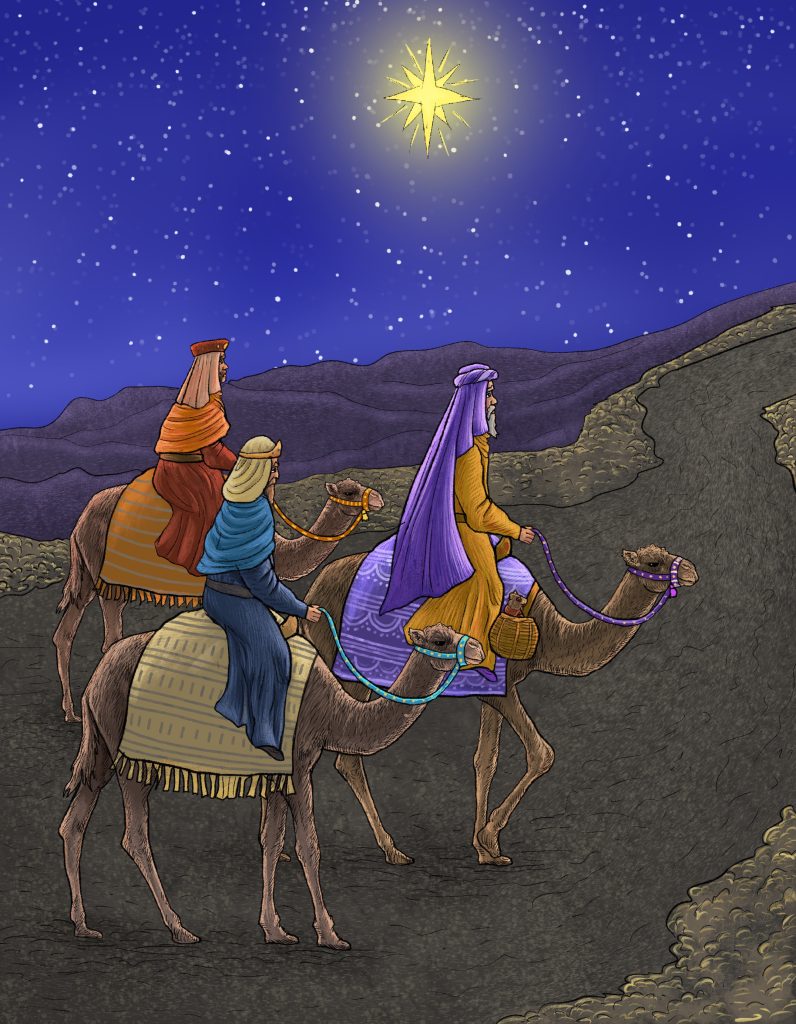
It was a clear night filled with stars overhead. There was one star, though, that shone the most brightly. It was the one over Bethlehem.
Ethan had something on his mind. He said to the three camels, “I am curious about something. Do you know where you are going when the kings are sleeping?”
Shaun and May seemed to chuckle while Jen replied, “Yes, do not worry, young Librarian. Remember the star you read about in the scroll? A bright star has appeared in the sky, and we follow it. The star is our guide. It lights our way and shows us where to go.”
Ethan noticed that the starlight also illuminated each camel so that they were easy to see even though there was darkness all around them. He remembered that the meaning of the camels’ Chinese names were Truth, Goodness, and Beauty. He thought to himself, “The star shines its light on Truth, Goodness, and Beauty so that I can see them!”
Mormor said, “Ethan discovered the power that light has in the darkness. On their journey, the source of that light was the Star over Bethlehem. It was guiding them to find baby Jesus.
“Before we look at the verses in the Bible that tells us Jesus is the Light of the world, let’s look at two verses that talk about the Word.”
“Your word is a lamp to my feet and a light for my path” (Psalm 119:105).
“…your word is truth” (John 17:17b).
“Those verses,” Mormor continued, “tell us that the Word is truth and light. Since we learned in John 1:14 that Jesus is the Word, let’s use some deductive logic:
If the Word is Truth and Light,
and Jesus is the Word,
then Jesus is Truth and Light.
“Let’s see if the Bible confirms that conclusion. A few days ago we read John 14:6, and that said that Jesus is Truth. Now let’s look at the verses that say Jesus is Light.”
“When Jesus spoke to the people, he said, ‘I am the light of the world. Whoever follows me will never walk in darkness, but will have the light of life’” (John 8:12).
“In him [referring to Jesus] was life, and that life was the light of men. 5The light shines in the darkness, but the darkness has not understood it” (John 1:4-5).
John the Baptist told people that Jesus was coming: 9The true light that gives light to every man was coming into the world” (John 1: 9).
“In John 8:12,” said Mormor, “Jesus refers to Himself as the Light of the world. In John 1:5, when it talks about how His light shines in the darkness, like the light from the Star of Bethlehem, it tells us that the world was in darkness. This is figurative darkness. When the camels are traveling at night, that is literal darkness. Figurative darkness is when the world is caught up in sin, despair, ignorance, cruelty, selfishness, greed, deceit, evil, and just bad choices. It’s like people are living in darkness because they can’t see what path to take or what choice to make. Jesus came, like a light shining in the darkness, to show us a good path.
“On this path, He lights the way for us to seek and discover Truth, Goodness, and Beauty which, as we have learned, is the nature of God Himself. Not only does He light up a path through the darkness of the world, but He walks on the path with us! As we walk in the Light, we move closer to God. We get to know God more and more. Listen to what Paul says in Ephesians 5:8-9:”
“For you were once darkness, but now you are light in the Lord. Live as children of light 9(for the fruit of the light consists in all goodness, righteousness, and truth)” (Ephesians 5:8-9).
“When we talked about beauty yesterday,” Mormor continued, “we learned that righteousness, or being right with God, is having beauty in our heart. It’s an inner beauty that radiates from us. When we look at righteousness like that, this verse is saying that when we are walking in the light with Jesus, we will experience truth, goodness, and beauty. In other words, when we have Jesus or His Spirit in our heart, we have Light in us. Let me ask you a question. Is it possible for a room to be completely dark if someone lights a candle in it?”
“That’s silly,” said Astrid. “As soon as you light a candle, the darkness goes away.”
“Exactly right,” said Mormor. “Light is more powerful than darkness. Light replaces darkness. Notice the importance of the word “light” in that verse. We do not experience the transcendentals of truth, goodness, and beauty without living in the light, without having Jesus in our heart. That makes sense because Jesus is the Light of the World, and He is also transcendental truth, goodness, and beauty. So, if Jesus or His Spirit is in our heart, then so is His truth, goodness, and beauty.
“Let’s look at how that verse is written in The Living Bible.”
“For though once your heart was full of darkness, now it is full of light from the Lord, and your behavior should show it! 9Because of this light within you, you should do only what is good and right and true” (Ephesians 5:8-9, TLB).
“When we see that list of ‘good and right and true,’ we can think of the true, the good, and the beautiful,” said Mormor. “Philippians 4:8 is another verse that, as it is written in The Living Bible, gives us that same list:”
Philippians 4:8 “Fix your thoughts on what is true and good and right. Think about things that are pure and lovely, and dwell on the fine, good things in others. Think about all you can praise God for and be glad about” (Philippians 4:8 TLB).
“In verses 4 through 8 of Philippians chapter 4, Paul is telling us what things we can choose to do. We can choose to rejoice in the Lord all the time no matter what. We can choose to take our worries to God and pray about them, seek His help, and find things to be thankful for. We can choose to think thoughts that are positive, that are focused on that which is true, good, and beautiful. These choices are examples of goodness. And then Paul tells us, ‘If you do this you will experience God’s peace, which is far more wonderful than the human mind can understand. His peace will keep your thoughts and your hearts quiet and at rest as you trust in Christ Jesus’ (Philippians 4:9 TLB).
“Do you know that it is easier to be a truth seeker, a goodness seeker, and a beauty seeker than it is to be a peace seeker? The reason I say that is because the easiest things for us to do are the things we can control ourselves. We can control the choices we make. We can choose to seek truth by reading the Bible. We can choose to seek goodness by using the example set by Jesus to help us make choices about what we do, say, and think about. We can choose to seek beauty by singing, as the angels do, of the glory of God. But how can we choose to feel peaceful in the middle of chaos? That is harder. Yet, if we make the choices that Paul recommends in Philippians 4:4-8, choices that are examples of goodness, then we will be filled with peace!
“When Paul tells us, in Galatians 5:22, that ‘the fruit of the Spirit is love, joy, peace, patience, kindness, goodness, faithfulness, 23gentleness, and self-control,’ notice the word fruit. A gardener does not make the fruit appear. The gardener can only control if he plants the seed or not, and if he gives it water and sunshine, and if he removes the weeds around it. Each of us is like that plant that is growing. We have the Holy Spirit living in our heart, and our faith can grow. But for us to bear the fruit of the Spirit, we need to make sure we are getting water and sunshine, and that there are no weeds in the way. This is a metaphor. It is comparing whether we can bear the fruit of the Spirit to whether a plant like a peach tree can bear its fruit. The peach tree needs literal water and sunlight. We need figurative water and sunlight. Something that, in our metaphor, can be compared to water and sunlight. Something that will help our faith grow in the same way that water and sunlight help a peach tree grow. What do you think are some things that could be that water and sunlight for us?”
Theo raised his hand. “I think if we are seekers of truth, of goodness, and of beauty, which means we are seeking God, and we do things like read the Bible, follow Jesus’s example, and sing songs of praise to God, then we are getting food and sunshine.”
Annika added, “Psalm 119:105 says the Word is a light unto our path, and John 8:12 says that Jesus is the ‘Light of the world,’ and so reading God’s Word gives us Light and Truth, because the Word, which is Jesus, is both Light and Truth.”
“Well said, Theo and Annika,” said Mormor. “It’s important for us to understand that giving ourselves water and sunshine is a choice. It’s a choice to be seekers of the true, the good, and the beautiful. It’s a choice to read the Bible, to follow the example that Jesus set for us, and to sing songs of praise to Him. It is a choice to pray to God when we are worried, when we seek His guidance and help, and when we want to express our gratitude. It is a choice to have a positive attitude and a grateful heart. It is a choice to memorize Bible verses. That is one way to write God’s Word in or on our heart! (See Deut. 11:18, 30:14; Jer. 31:33; Heb. 8:10, 10:16; Rom. 10:8-10.) In Deuteronomy chapter 11, God warns the people that they may be tempted to “turn away and worship other gods and bow down to them’ (Deut. 11:16), but the solution is to fix God’s words on their hearts and minds (11:18).
“But, we live in a world where people are distracted by other things in life. They find other idols or gods or things to worship. Things that are more important to them than God is. Maybe that is wealth or power or status or all the things they want to have.
“This world is not Heaven. This world has sin in it. This world is ruled by Satan, also known as Beelzebub, Lucifer, the prince of darkness, the evil one, the devil, or, in 2 Corinthians 4:4, the god of this age or the god of this evil world. The evil one does not want us to provide ourselves with water and sunlight. He does not want us to be seekers of the True, the Good, and the Beautiful. When we hear Jesus speak in parables, the evil one does not want us to understand. When we see evidence of Jesus being in the hearts of others, the evil one doesn’t want us to believe it. How does he stop us? He has a few strategies. One is to encourage us to be so busy that we are constantly distracted. Another is to whisper doubts into our ear. When you are older, I would recommend you read The Screwtape Letters by C.S. Lewis! It will open your eyes to many of the strategies used by the evil one in his attempt to keep us from getting the water and sunlight we need.
“Let’s read what it says in 2 Cor. 4:4. We will read it first in the NIV version, and then in The Living Bible.
“The god of this age has blinded the minds of unbelievers, so that they cannot see the light of the gospel of the glory of Christ, who is the image of God. 6For God, who said, ‘Let light shine out of darkness,’ made his light shine in our hearts to give us the light of the knowledge of the glory of God in the face of Christ” (2 Cor. 4:4, 6 NIV).
“Satan, who is the god of this evil world, has made him (the unbeliever) blind, unable to see the glorious light of the Gospel that is shining upon him, or to understand the amazing message we preach about the glory of Christ, who is God. 6For God, who said, ‘Let there be light in the darkness,’ has made us understand that it is the brightness of his glory that is seen in the face of Jesus Christ” (2 Cor. 4:4, 6 TLB).
“Before we talk about how the evil one tries to blind the minds of unbelievers, let’s look at the part that says, ‘let light shine out of darkness.’ Does anyone know the first time the Bible talks about creating light and making it separate from darkness?”
Lukas raised his hand. “In Genesis, when God created the world.”
“Yes,” said Mormor. “Let’s look at a few verses from the first chapter of Genesis.”
“And God said, ‘Let there be light,’ and there was light. 4God saw that the light was good, and he separated the light from the darkness… 16God made two great lights – the greater light to govern the day and the lesser light to govern the night. He also made the stars. 17God set them in the expanse of the sky to give light on the earth, 18to govern the day and the night, and to separate light from darkness. And God saw that it was good.”
“And earlier today, we looked at John 1:4-5.”
“In him [referring to Jesus] was life, and that life was the light of men. 5The light shines in the darkness, but the darkness has not understood it” (John 1:4-5).
“Do you think the word ‘light’ has the same meaning in Genesis chapter 1 and in John chapter 1?”
Annika spoke up. “Genesis 1 is talking about the sun and moon and stars. They provide literal light. Before they existed, there was only literal darkness. But in John 1, light is being used as a metaphor. It is about figurative light and figurative darkness. In the same way that the sun literally lights up the day so we can see, Jesus (who is the Son of God) lights up the world we are in so that we can see.”
Theo added, “I just thought of something. If I was standing in a completely dark room with no light at all, I would not be able to see anyone else in the room. I would feel so alone, and probably all I would think about is just myself since I couldn’t see anything else. But if there was light, and I could see the other people around me, then maybe I would think about them.”
“That is good thinking, Theo,” said Mormor. “When Jesus is in our life, and with His example of loving others, and with Him being like the Light that gets rid of the darkness, it is easier for us to think about being loving and kind to our neighbors rather than only thinking about what we want for ourselves.
“Now I have a question for you. If we go back to John 1:5, look how the verse ends: ‘The light shines in the darkness, but the darkness has not understood it.’ The light is Jesus, and He is there to shine in the darkness, but ‘the darkness has not understood it.’ And then look again at the part of 2 Corinthians 4:4 that says the unbeliever was ‘unable to see the glorious light of the Gospel that is shining upon him.’
“I want us to look at three places in the Bible that talk about how some people are unable to see the light shining in the darkness. It can be useful to understand why some people don’t see the light, why they can’t accept Jesus. Sometimes knowing how not to be is a helpful way to know how to be.
“The first one is in Isaiah 6:9-10. Jesus will later quote this entire passage in Matthew 13:13-15. It is right after he tells the Parable of the Sower, and right before he explains the meaning of the parable. As we read it in Isaiah, it will sound hard to understand. But don’t worry. We will talk about it. First, it’s helpful to know what is happening. The people of Israel have been ignoring God for a long time. They are busy making idols. In fact, before we look at Isaiah 9, let’s read Isaiah 2:8 and Psalms 115:4-8.”
“Their land is full of idols; they bow down to the work of their hands, to what their fingers have made” (Isaiah 2:8).
“Now let’s look at Psalms 115:4-8.
4But their idols are silver and gold,
made by human hands.
5 They have mouths, but cannot speak,
eyes, but cannot see.
6 They have ears, but cannot hear,
noses, but cannot smell.
7 They have hands, but cannot feel,
feet, but cannot walk,
nor can they utter a sound with their throats.
8 Those who make them will be like them,
and so will all who trust in them” (Psalms 115:4-8).
“What do we understand so far?” asked Mormor.
Linnea raised her hand. “The people were making idols. That is against the Ten Commandments. In Exodus 20:3-4, God says, ‘You may worship no other god than me. 4You shall not make yourselves any idols’ (TLB). Psalms 115 points out that idols are not alive. They have no senses. They can’t listen to you, talk to you, understand you, or be like you in any way.”
Theo added, “I think verse 8 is interesting. It says that the people who make idols and trust the idols will become like the idols. That means they will have eyes that don’t see, ears that don’t hear, hands that don’t feel, feet that don’t walk, and mouths that don’t speak.”
“Maybe,” said Annika, “that means they could walk but it will be aimlessly. They won’t go anywhere. They can hear but not understand what they are hearing. They can see but not understand what they are seeing. They can speak but nothing they say will have meaning. They won’t have any purpose or usefulness to their lives. Their lives will just be aimless, drifting, and meaningless.”
“Great thinking, my young philosophers,” said Mormor. “Now let’s read Isaiah 6:9-10. This is God telling Isaiah what He wants Isaiah to tell the people.”
9He said, “Go and tell this people:
“‘Be ever hearing, but never understanding;
be ever seeing, but never perceiving.’
10Make the heart of this people calloused;
make their ears dull
and close their eyes.
Otherwise they might see with their eyes,
hear with their ears,
understand with their hearts,
and turn and be healed.”
“Now,” said Mormor, “let’s see how Jesus quotes that passage from Isaiah when He is talking in Matthew 13:13-15. He is answering the question about why he speaks to the people in parables. A parable is a short, realistic story that teaches a moral or spiritual lesson. It has a deeper meaning that one has to really think about in order to find. He has just finished telling the Parable of the Sower.”
13 This is why I speak to them in parables:
“Though seeing, they do not see;
though hearing, they do not hear or understand.
14 In them is fulfilled the prophecy of Isaiah:
“‘You will be ever hearing but never understanding;
you will be ever seeing but never perceiving.
15 For this people’s heart has become calloused;
they hardly hear with their ears,
and they have closed their eyes.
Otherwise they might see with their eyes,
hear with their ears,
understand with their hearts
and turn, and I would heal them’ (Matthew 13:13-15).
“So, what does this mean?” asked Mormor. “Let’s look at where Jesus says this. He had just finished telling the Parable of the Sower to the people, and He is about to explain to them what it means. But right in the middle of these two things, he quotes this passage from Isaiah. Maybe it would help us to know what the Parable of the Sower is, and what the explanation is. A sower is someone like a gardener or a farmer who plants seeds and hopes they will grow into healthy plants.
“The Parable of the Sower is in Matthew 13:3-9. It goes like this:”
3 Then he told them many things in parables, saying: “A farmer went out to sow his seed. 4 As he was scattering the seed, some fell along the path, and the birds came and ate it up. 5 Some fell on rocky places, where it did not have much soil. It sprang up quickly, because the soil was shallow. 6 But when the sun came up, the plants were scorched, and they withered because they had no root. 7 Other seed fell among thorns, which grew up and choked the plants. 8 Still other seed fell on good soil, where it produced a crop—a hundred, sixty or thirty times what was sown. 9 Whoever has ears, let them hear.”
“Then,” said Mormor, “Jesus explains the meaning of the parable in verses 18-23.”
18 “Listen then to what the parable of the sower means: 19 When anyone hears the message about the kingdom and does not understand it, the evil one comes and snatches away what was sown in their heart. This is the seed sown along the path. 20 The seed falling on rocky ground refers to someone who hears the word and at once receives it with joy. 21 But since they have no root, they last only a short time. When trouble or persecution comes because of the word, they quickly fall away. 22 The seed falling among the thorns refers to someone who hears the word, but the worries of this life and the deceitfulness of wealth choke the word, making it unfruitful. 23 But the seed falling on good soil refers to someone who hears the word and understands it. This is the one who produces a crop, yielding a hundred, sixty or thirty times what was sown.”
“Do you know what this reminds me of?” asked Mormor.
Astrid raised her hand. “It reminds me of plants needing water and sunshine in order to grow.”
Lukas added, “And no weeds in the way.”
“Yes,” said Mormor. “Exactly right. We talked about that earlier. And remember when we talked about it, we said that there is a peach tree that needs literal water and sunshine, and there is our heart that needs figurative water and sunshine. If we give ourselves the water and sunshine of reading in the Bible, following the example of Jesus, and singing songs of praise to Him, our faith will grow and we will bear the fruit of the Spirit. We were using the importance of watering a plant as a metaphor.
“Remember when we have a metaphor, we are comparing two things. One of the things is obvious and easy-to-understand. We use the obvious thing to help us understand something about the other thing. The parables that Jesus told often had metaphors in them. He used a simple story to help people understand something that had a deeper meaning about life.
“This parable of the sower tells us a story about a simple thing. It is easy to understand. The sower plants seeds in four different places, and they only grow into healthy plants in one of those places. The explanation tells us that the seeds and their locations are all a metaphor. In the explanation, planting a seed is compared to telling someone about Jesus. The seed is the message about Jesus. The locations of where the seeds are planted are compared to the situations in the person’s life who is hearing about Jesus.
“The first location, which is where the birds come and eat the seeds they find lying on the path, is compared to a person who doesn’t understand what they heard, and before they could put any time into thinking about it, the evil one (like the bird) snatches it away. So, the person forgets all about it. How does the evil one snatch it away? Well, maybe he finds a way to distract the person with their busy life, or plant a doubt in their mind.
“The second location, which is a rocky area with shallow soil, is compared to someone who is excited to hear about Jesus but the excitement only lasts a short time. In shallow soil, the plant can’t grow deep roots, and without deep roots, the hot sun can cause the young plant to wither and die. In this comparison, the person’s faith doesn’t take root. When trouble comes, the person’s faith doesn’t survive. The sun is compared to troubles and challenges that show up in a person’s life.
“The third location, which is an area that has thorny weeds which grow up and choke the plant, is compared to things in a person’s life which can replace the person’s interest in Jesus. It compares weeds to things like having worries, or having a focus on being wealthy. These things take over the person’s thoughts so that they don’t think about Jesus anymore.
“The fourth location, which is an area that has good soil, is compared to the person who hears about Jesus and understands. This person’s faith will grow. It will be rooted in the ground.
“When we understand the point that Jesus is making in this parable, we realize that all those seeds got planted, but only a few of them grew into a healthy plant. In the explanation, we realize that all those people heard about Jesus, but only a few of them understood. Why? They needed to be in good soil, able to receive water and sunshine, and not have any weeds in the way. The person who is hearing about Jesus needs to make some choices. They need to get rid of the weeds. They need to get water and sunshine. They need to be able to grow deep roots, to be rooted. Then, when hardships come, their faith will stay strong.
“In 2 Corinthians 4:8-9, as written in The Living Bible, Paul says, ‘We are pressed on every side by troubles, but not crushed and broken. We are perplexed because we don’t know why things happen as they do, but we don’t give up and quit. 9We are hunted down, but God never abandons us. We get knocked down, but we get up again and keep going.’ Does this sound like someone whose faith is growing in good soil, rooted, getting plenty of water and sunshine, and bearing fruit, or someone whose faith flew away in the wind when life got hard or they were too busy to think about it?”
Linnea said, “The first one.”
“You are right,” said Mormor. “It’s the person who wants to understand what they hear about Jesus, and so they make choices that help them. They choose every day to remember that Jesus is their King of kings, and that He is in their heart. They choose to be seekers of the True, the Good, and the Beautiful. And they do that by choosing to read the Bible, follow the example set by Jesus, and worship God just as the angels do.
“But if we think about what was going on when God spoke to Isaiah, we realize that no matter how many chances God gave the people to apologize for their choices to make and worship idols, to get rid of the idols, and to turn back to God, they were choosing not to do that.
“Idols are not just made out of wood, stone, or metal like silver or gold. Idols are anything we create in our life that we value more than God. They are like having other gods in our life that we want in our life more than we want God. Making them more important than God, or trying to have them in our life in addition to God, is like worshiping gods other than God. In the Ten Commandments, God is very clear that there should be no other gods in our life.
“In the world today, there are many things that are like idols or gods in a person’s life because they are more important to the person than God is. In fact, many people think that God is not needed in their life at all because they are able to be the god of their own life. They think they can choose for themselves what is true, what is good, and what is beautiful. Subjectivity is more important than objectivity. There are no transcendentals. Having virtue is less about how one treats others, and more about focusing on oneself.
“In the world today, people are bombarded on all sides by misinformation. The news media, social media and its algorithms, Artificial Intelligence and deepfake videos, school curriculum and adjusted history books. Most people, and especially young people, think they are smart enough to avoid being fooled by misinformation. Yet, either they haven’t learned how, or they don’t take the time, to think deeply about and determine if the information is logical or not, if it is one’s opinion or not, or if it could possibly be misinformation. If it sounds good, they tend to believe it. No need to ask questions or think critically about it. They think they are open-minded, tolerant, and nonjudgemental. Yet, they are misled and deceived by misinformation, judgmental of anyone who has a different viewpoint, and lacking courage to discern right from wrong and take a stand on it. Convinced that they do not need God because they are their own god, their hearts are hardened.
“These are people who have ears but are not hearing. Or, they are hearing but are not understanding. They have eyes but they are not perceiving. In fact, if they are going to believe anything they are told and anything they read, then they are not much different than a lifeless computer that can only do what it’s told to do, and can only churn out information that it’s been programmed to have.
“Remember Psalm 115:8 which says, ‘Those who make them (idols) will be like them, and so will all who trust in them.’ Isaiah’s job is to tell the people that since they have been so unwilling to admit their sin, to apologize, and to change, God is going to make them just as spiritually lifeless as the idols that they worship. He is basically saying that they have had their chance, have made their choice, and now will have to face the consequences of that choice.
“Let’s remember why we started looking at these passages in the Bible about people who could have ears but cannot hear, have eyes but cannot see. We wanted to understand why some people do not see the light shining in the darkness so that we would not be like that! We were trying to understand why John 1:5 says that the darkness has not understood that the light that shines in it, and why 2 Corinthians 4:4 says that the unbeliever is unable to see the light shining in the darkness. What have we learned?”
Theo spoke up. “We learned that when someone values something in their life more than God, then they are not actually interested in trying to understand who Jesus is, why He came to Earth, and what He offers us.”
Annika added, “We learned that if people choose not to be seekers of God, being the True, the Good, and the Beautiful, and think that their own subjective opinions about truth, goodness, and beauty are all that matters, then their ears are closed. Like their lifeless idols, they will have ears that neither hear nor understand. They will have feet that can walk but without knowing where they are going or why.”
Linnea said, “So if we don’t want to be like that, then we should be seekers of the True, the Good, and the Beautiful. That means we should be seekers of God. We should read our Bible, memorize verses so they are written on our heart, think of the example set by Jesus when we choose what we do and say, and sing songs of praise and thanksgiving to God. These are things that will give us the water and sunshine we need.”
Lukas said, “We learned that we should have the courage to know what is right and wrong, and to stand up for that.”
Astrid added, “We learned that there is only one true God, and it is not us!”
Mormor said, “In 2 Corinthians 3:16-18, Paul explains that people can’t see if there is a veil in front of their eyes. But, if that veil is taken away, then they can see. He explains that if someone wants the veil removed, all they have to do is turn to God. Let’s see how those verses are written in the NIV version and in The Living Bible.”
“But whenever anyone turns to the Lord, the veil is taken away. 17Now the Lord is the Spirit, and where the Spirit of the Lord is, there is freedom. 18And we, who with unveiled faces all reflect the Lord’s glory, are being transformed into his likeness with ever-increasing glory, which comes from the Lord, who is the Spirit” (2 Cor. 3: 16-18 NIV).
“But whenever anyone turns to the Lord from his sins, then the veil is taken away. 17The Lord is the Spirit who gives them life, and where he is there is freedom [from trying to be saved by keeping the laws of God]. 18But we Christians have no veil over our faces; we can be mirrors that brightly reflect the glory of the Lord. And as the Spirit of the Lord works within us, we become more and more like him” (2 Cor. 3: 16-18 TLB).
“Those are some fancy words,” said Mormor. “What do you think they mean?”
Linnea said, “I think turning to God is when we tell Jesus we are sorry for our sins and ask for His forgiveness. We tell Him that we believe He is God’s Son and that He died on the cross so we could be forgiven for our sins. We believe He rose from the dead because death has no power over Him, and because He wants to offer us the gift of salvation and eternal life with Him. We ask Him to come into our heart to be our Lord and Savior. This is what it is to turn to God and to become a follower of Christ, a Christian. When we do this, there is no veil between us.”
“Yes,” said Annika. “And then Jesus sends the Holy Spirit to be in our heart always. The freedom He gives us is the free gift of salvation. We are free to live according to our own choices, without fear of God taking away the gift of His presence in our lives, of eternal life with Him, if we make a mistake. We don’t have to try to earn salvation by being perfect. God knows we could never earn it because no one is perfect except for Him. It was all part of His plan for Jesus, His Son, to pay the price for our sins so that we don’t have to. That lets Him offer us the gift of salvation, of eternal life, without our having to do anything other than accept the gift.”
“And,” said Theo, “when we choose to do things that help us know the truth, do the good, and sense the beauty of God, the more we are letting the Holy Spirit work in our heart, and the more God’s glory will radiate from us. When we try to follow the example set by Jesus, we become more like Him.”
“You know what?” said Annika. “I bet it’s a lot easier to see the truth, goodness, and beauty of God if we ask the Holy Spirit to help us. If someone is seeing but never perceiving, or hearing but never understanding, maybe they do not have the Holy Spirit in their heart, or maybe they haven’t asked the Holy Spirit to help them.”
“You are all such great thinkers,” said Mormor. “Before we close for today, I want to remind us of the thought that Ethan had. As he was looking at the light coming from the Star over Bethlehem, he thought about how it was illuminating the three camels, and the meaning of their Chinese names was Truth, Goodness, and Beauty. This thought reminds me of 2 Corinthians 4:6. We have talked about that verse already today, but I’m going to read it one more time.”
“For God, who said, ‘Let light shine out of darkness,’ made his light shine in our hearts to give us the light of the knowledge of the glory of God in the face of Christ.”
“When you think about that verse and the part of the story we read today, what do you picture in your mind or think about?” asked Mormor.
Annika answered, “The star is a light that is guiding them to see the face of Jesus Christ.”
Astrid said, “The starlight is light shining out of darkness.”
Theo added, “Since we have been talking about God being perfect truth, goodness, and beauty, this verse makes me think about what the light shining out of darkness is revealing to us. The verse mentions knowledge, glory, and the face of Christ. Knowledge makes me think of truth. Glory makes me think of beauty. And maybe the ‘face of Christ’ is goodness since He is perfect. There is no evil in Him. The ‘face of Christ’ also makes me think of beauty as it is just who He is.”
Mormor said, “I always think it’s fun to find a verse that reminds me of the Truth, the Goodness, and the Beauty of God all in one verse. For example, look at the first part of Hebrews 1:3 in the NIV and The Living Bible.”
Hebrews 1:3a (NIV) “The Son is the radiance of God’s glory and the exact representation of his being, sustaining all things by his powerful word.”
“God’s Son shines out with God’s glory, and all that God’s Son is and does marks him as God. He regulates the universe by the mighty power of his command.” (TLB).
“Can you find a part that tells us about God’s truth, a part that tells about God’s goodness, and a part that tells us about His beauty?”
Lukas said, “The part about his Word and his command could be His being Truth, because He is the Word and the Word is Truth.”
Astrid said, “I think the part about God’s glory, and it shining and being radiant, is about His beauty.”
Annika said, “In The Living Bible, it says ‘all God’s Son is and does marks him as God.’ The word ‘is’ talks about who He is, about His identity as God’s Son, and I think that is beauty. The word ‘does’ talks about what He does, such as regulating the universe, and that is goodness.”
“Well said,” exclaimed Mormor. “It was fun today to take everything we’ve learned about what is True, what is Good, and what is Beautiful; and see how Jesus, being the Light who shines in the darkness of the world, can help us, when we are seeking; to find, see, and understand that which is True, Good, and Beautiful. It is really just discovering more and more about Him, and becoming more like Him as we strive to follow His example, to hear His words, and to ‘gaze on the beauty of the Lord.’”
Application:
We live in a world that has a lot of darkness in it, figuratively speaking. We might be searching for things like hope, peace, and joy, but we can’t find them. It’s hard to find them because it’s hard to control how we feel. What we can control are things we do, what we think about, and, with practice, our attitude about things. We control the choices we make, and we can make choices about what we do, think, and say.
If, for example, we choose to seek God, we will find ourselves experiencing hope, peace, and joy. Peace and joy might be the cause or the effect of our actions but not the actions themselves. We don’t do peace; rather, we feel peace.
When we seek something, we are doing an action. And being able to do something feels good. It gives us a sense of control because we can make choices about what we do, what we think, and what kind of attitude we want to have. So instead of seeking peace and joy, which are effects of actions rather than actions, let’s be seekers of God. And we can do that by being seekers of Truth, Goodness, and Beauty because those are attributes of God. This kind of seeking helps us know how to think, what to do, and who we are.
How do we seek beauty? Here’s a tip. When you see beauty in the sunrise or in an act of kindness that is showing you the beauty in a person’s soul, let it be a reminder to you of the beauty God put into the essence of all creation.
Our senses let us hear, see, smell, taste, and feel the things which are outside of our body. It is through our senses that we take in information about the world around us, about the environment we are in. And then that information gets sent to our brain for us to think about.
As we hear birds chirping, see stars twinkling, smell a rose in bloom, feel the grass under our bare feet, or taste the sweet sap from a Maple tree after it’s been turned into syrup, our brain processes those signals and thinks, “This is good.”
After God created the world, He said, “This is good.” There is goodness in our world, including in human nature. Our senses recognize it as being beautiful, and our brain processes it as being good and true. That which we directly experience can be depended on to be true. In this way, beauty is the window through which we see goodness and truth.
When we are intentionally seeking beauty, and finding both goodness and truth, as happens when we are seeking God in all of His creation including in the acts and words of people who have a heart that is right with God, and when we are reading God’s Word, we will discover that we are feeling more hope, peace, love, and joy in our lives. Peace, love, and joy are fruit of the Spirit, as is goodness.
If we have invited Jesus into our heart, and if we are continually seeking to know Him more and more, the Holy Spirit’s presence in our lives will bear fruit. Our senses will be more attuned to the beauty in the world, more able to see the goodness, more able to act and speak in ways that are good because we think of the example that Jesus set for us, and more able to understand the truth that we find in God’s Word. And part of that truth is that God loves us all the time no matter what, and He is always with us even when we are not paying attention.
You might have heard people say, “Just decide to feel at peace and you will. Just decide to feel joyful and you will.” And you might wonder, “How am I supposed to do that?” It can be harder to control how we feel than it is to choose our actions and words. We can choose to read the Bible. That is being a truth seeker. We can choose to intentionally look for beauty around us, whether in nature or in the hearts of those whose words and actions show kindness and love.
Of course, actions and words that show love can be a tricky one. Your parents, for example, have the important job of teaching you how to decide which words and actions are good and which are not. So, if you say or do something that is not good, your parents might give you a consequence for that, and you might think that is being mean rather than loving. But, think about what your parents want for you and why they want it.
They want you to learn and understand what is moral, ethical, and virtuous. They want you to know how to interact with other people in a way that is polite and respectful. And they want this for you because they love you.
How do they teach this? In school, when you make a mistake doing math, does the teacher tell you, “That’s okay. You can do math however you want.”? No, the teacher explains what you did wrong and shows you a different way. Think about what the teacher might do if she tells a student to sit down, and instead the student climbs on top of the desk and starts yelling. Maybe the teacher will tell that student to stay inside during recess and write down what a better choice would have been. Did the teacher choose that consequence because she doesn’t like the student? No, she chose it because she wants to teach the student that choices matter.
It is the same with your parents. When they choose a consequence for behavior that isn’t good, it is because they love you and want you to learn how to be a seeker of goodness in your choices about what you do and say.
So, the next time your parent tells you to write a letter of apology to your brother or sister or friend for something you said or did that wasn’t kind, maybe you can be thankful that your parents love you enough to care about teaching you to be a seeker of goodness, to discern the difference between that which is good and that which is not.
It is possible to be thankful, even in hard times, if we seek and find beauty. That might be seeing beauty in the heart of someone who loves us, and who is choosing their actions and words because of their love for us. That might be seeing God’s beauty in creation. It might be listening to music that is singing of the glory of God. It might be reading God’s Word and seeing how much God loves us.
When we see the lights on the crown of St. Lucia, or on the Christmas tree, or on the Advent wreath, we are drawn to them. We gaze on their beauty, just as we gaze on the beauty of God. These lights remind us that Jesus is the Light of the world.
Hymn options:
Do You Hear What I Hear was written by Noël Regney in 1962, and set to music by Gloria Shayne Baker.
The Light of the World is Jesus was written by Philip P. Bliss in 1875.
Thy Word is a Lamp Unto My Feet (or “Thy Word”) written by Amy Grant and Michael W. Smith in 1984
This Little Light of Mine. It is not known for sure who wrote this song, but it is thought to be Harry Dixon Loes in the 1920’s.
