
An Advent Storybook and Study: Seeking Truth, Goodness, and Beauty
Copyright 2025 by Lūminé Press, Written by Elsie Lungren, Illustrated by Nicoleta Dabija
Day 13
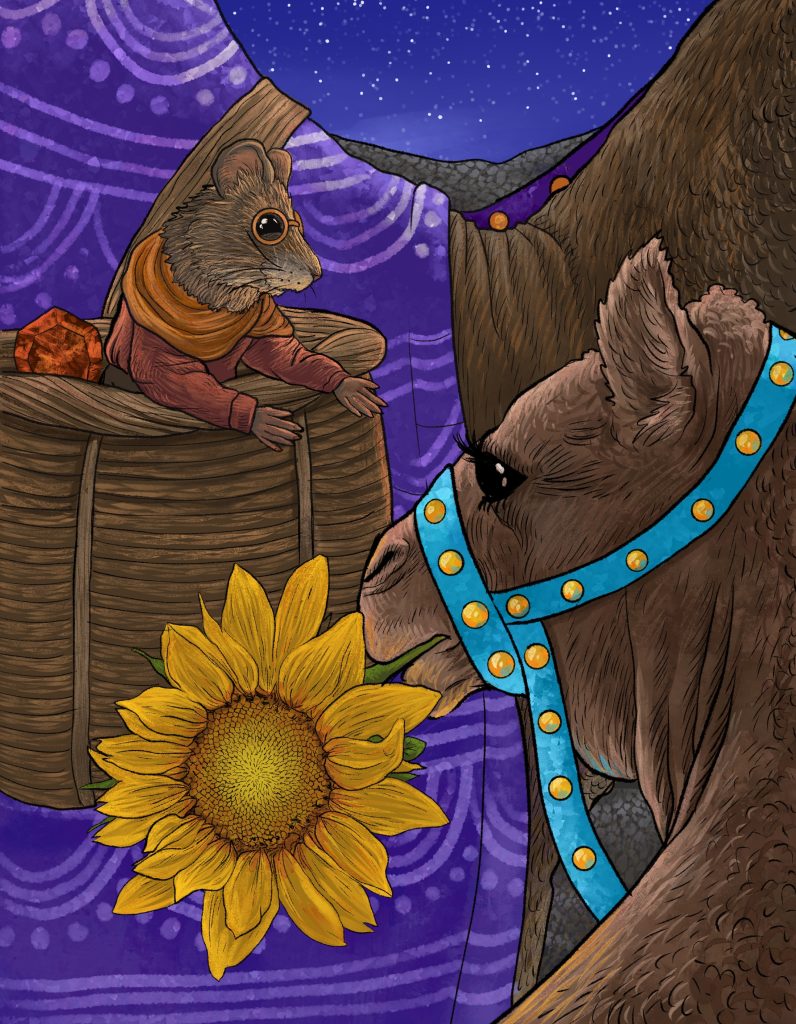
“What a beautiful day,” said Mormor. “Today we are talking about beauty. Any suggestions on how we can define beauty?”
Annika raised her hand. “I know some idioms about beauty. One says, ‘Beauty is in the eye of the beholder.’ Another one says, ‘Beauty is only skin deep.’”
“Those are good examples, and they help us understand how people think of beauty,” said Mormor. “The one about the beholder means that beauty is completely subjective. Each person gets to decide for himself or herself what is beautiful. It depends completely on their own perspective.
“The other one, about being skin deep, means that how a person looks on the outside does not tell us how they are on the inside. Someone could look beautiful on the outside but be a very mean person on the inside. Would you agree that it’s more important for a person to be cheerful, loving, and kind than to look beautiful on the outside?”
“Yes!” everyone agreed.
“That is the point of the skin deep idiom. It says that what really matters is how someone is on the inside. It encourages us to look below the surface and find the true beauty that lies within, that is the character of the person.
“Today we are going to talk about how a scientist, a philosopher, and a Christian define beauty in a way that is objective rather than subjective.
“Let’s start with the scientist. Scientists like to be objective. They like to say things that everyone has to agree with no matter what their own personal point-of-view or opinion is. As an example, let’s pretend that one thousand scientists from around the world go to a circus together. If an elephant stands on a ball, then everyone who is there will agree that an elephant is standing on a ball. They all see it. They all agree. But if you ask them if the elephant is beautiful, they might not all agree. Being objective about beauty is harder. This is why people like the idiom, ‘Beauty is in the eye of the beholder.’
“However, there is a field of science known as psychology that studies the mind and behavior of a person. The scientists are curious about why people think, feel, and act as they do. One thing they have discovered is that the human brain seems to like things that have order, symmetry, and proportion. Symmetry is when you can fold something in half, and both sides are identical. It’s like one side is looking at the other side in a mirror. Think of the butterfly’s wings. Proportion is a little harder to understand. Theo, would you like to explain it?”
“Sure,” said Theo. “I knew Mormor wanted me to teach you about this today, so I have given each of you six colored squares, and I wrote on each one how long the side of the square is. The squares you have include these:
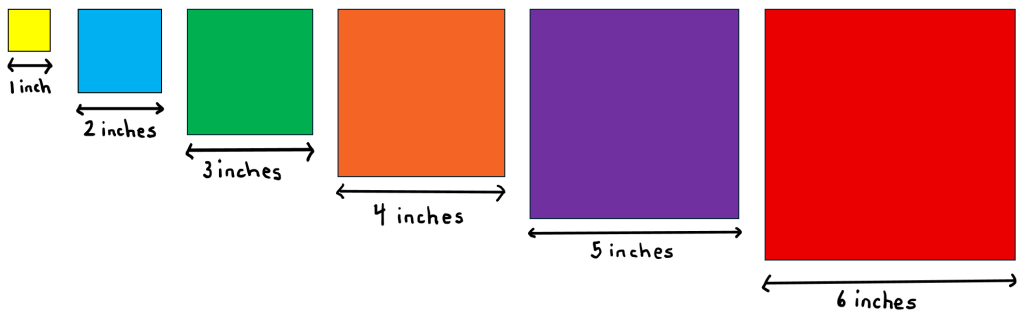
– A yellow square that is 1 inch long on each side.
– A blue square that is 2 inches long.
– A green square that is 3 inches long.
– An orange square that is 4 inches long.
– A purple square that is 5 inches long.
– A red square that is 6 inches long.
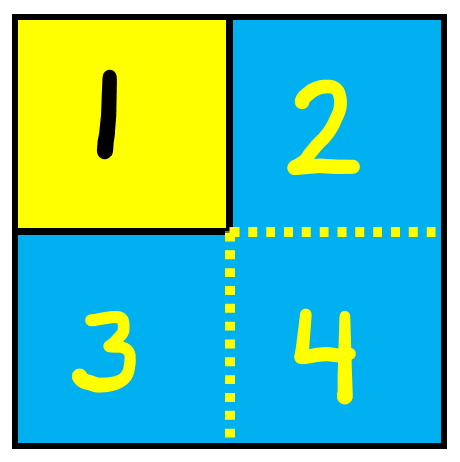 “Put the yellow square on top of the blue square so that it fits exactly into one corner of the blue square. It should look like you could fit four of the yellow squares on the blue square because there is room in each corner of the blue square for one of those yellow squares. If you have glue, you can glue the yellow square onto one of the corners of the blue square. Make sure their edges are nice and neat.
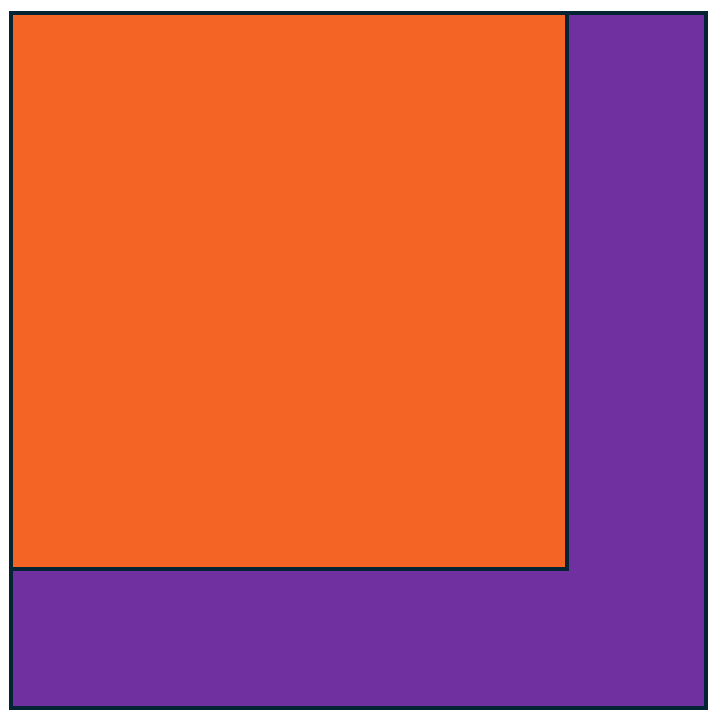 “Now do the same thing with the orange and purple square. Fit an orange square into one of the corners of the purple square. Finally, do the same thing for the green square and the red square. Now you have three piles. Two of them are in proportion to each other. Any guesses?”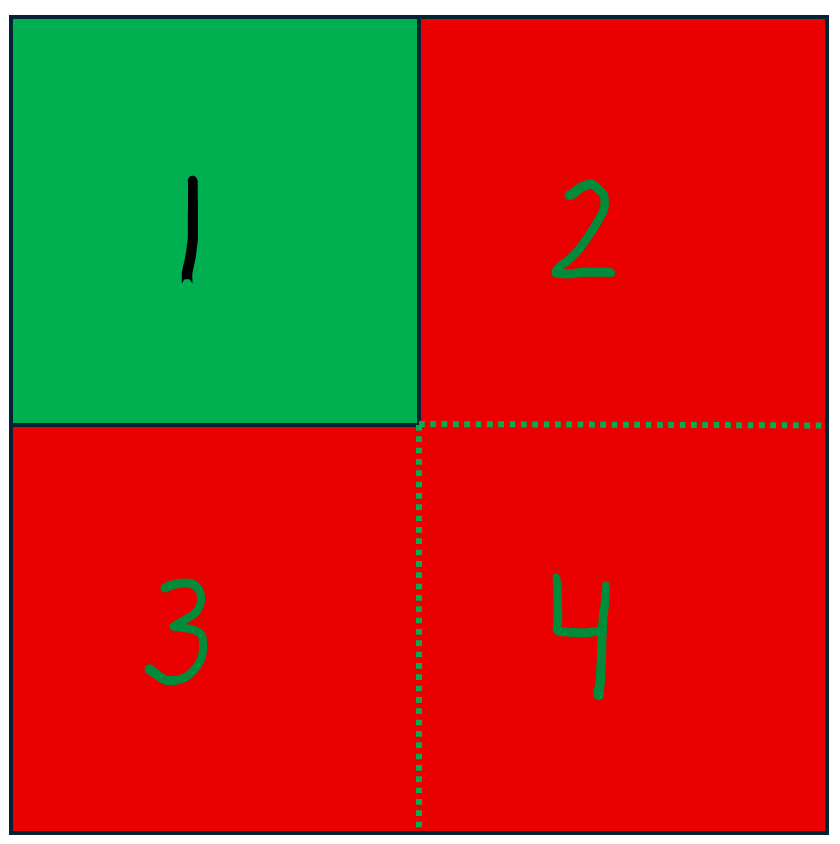
“I think I know!” said Lucas. “I think I could fit 4 green squares on the red square just like I could fit 4 yellow squares on the blue square. That is the same! So, I think it’s those two. Not the orange-purple one.”
“You’re right, Lucas!” said Theo. “Figuring our proportion uses math. We start out with four measurements. Our four measurements are knowing the length of the yellow, blue, red, and green squares. We could also do this by figuring out the area of each square. Next, we split those four measurements into two groups. We put the yellow and blue squares into one group, and we put the red and green squares in the other group. After that, we look at just one group. Let’s look at the yellow and blue group.
“The blue paper is 2 inches long on each side. The yellow paper is 1 inch long on each side. We can see that the blue paper is larger than the yellow paper. Using math, we can figure out exactly how much bigger the blue paper is than the yellow paper. It is a simple division problem. We take the length of one side of the blue paper and divide it by the length of one side of the yellow paper. 2 ÷ 1 = 2. If you know that the area of the blue paper is 4, and the area of the yellow paper is 1, then you can divide those two numbers: 4 ÷ 1 = 4. The answer to this division problem is called a ratio.
“The ratio tells us how two measurements compare to each other. In this case, it tells us how the size of one of the squares compares to the size of the other square. If we divide the length of the sides, then our ratio is 2. That means the length of the blue square is twice as long as the length of the yellow square. If we divide the area of each square and get a ratio of 4, that means the blue square is four times bigger than the yellow square. That is why we could fit four of the yellow squares onto one of the blue squares.
“Now we look at the other group and do the same thing. Once we get the ratio for the red and green squares, we will compare it to the ratio we got for the blue and yellow squares. But, it is important that we set up the division problem the same way for both sets. For example, if we divide the blue measurement by the yellow measurement, which is the bigger square by the smaller square, then we need to do the same thing with the red and green squares. Bigger by smaller would be red by green. So we would divide the length of the red square by the length of the green square. 6 ÷ 3 = 2. If you know the area of each square, we can divide those. We just need to remember to do bigger by smaller. 36 ÷ 9 = 4. Notice that the answers we got are the same as what we got for the blue and yellow group. The ratio of blue to yellow is the same as the ratio of red to green. That means they are proportional. We say things are proportional if each thing has two measurements which have the same ratio.
“Another way to show a division problem is creating a numerator and a denominator like in a fraction. 6 ÷ 3 = 2 can be written like this: 6/3 = 2. If we write it that way, then we can show how the two ratios are the same:”
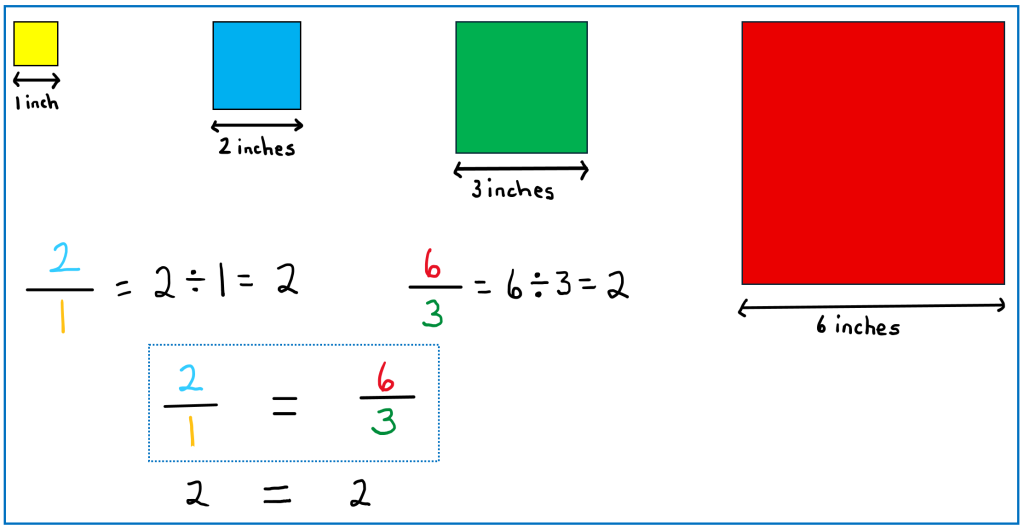
“You can see how there are 4 measurements: 2, 1, 6, and 3. They are divided into two groups: 2 and 1, 6 and 3. Then, we divide the numbers in each group to get their ratio. Finally, we see if the two ratios are the same. If they are, then we say they are proportional.
“It would have also worked if we divided the smaller square by the larger square, as long as we also did it the same way for both the blue/yellow set and the red/green set. To see if things are in proportion, it does not matter what answer we get for the ratio. It just matters that each ratio follows the same pattern, and that both ratios are the same.”
“Thanks so much, Theo,” said Mormor. “You are a great teacher. Our next teacher is going to be Annika. She is going to explain how scientists have discovered a very interesting proportion which occurs many times in all of creation. It is called the Golden Ratio, and it has to do with something called the Fibonacci Sequence. Ready, Annika?”
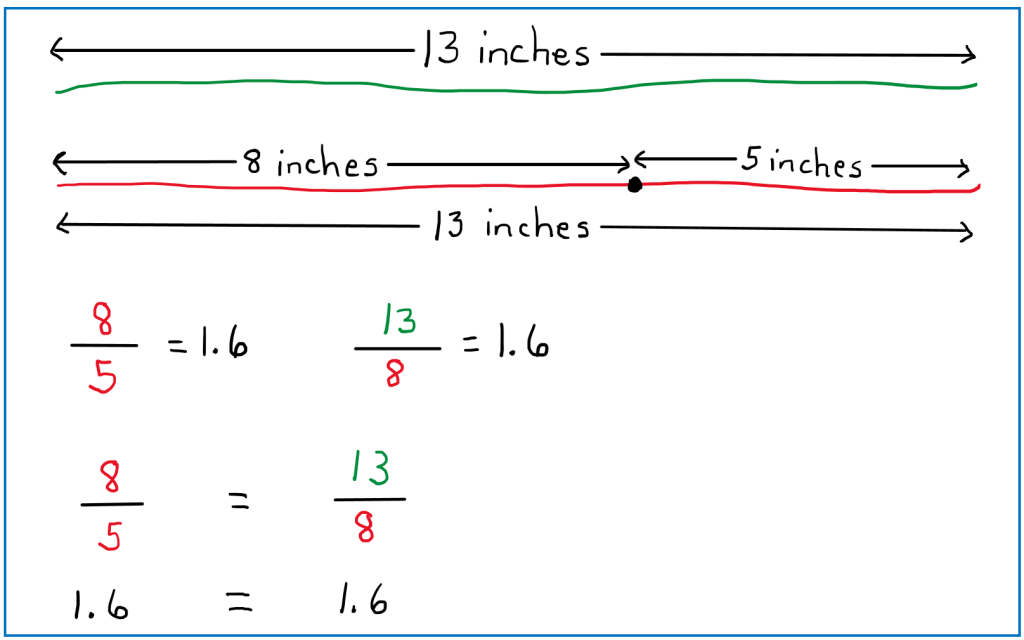
“Ready!” said Annika. “So, the Golden Ratio is when you divide two measurements and get a number close to 1.62. That is just a little more than one and a half. Mathematicians and scientists have a special name for this number. They use the Greek letter phi (Φ) to name it. For example, 13 ÷ 8 = 1.6 which is close.
“To see the Golden Ratio, I have given each of you two pieces of yarn. One is green and the other is red. Both are 13 inches long. On the red yarn, I marked a black dot. Cut the yarn right on that dot. Now your red yarn has one piece that is 8 inches long, and the other piece is 5 inches long. If you put them next to each other, they are 13 inches long just like the green yarn. Next, we will make two ratios. The first one will be the longer piece of red yarn divided by the shorter piece of red yarn. 8 ÷ 5 = 1.6. That is close to the Golden Ratio. For our other ratio, we are going to divide the length of the green yarn by the longer piece of the red yarn. 13 ÷ 8 = 1.6. Let’s show these two ratios next to each other:”
“The Golden Ratio can be used in something called the Golden Rectangle. To make our golden rectangle, we will use our green piece of yarn, both of our red pieces of yarn, and then two more pieces of red yarn that are the same length as the longer red piece. Mormor just handed them to you. Okay, let’s check. What do you have?”
Lukas raised his hand. “I have a 13-inch piece of green yarn, and I have 4 pieces of red yarn. Three of the red pieces are 8 inches long, and one of them is 5 inches long.”

“Perfect,” said Annika. “We’re ready. A rectangle has four sides. For our top side, put one long piece of red yarn next to one short piece of red yarn. So, there is an 8-inch piece of red yarn next to a 5-inch piece of red yarn. That means that side is 13 inches long. The opposite side also has to be 13 inches long, so use the green yarn for the bottom side of the rectangle. For the left and right side, use your other pieces of red yarn. So the left side is 8 inches wide, and the right side is also 8 inches wide. Because we used the same measurements that make the Golden Ratio, this is called the Golden Rectangle.
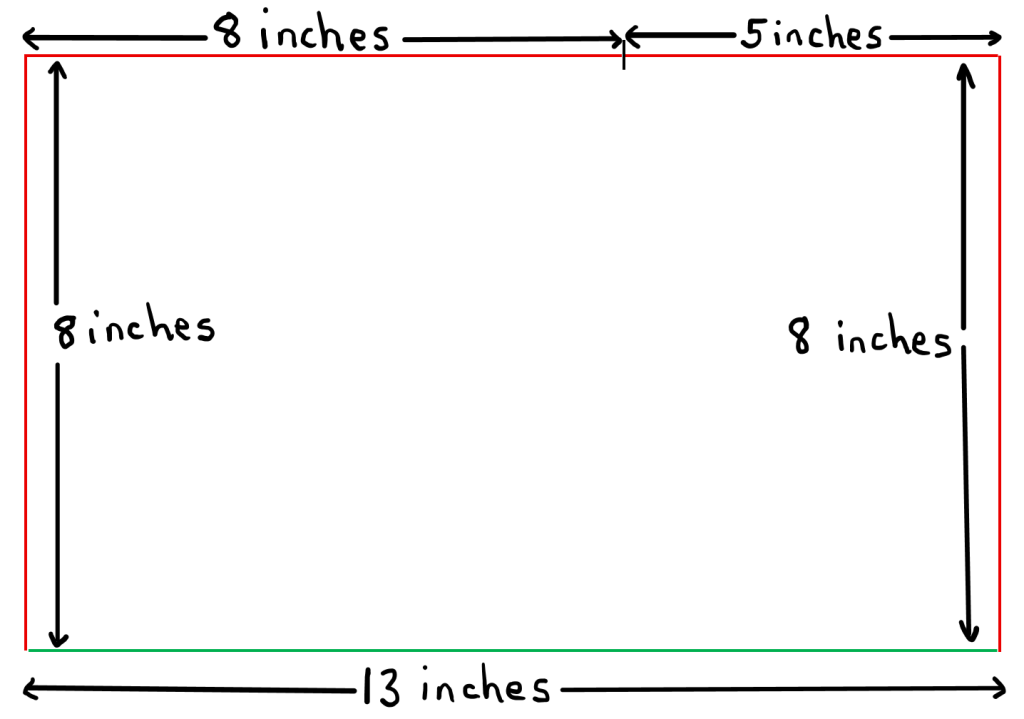
“Now Mormor is giving you one more piece of red yarn that is 8 inches long. Find the point on the top side between your long 8-inch piece of red yarn and your shorter 5-inch piece of red yarn, and lay your new piece of red yarn from that point on the top to the same point on the bottom. You’ll have to guess where that point is on the bottom, unless you use a ruler, but try to make it look like you’ve made a square inside the rectangle. If it works, then inside your big rectangle, you will see a square on one side and a smaller rectangle on the other side.
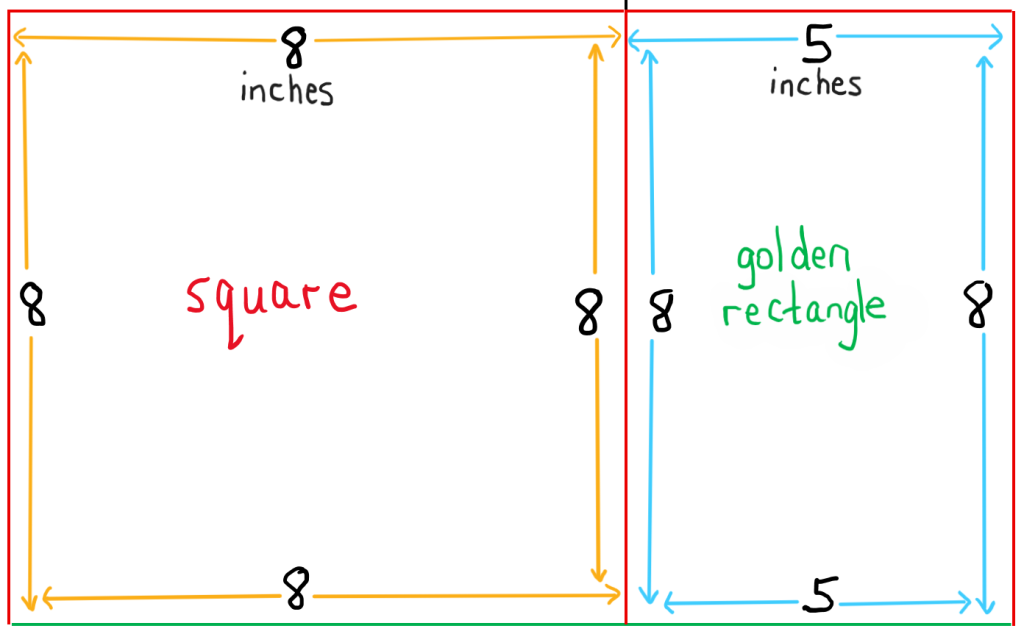
“If we turn the whole thing sideways and look at the smaller rectangle, we can repeat the entire process in that smaller rectangle.
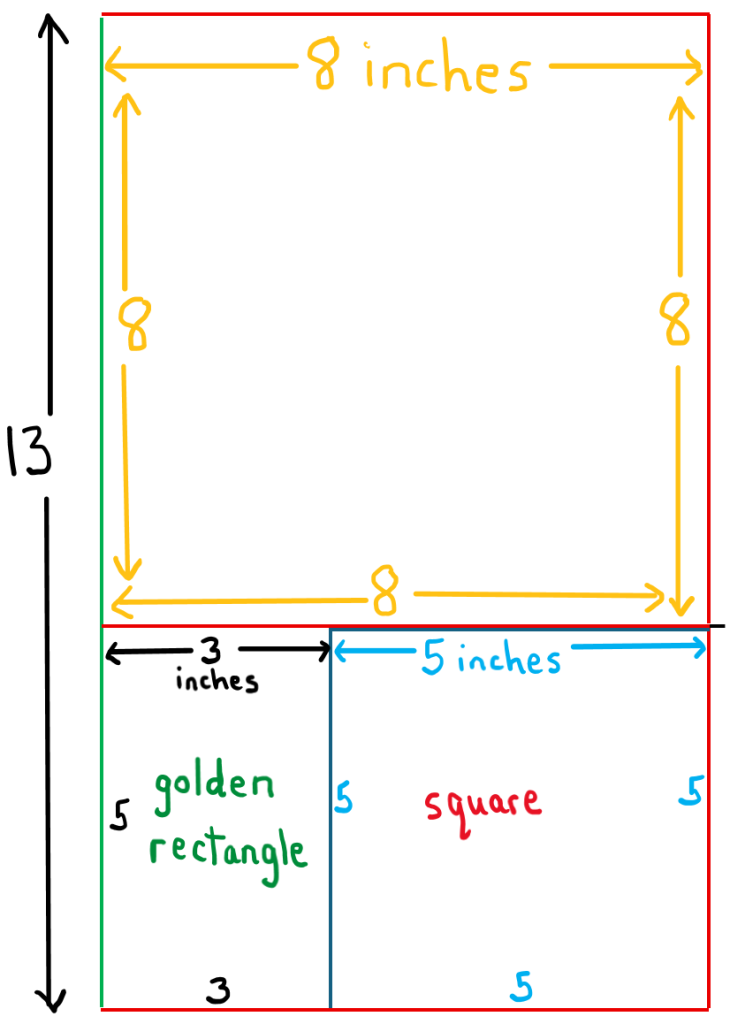
“And once we have a square and a smaller rectangle inside of that one, we can turn it again, and keep going, again and again. Each time, the smaller rectangle that gets created is a Golden Rectangle.
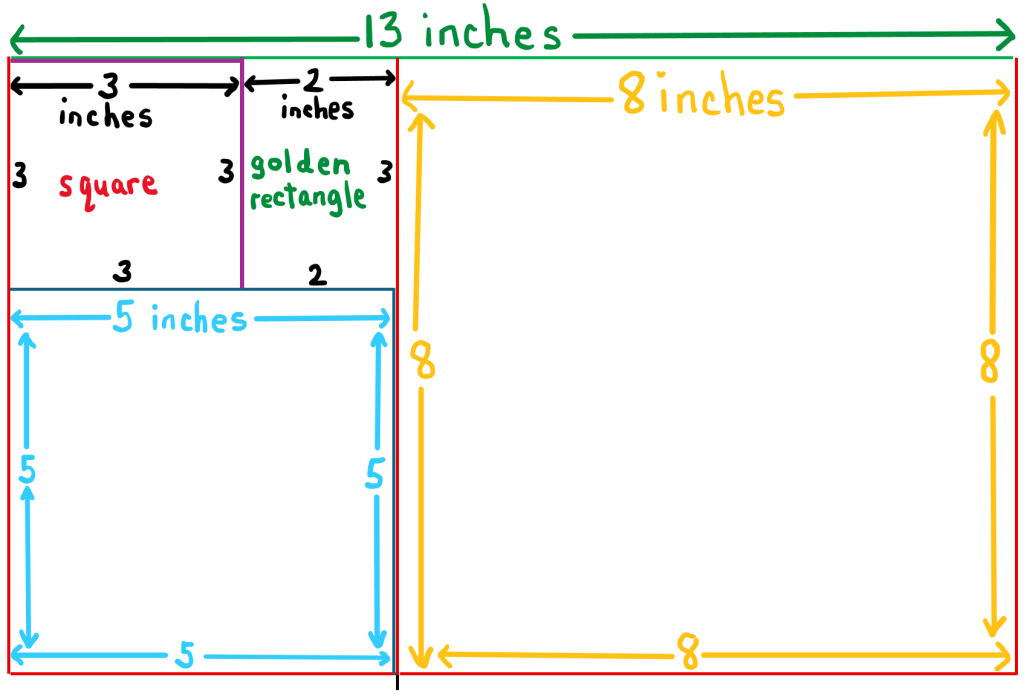
“If we keep going, it will start to see a spiral.

“Now I’m going to tell you why I chose the numbers 5, 8 and 13. They are part of something called the Fibonacci Sequence. It is a list of numbers that begin with 0 and 1. Every number after that will be the sum of the two numbers that come before it. And this list goes on forever. A sum is the number you get when you add two numbers together. So let’s try it. 0 + 1 = 1, so the third number is 1. Now the list is 0, 1, 1. Add the last 2 numbers together: 1 + 1 = 2. So 2 will be the next number in the list. Now the list is 0, 1, 1, 2. Add the last 2 numbers together: 1 + 2 = 3. So now our list will be 0, 1, 1, 2, 3. What do you think the next number will be?”
Linnea raised her hand. “The last 2 numbers are 2 and 3. Their sum is 5 because 2 + 3 = 5. So 5 is the next number.”
“Correct, Linnea!” said Annika. “So now the list is 0, 1, 1, 2, 3, 5. The last two numbers are 3 and 5. What do you think is the next number?”
“It’s 8!” said Astrid. “3 + 5 = 8.”
“That’s right, Astrid,” said Annika. “Now the last two numbers in our list are 5 and 8. What do you think is next? Do you know, Lukas?”
“5 + 8 = 13,” said Lukas. “So, it’s 13.”
“Excellent,” said Annika. “So now our list is 0, 1, 1, 2, 3, 5, 8, 13, and it can keep going forever. This sequence of numbers, called the Fibonacci Sequence, can be used to make Golden Rectangles. Just take any two consecutive numbers from the list. They are like our two red pieces of yarn. If we divide the larger number by the smaller number, the answer will be close to 1.6. That is the Golden Ratio. When we add the two consecutive numbers together, we get the next number in the Fibonacci Sequence. That number is like the green piece of yarn. That is the length of the long side of the rectangle. The length of the shorter side of the rectangle, which we call the width of the rectangle, is the number that comes right before it in the Fibonacci sequence. It’s the larger of the two red pieces of yarn.
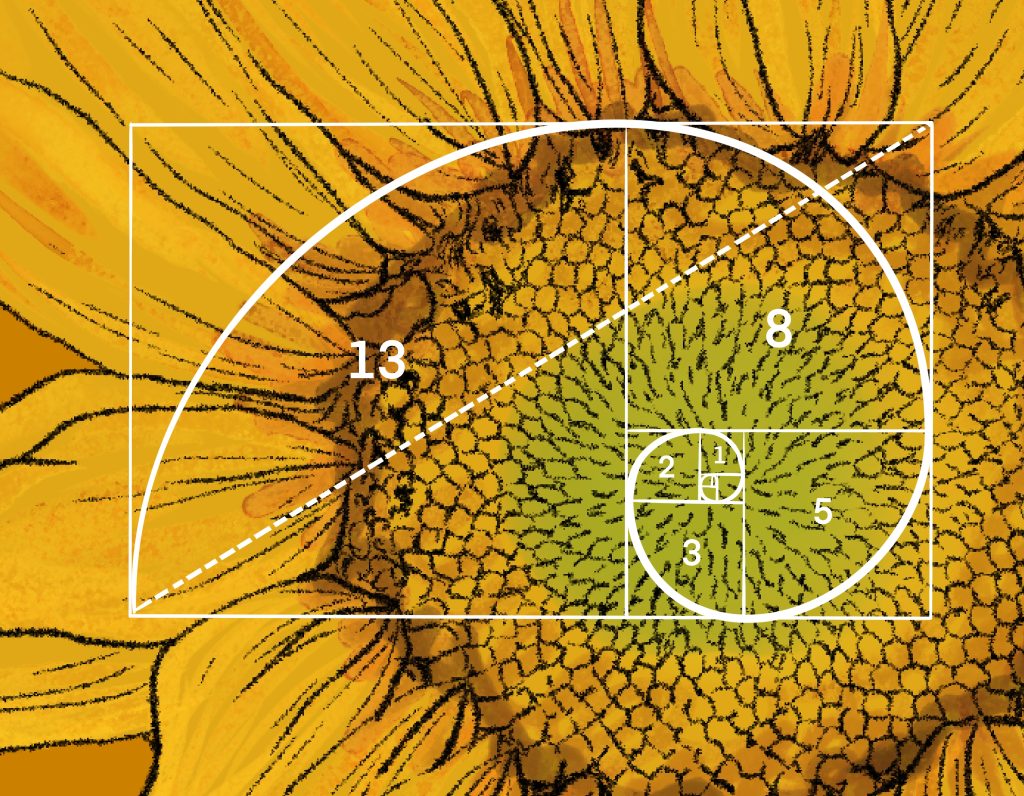 “For every Golden Rectangle we make, we can turn it and make a smaller one inside it. The length and the width of every one of these rectangles are found in the Fibonacci Sequence. As more and more smaller rectangles are added, it begins to look like a special kind of spiral. This is seen throughout nature. Examples can be seen in the arrangement of sunflower seeds in the center of a sunflower, in the design of pinecones and the arrangement of flower petals, in the arrangement of leaves around a stem, in a spiral galaxy like the Milky Way, in the design of some spider webs, in the spiral pattern of a hurricane, and even in the design of humans.
“For example, the height of the face divided by the width of the face can be close to the Golden Ratio. The width of the mouth divided by the width of the nose is another example. The width of the nose divided by the distance between the eyes can also be equal to the Golden Ratio. There are even more examples that include the arms, hands, and fingers. The Fibonacci Sequence is even found in the structure of our DNA!
“Whenever I look at a sunflower, I remember that God came up with the Fibonacci Sequence, the Golden Ratio, and how He includes it in the design of so many parts of His creation.”
“Thank you, Annika!” said Mormor. “You explained that so well. I want to add that it’s not just in nature that we find the Golden Ratio. Famous artists and architects have also used it. Leonardo da Vinci used it when he drew the Vitruvian Man in around 1490 AD. Michelangelo used it when he created the sculpture, David, in 1501-1504 AD. It is even seen in the design of the Parthenon in Greece which was built in the 5th century BC.
“Scientists have discovered that the human brain finds it easier to process things that have patterns, order, symmetry, and proportion, and especially when the Fibonacci sequence and Golden Ratio are involved. If this is true, then they hypothesize that the human brain is wired to be drawn to these things, to find them more pleasing and attractive. From this perspective, mathematics has a role to play in what humans naturally find beautiful, whether that is the symmetry of a flower or butterfly, the Golden Ratio proportions of the human face, or the spiral shape of the Milky Way galaxy.
“Philosophers,” continued Mormor, “agree that patterns, order, symmetry, and proportion have attracted people across time and place. They often use those words when trying to explain the meaning of transcendental beauty. To be transcendental, the definition of beauty cannot depend on the who, when, and where. It can’t be defined by one person living in a one culture during a one time in history.
“However, philosophers look deeper than what is on the surface. Plato defined beauty as the ‘essence’ or ‘pure form’ of something. He explained that ‘true beauty’ was not a matter of opinion, but because of what the thing is made up of. The ‘essence’ of something could be seen as the core, the character, the nature, the inner workings, or maybe the design. Plato believed that when the ‘essence’ showed a sense of order, symmetry, proportion, or harmony, it would draw people toward it. That, to Plato, was transcendental beauty.
“Plato saw the connection between that which is transcendentally beautiful with that which is transcendentally good and true. He saw beauty as a window toward that which is good and true. For example, we might think of a person’s mind as where they think about what is true and choose actions and words that are good, but when we think about what makes a person who they are, we might use the word soul or spirit or heart. When a person has a beautiful soul, they value truth and goodness. They seek to gain knowledge and wisdom as well as live a moral and virtuous life. When you meet someone like this, you might sense a radiance about them.
“Before we find out what God says about beauty, let’s check in with Ethan to find out how he is doing on his journey with the wise men and their camels.”
Being a Seeker of Beauty: What is Beauty?
Ethan was too excited to sleep. The rhythmic jostling of the saddle basket was in harmony with the sway of the camel’s body, and it did draw him toward sleep, but the beauty of the starry sky was too awe-inspiring for him to close his eyes. He was taking a turn in Měilì’s saddle basket, and he was looking forward to hearing her thoughts about this trip.
“May?” Ethan asked, using Měilì’s nickname. “Can I ask you a question?”
“Sure,” said May. “What is on your mind?”
“Well,” said Ethan. “Your Chinese name means ‘beauty,’ and I am wondering if you are a seeker of beauty. And if you are, then how do you know if you have discovered it?”
“You are a philosopher, young Librarian,” said Měilì. “You are like my rider, Balthazar. Yes, I am a seeker of beauty. I see beauty in the starry sky above us. I see beauty in the glorious colors of the sunrise and the sunset. I also see beauty in the heart of Balthazar who is bringing a gift to the new king. Not only that, but he makes sure I have enough water, and that my saddle baskets are balanced so that it is easier to walk for a long time. He thinks about my needs even before he thinks of his own. I think he has a beautiful heart.”
As Ethan was thinking about this, Měilì stopped abruptly.
“Look!” said May. “Do you see that sunflower growing there next to the path?”
“Yes,” said Ethan.
“In the middle of the sunflower, you will see all the seeds. If you look carefully, you will see they form a spiral. I think that is beautiful. That is how they were designed. God came up with that design.”
Ethan asked May if she could pick the sunflower and pass it back to him.
“Of course, young Librarian,” said Měilì. “It will remind you of God’s beauty. The spiral seen in the seeds is like God signing his artwork.”
Ethan put the sunflower next to the stone and the seed in his saddle basket. “Thank you, May,” he said. “I like being a seeker of beauty.”
“When Ethan was talking to Měilì,” said Mormor, “she pointed out that God is the one who came up with the mathematical design of the sunflower. We have talked about how a scientist or a philosopher might define beauty. Let’s find out how God defines beauty.
“Just as God is a God of order, balance, harmony, and purposefulness, so is that which He creates. We are created in His image. Our brains are designed to appreciate patterns, symmetry, order, balance, and harmony. We recognize and like these things more so than chaos and meaninglessness. That which attracts us, draws us toward it, is beautiful.
“When we recognize something as beautiful, we are not just looking at the outside, but at the heart, at the inside part that makes it good. At the source of goodness.
“For a person, if their heart is right with God, which we can call righteousness, we will see evidence in that person’s life of wisdom, of the fruit of the Spirit, and even of the glory of God. How so? Radiance. Sometimes, when I see evidence in a person’s life of their heart being right with God, I feel like I can almost see the Holy Spirit radiating from the person’s face! There is a peace and joy on their face that makes it glow.
“For other parts of creation, we can see God’s handiwork and artistry. The intelligence of his design. The painted sky with the sunrise. The Fibonacci sequence in the sunflower. Harmony in music. The sight and sound of rain on the lake. Wind blowing through the trees. Crickets chirping. There is beauty, therefore, in all of God’s creation, both in nature and in people.
“I think scientists and philosophers would agree that there is no such thing as ‘perfect beauty’ of how a person looks on the outside. I don’t think such a thing exists. God made every person in His image, and He said every part of His creation was good. Yet, every person is unique. He did not use a cookie cutter approach to the creation of people. So, by His own design, there is no such thing as ‘perfect beauty’ for how people look on the outside. When God talks about beauty, He is looking at the heart. He is looking at the ‘essence’ of a person or thing that makes it what it is. For people, that is our heart or soul.
“Just as God is perfect truth and perfect goodness, He is also perfect beauty. If our heart is right with God, then we will have a beautiful soul.
“In the Bible, there are many verses about beauty and that which is beautiful. Some verses use imagery of a tree or clothing like a robe. Some talk about inner beauty. In others, there are angels singing about the glory of God or new Jerusalem shining in splendor with the presence of God. There are also verses that talk about seeking the beauty of the LORD. Let’s look at a few verses from each of these categories.
“When we talk about having a beautiful soul, we are talking about inner beauty. Let’s open our Bibles and look at these verses: 1 Peter 3:3-4; Ephesians 4:22-24; Matthew 5:8; Psalm 51:10-11; and 2 Corinthians 8:2-3. These verses talk about what is in our heart or written on our heart. In referring to our inner self, it compares our old self to our new self. Let’s take turns reading them.
1 Peter 3:3-4 “Your beauty should not come from outward adornment, such as braided hair and the wearing of gold jewelry and fine clothes. 4Instead, it should be that of your inner self, the unfading beauty of a gentle and quiet spirit.”
Ephesians 4:22-24 “You were taught, with regard to your former way of life, to put off your old self, which is being corrupted by its deceitful desires; 23to be made new in the attitude of your minds; 24and to put on the new self, created to be like God in true righteousness and holiness.”
Matthew 5:8 “Blessed are the pure in heart, for they will see God.”
“What are some of the words used in those verses to describe a beautiful soul, or a heart that is right with God?” asked Mormor.
“A gentle and quiet spirit,” said Annika.
“To have a Christ-like attitude,” said Theo.
“To be pure in heart,” said Linnea.
“Yes,” said Mormor. “And what do you think a Christ-like attitude might be like?”
“I think it is trying to be thankful and positive,” said Astrid.
“Well said, Astrid,” said Mormor. “Philippians 4:8 says, in The Living Bible, ‘Fix your thoughts on what is true and good and right. Think about things that are pure and lovely, and dwell on the fine, good things in others. Think about all you can praise God for and be glad about.’ That sounds like being thankful and positive!
“As for being pure in heart, let’s look at Psalm 51:10-11:
“Create in me a pure heart, O God, and renew a steadfast spirit within me. 11Do not cast me from your presence or take the Holy Spirit from me” (Psalm 51:10-11).
“David asks God to create a pure heart in him, and then he immediately begs God to let the Holy Spirit be with him always. Why do you think he says those two things right next to each other?”
“I think,” said Annika, that having a pure heart is being right with God, and it’s easier to be right with God if God is right there with you. Having the Holy Spirit with him, in his heart, fills his heart with positive feelings like joy and peace and love. It helps him remember that God created him and loves him.”
“I love how you said that, Annika,” said Mormor. “I am reminded of John 1:14 that tells us ‘The Word became flesh.’ Jesus is the Word. When we invite Jesus into our heart, it is like having God’s Word written on our hearts. In the Old Testament, God’s Word was written on stone tablets. Those were the Ten Commandments. In the New Testament, God’s Word is written on our hearts by the Holy Spirit. Listen to what Paul says in 2 Corinthians 3:2-3.”
“You yourselves are our letter, written on our hearts, known and read by everybody. 3You show that you are a letter from Christ, the result of our ministry, written not with ink but with the Spirit of the living God, not on tablets of stone but on tablets of human hearts” (2 Corinthians 3:2-3).
“Paul was a missionary. I have some friends who are missionaries. They tell their Christian friends, ‘You are the only Bible that some people will ever read.’ They say that because they live in a country where most people have never heard about God, and they don’t have Bibles to read. So, if the people there meet someone who says they are a Christian, then they think that person’s behavior and attitude tells them what it means to be a Christian. What they learn about God is from the words and actions of that person. That makes sense. People’s actions, words, and attitude come from what is in their heart. When we invite Jesus into our heart, and He invites the Holy Spirit to be with us always, and we are paying attention to His presence which includes God’s Word, then it’s likely our words, actions, and attitude will be more pure, more Christ-like. This is inner beauty.
“Of course, it’s easier for us to think of beauty as something we can see. So, many writers and poets like to use imagery to help us make a picture in our minds of something that is beautiful. Do any of you want to try and explain what imagery is?”
Theo spoke up. “Imagery is when the writer chooses words that help one or more of our senses make an image in our mind of how it feels, sounds, looks, tastes, or smells. For example, the writer could write, ‘On a dark and stormy night, the icy wind and pounding rain made it hard for the old fisherman to hear the distant church bell ringing through the salty air as the sea churned around him.’ In that sentence, what do you think is an example of imagery?”
Linnea raised her hand. “Dark and stormy night. Old fisherman. Churning sea. Those are examples of visual imagery. We can make a picture in our mind.”
Lukas added, “Icy wind is imagery that lets us imagine how it feels.”
“Pounding rain. Church bell ringing. Those are examples of imagery that lets us imagine how it sounds,” said Annika.
“Salty air,” said Astrid. “That helps me know what the air tastes like.”
“Great example, Theo,” said Mormor. “When we listen to that sentence, almost all our senses help us imagine what it would be like to be right there. We can picture it, smell it, hear it, and taste it. Then we can ask ourselves how it feels, and maybe it’s a bit scary or suspenseful. We wonder what will happen next.
“Theo could have said, ‘On a clear and bright, starry night, with the moon reflecting on the glassy, smooth surface of the sea, the old fisherman heard the church bells ringing.’ When our mind puts those words together, we find ourselves imagining a peaceful, tranquil, beautiful scene.
“Both sentences are about an old fisherman in a boat on the ocean, with church bells ringing on the shore, but the feeling that we get from each sentence is completely different. That is the power of imagery. Poets love to use imagery, and books in the Bible like Psalms and Isaiah are examples of poetry. In these books, the poet often uses imagery to help us see beauty even when the beauty is in the heart. One image is that of a crown worn by a king, and another is of a robe or clothing. When you notice those words, be on the lookout for words that help our senses picture the crown or the robe. For example, words like splendor, glory, glorious, majesty, and royal make us think of a king. We picture something majestic which is beautiful.
“When you hear about a robe of righteousness, remember that there is a difference between self-righteousness and righteousness. Self-righteousness is when we smugly think that we are perfect on our own, with no need of God’s grace and forgiveness. It may be when someone feels morally superior to others, judgmental of others, and resistant to being corrected. That is not a good thing. Righteousness, though, is when we are right with God. That happens because Jesus paid the price for our sins when he died on the cross so that we don’t have to. Since that price has been paid for us, there is no sin that separates us from God. We are free to be in God’s presence. The Holy Spirit can live in our heart and be with us always.
“Jesus is the King of kings. When we invite Him into our heart, we are in the presence of the King of kings. His presence fills our heart with the beauty that we associate with majesty, royalty, glory, and holiness. Tomorrow we will talk about how Jesus is the Light of the World, and so when Jesus is in our heart, His Light is in us. And that Light shines forth from us. When we look at our Advent candles shining brightly, we realize how beautiful they are. Light shining in the darkness is another great example of imagery.
“Listen for the words of imagery in these verses from Psalms and Isaiah that make us think of something beautiful. Imagine how a bride tries to make herself look as beautiful as possible on her wedding day. Also, think about the image of an oak tree. It has roots that go deep into the ground. Being rooted like that allows it to be strong and dependable. The oak tree is known as the king of trees.
“You will hear of a place called Zion in some of these verses. Zion can refer to a place in Jerusalem, the city of David, or it can refer to the future kingdom of God when Jesus returns. Sometimes it refers to Mount Zion or Solomon’s temple or all of Israel, but all of the time it refers to the presence of God.
“Okay,” said Mormor. “Are you ready? You are listening for words of imagery. These include crown or wreath, robe or clothing, the mighty oak tree, and words that sound kingly like royal, splendor, majestic, and glorious. Listen for the word righteousness which lets us know that Jesus, the King of kings, is in our heart because we have accepted His gift of salvation and are right with God. Here we go!”
Psalm 104:1. “Praise the LORD, O my soul. O LORD my God, you are very great; you are clothed with splendor and majesty.”
Isaiah 33:17. “Your eyes will see the king in his beauty and view a land that stretches afar.”
Isaiah 61:3. This is a prophecy that says Jesus will come to “provide for those who grieve in Zion – to bestow on them a crown of beauty instead of ashes, the oil of gladness instead of mourning, and a garment of praise instead of despair. They will be called oaks of righteousness, a planting of the LORD for the display of his splendor.”
Isaiah 61:10. “I delight greatly in the LORD; my soul rejoices in my God. For he has clothed me with garments of salvation and arrayed me in a robe of righteousness, as a bridegroom adorns his head like a priest, and as a bride adorns herself with her jewels.”
Isaiah 62:1. “For Zion’s sake I will not keep silent…till her righteousness shines out like the dawn…”
Isaiah 62:3. “You will be a crown of splendor in the LORD’s hand, a royal diadem in the hand of your God.”
Isaiah 28:5. “In that day the LORD Almighty will be a glorious crown, a beautiful wreath for the remnant of his people.”
“Isaiah,” said Mormor, “was a prophet, and so he spoke about things that were going to happen in the future. Those are called prophecies. When the prophecy comes true in the future, we say it was fulfilled. Some of Isaiah’s prophecies were fulfilled when Jesus was born, when he lived, and when he died and was resurrected. Some of his prophecies won’t be fulfilled until Jesus returns to Earth. That is in our future. John had a vision about that and wrote about it in the book of Revelation. When you hear Isaiah say, “In that day…,” it is usually a prophecy about when Jesus returns and there is a new Jerusalem.”
Revelation 21:11 refers to the new Jerusalem that John sees in his vision and describes in Revelation. “It shone with the glory of God, and its brilliance was like that of a very precious jewel, like a jasper, clear as crystal.”
Psalm 50:2 refers to the new Jerusalem as Zion. “From Zion, perfect in beauty, God shines forth.” Why is it perfect in beauty? Because God is present and is shining forth. Remember how Plato defines beauty as the essence of something? When God is in the heart of someone or at the heart of something, He is present there. He shines forth.
“Beauty,” said Mormor, has more to do with one’s identity, with what makes someone or something what it is. We are all made in God’s image, and in that way we are each beautiful. But, to be right with God in our heart, to have righteousness, we need to accept God’s gift of salvation and invite Jesus into our heart to be our Lord and Savior. And then, Jesus gives us the gift of the Holy Spirit to be with us always. And then, His Light shines forth from us. Wherever God is present, there is the imagery of light shining in darkness, and there is beauty. In this way, perfect beauty is seen in righteousness or being right with God in our heart.”
“In Psalm 27:4,” continued Mormor, “David said, ‘One thing I ask of the LORD, this is what I seek: that I may dwell in the house of the LORD all the days of my life, to gaze upon the beauty of the LORD and to seek him in his temple.’ What did David want more than anything else? What was the desire of his heart?”
“He wanted to gaze on the beauty of the Lord,” said Annika. “He wanted to be in God’s presence.”
“Yes!” said Mormor. “And do you know what? The angels felt the same way. They loved to focus on the glory of God and sing praises to Him. We see this in the Christmas story when the shepherds are out in the field, and the angels in the sky start singing. We also see it in Isaiah 6:3.”
Luke 2: 13-14. “Suddenly a great company of the heavenly host appeared with the angel, praising God and saying, ‘Glory to God in the highest, and on earth peace to men on whom his favor rests.’
Isaiah 6:3. “And they were calling one another: ‘Holy, holy, holy is the LORD Almighty; the whole earth is full of his glory.’”
“When people are in the presence of God, they sense His holiness, the splendor and glory of God. These are words that create images of His beauty. And then, people want to worship God! It’s as though what is in their heart just bursts out in songs of praise!”
Psalm 57:11. “Be exalted, O God, above the heavens; let your glory be over all the earth.”
Psalm 29:2 (and 1 Chronicles 16:29) “Ascribe to the LORD the glory due his name; worship the LORD in the splendor of his holiness.”
“When we talk about God’s holiness, and about Jesus being the King of kings, we are not talking about what He does. We are talking about who He is. This is the difference between how we define goodness and how we define beauty. Goodness has more to do with one’s actions and words, with what one does and says. God loves us. God creates. Those are actions that show His goodness. Beauty is about one’s identity, what makes one who they are, what is in one’s heart.
“We might sense the presence of God in someone because of the goodness we see in their actions and words, and we would recognize that presence as being beautiful. We would be seeing the glory of God, the presence of the Holy Spirit, in that person’s heart, and we would be drawn to it just as beauty catches a person’s eye and draws them toward it. Just as David said, his greatest desire was to ‘gaze on the beauty of the LORD’ (Psalm 27:4).”
Application:
St. Lucia’s Day, primarily celebrated in Sweden and Norway, is on December 13. We talked about it yesterday. When the girls dress up as St. Lucia, they wear a crown or wreath of candles on their head. Isaiah 28:5, 61:3, and 62:3 refer to a crown of beauty, splendor, or glory. When we picture St. Lucia wearing this crown of lights, we can remember that God is perfect beauty.
And when God is in our heart, who we may refer to as Jesus being in our heart or the Holy Spirit being in our heart, we are right with God (our sin is forgiven) and God is right with us (present with us).
Being a child of God is our identity. It is who we are. How did we become a child of God? It is not about what we have done, but about what Jesus has done for us. After Jesus died for our sins so that the price of our sins was paid, he rose again and offered us the gift of being adopted into God’s family. We call that salvation because we are saved from having to suffer the consequences of our sins. And we know that we will live forever in the presence of God, both here on Earth and then in Heaven once our life on Earth is over.
As Plato said, beauty is the essence of something, the part of something that makes it what it is. Who are we? We are children of God. Who is in our core, our heart, our essence? It is Jesus. Therefore, there is beauty in us. There is also beauty in the world around us that God has designed and created. And even in our own creations, when we see examples of the order, harmony, proportionality, symmetry, radiance, and intelligence that are part of God’s character and imbued in His creation, we also see beauty.”
Ecclesiastes 3:11 says, “God has made everything beautiful in its time.”
Choice of hymns about the beauty of creation:
For the Beauty of the Earth written by Folliott S. Pierpoint in 1864
How Great Thou Art
This beautiful hymn has a long history. It has gone from Swedish to Russian to English! In 1885, a Swedish minister named Carl Boberg wrote, in Swedish, a poem titled O Store Gud. The story is that he was inspired by seeing a beautiful sunset that followed a thunderstorm. Later, the poem was translated into Russian. Finally, the missionary Stuart K. Hine translated the Russian into English in 1949. Hine added two new verses.
This is My Father’s World written by Maltbie Davenport Babcock in 1901
He Keeps Me Singing (verse 1) written by Luther B. Bridgers in 1910
