
An Advent Storybook and Study: Seeking Truth, Goodness, and Beauty
Copyright 2025 by Lūminé Press, Written by Elsie Lungren, Illustrated by Nicoleta Dabija
Day 12
Mormor looked at her grandchildren and said, “What is goodness?”
Lukas raised his hand. “It is the opposite of evil.”
“Okay,” said Mormor. “Sometimes we can say what something is by saying what it’s not. How would you explain what evil is?”
Lukas said, “It’s doing the things that Satan wants people to do, so it makes people be far away from God instead of close to Him.”
Astrid said, “It makes the heart be dirty instead of clean.”
“That is a good description,” said Mormor. “It sounds like goodness has to do with things that we do. Maybe things that bring us closer to God, and that make our heart clean.”
Annika spoke up. “Mark 10:18 says that ‘God alone is good.’”
“Great detective work, Annika!” said Mormor. “We know that God is the only one who is perfect, and being perfect makes us think about how one chooses their actions and words. God created us to have free will. The word ‘will’ means we get to make choices about what we do and say. But whatever we decide, it affects someone else. It can help or harm. It can empower, encourage, ease one’s burden, or set a good example. Or, it can discourage, deceive, deride, or dismiss people. Maybe evil is what motivates a person to bring another person down, and goodness is what motivates a person to lift another person up. Let’s look at 1 John 4:8.”
“Whoever does not love does not know God, because God is love” (1 John 4:8).
“Maybe,” said Mormor, “goodness is making choices about our words and actions out of love. If truth is about our intellect, about what we think; maybe goodness is about our will, about what we choose to do and say. Maybe it’s about choosing love and kindness. Let’s see what Ethan finds out when he talks to the camel, Shànliáng, today.”
Being a Seeker of Goodness: What is Goodness?
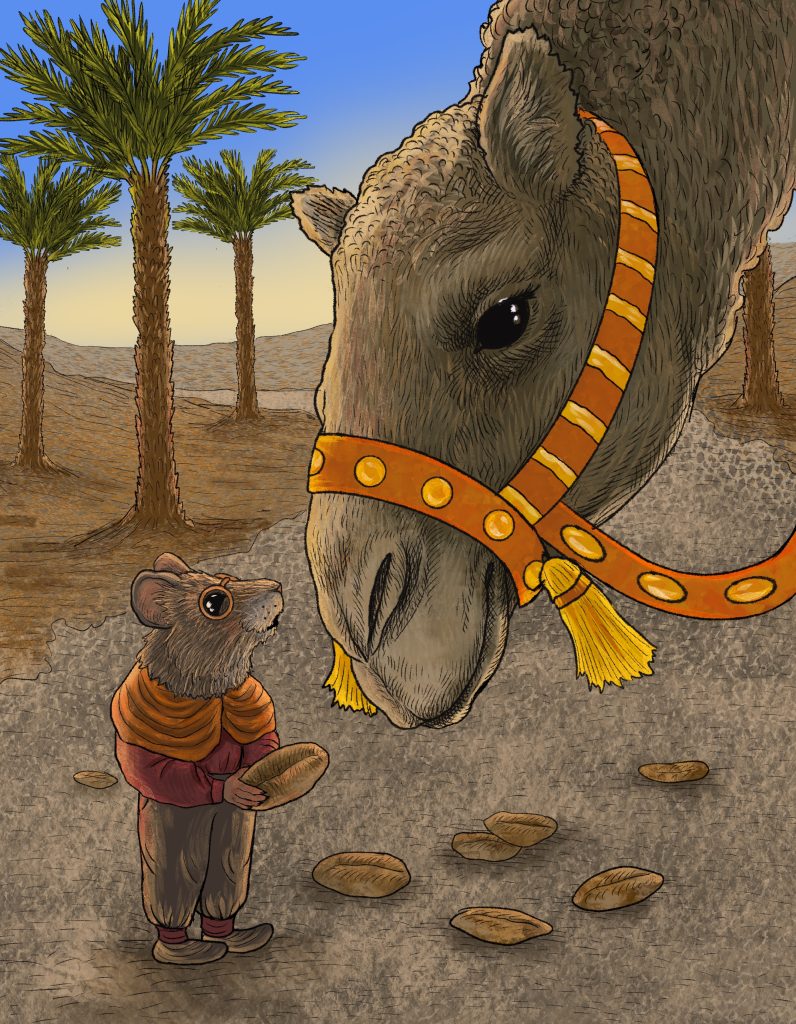
Ethan was enjoying the journey. It was such an adventure. Wherever he looked, if he looked very carefully, there was something interesting to be found. As if reading his own thoughts, something very interesting turned up right at that moment!
“Are those seeds on the path?” he asked himself.
Shànliáng, Caspar’s camel, heard him. “Yes, Young Librarian,” he said. “Would you like one for your collection of keepsakes?”
“Thank you,” said Ethan. “I would.”
After collecting the seed with a bit of help, he turned to Shànliáng and said, “Shaun, your Chinese name means goodness. Are you a seeker of goodness?”
Shaun replied, “Yes, I believe that anywhere we look, goodness can be found. It might be hard to find, but we can find it if we are determined.”
Ethan was skeptical. “Really?” he said. “If something is evil, then I don’t think goodness can be found. How can evil and goodness be found at the same time if they are opposites?”
Shaun said, “Oh, Librarian, that is a good question. To answer you, I am going to ask you another question. Can you think of a time at the library when you welcomed someone to the library, and later spoke angrily to that same person for spilling tea on one of the scrolls?”
Ethan looked sheepish and said, “Yes, that has happened. Probably a lot. One time, I felt so guilty for yelling at the person because I learned that it wasn’t his tea and he hadn’t even been the one to knock the tea over! A dog had run through the library, jumped onto the table, knocked the tea over, and ran out.”
Shaun said, “You have a good heart, young Librarian. You have goodness in you. You care about the library and want to protect the scrolls. Yet, you are not perfect. None of us are. Only God is perfect. So, it makes sense that in one day, you could speak to the same person in two different ways. First, with kindness, and second, with annoyance and judgment. Do you see how each of us has goodness in us, but we are not perfect?”
Ethan replied, “Thank you, Shawn. You have helped me understand that if we want to see pure goodness, that is only in God.”
“Yes,” said Shawn. “But, God created people in His image, and so I believe there is goodness in everyone.”
“This seed will remind of that,” said Ethan. “Inside this seed there is the beginning of a new life. In the very first chapter of the Bible, every time God created something new, it says ‘and God saw that it was good.’”
“Mormor?” asked Astrid. “What does it mean that God created people in His image?”
“That is a good question, Astrid,” said Mormor. Let’s see what it says in Genesis 1:26-27.”
26“Then God said, ‘Let us make man in our image, in our likeness, and let them rule over the fish of the sea and the birds of the air, over the livestock, over all the earth, and over all the creatures that move along the ground.’ 27So God created man in his own image, in the image of God he created him; male and female he created them.”
“Has anyone heard of the Latin phrase, ‘Imago Dei’?” asked Mormor.
Annika raised her hand. “It means ‘image of God.’ God is able to love and to have an understanding of morals. This is goodness. God is creative. He can reason. When it says that God created humans in His image, it does not mean that humans are the same as God. It means that people, like God, have these abilities. In all of creation, this is unique to humanity. Only people are created in the image of God. Animals, for example, do not think about what is moral or what is good. They do not use deductive reasoning to figure out what is true.”
“Great explanation, Annika,” said Mormor. “Shaun is correct that there is goodness, or the capacity for goodness, in every person because humans are designed by God to have this capacity. But if we want to show goodness in our own lives, it is helpful to look at the example that Jesus sets for us. Jesus is perfect, and so there is perfect goodness in Him. If we look at His words and actions, then we see the best possible example that we could follow. Let’s look at what the Bible tells us about this.”
“The LORD is gracious and compassionate, slow to anger, and rich in love. 9The LORD is good to all; he has compassion on all he has made” (Psalm 145:9).
“For the LORD is good and his love endures forever; his faithfulness continues through all generations” (Psalm 100:5).
“Give thanks to the LORD, for he is good; his love endures forever” (1 Chronicles 16:34).
“All of these verses say that God is good, and they all have something else in common. Does anyone notice how God’s goodness is shown in each of these verses?”
“God loves us,” said Astrid.
“Yes!” said Mormor. “God’s goodness is shown in what he does, and what He does is He loves. If we want to know what love looks like and sounds like, we only have to look at Jesus. He is the inventor and designer of love. If someone does not know God, they might define love differently than the way God does. If they haven’t experienced God’s love in their life, then they cannot know what God’s love is.
“Someone who does not know God may seem like a very good person who is kind and generous, but remember that all people were created in the image of God, and that means all people have the capacity for goodness and for understanding what is moral. However, if God is not in their life, then they are missing out on seeing the example that Jesus sets for us of what true goodness looks like, and what love as designed by God looks like. They are missing out on having the Holy Spirit being with them all the time, serving as a guide and a counselor. Listen to what John says in 1 John chapter 4, verse 7:”
“Dear friends, let us love one another, for love comes from God…”
“Where does love come from?” asked Mormor.
“It comes from God,” said Linnea.
“Right!” said Mormor. “So if someone does not know God, and the people in their life don’t know God, then they can’t know what God’s love is. They can use the word love, say they are loved, and say they love others, but their definition of love, and their experience of love, isn’t going to be God’s love. This is why, when you decide someday who you want to marry, I encourage you to marry someone who has God in their heart. In a marriage, each person deserves to be loved in the way that is God’s idea of love. If one of the two people doesn’t know what that is, then they can’t love the other person in that way. And their kids deserve to be loved in the way that is God’s idea of love. And if both parents don’t agree on what that is, then the kids aren’t going to grow up experiencing God’s love from both parents. But if they can grow up with that experience, it makes it much easier for them to understand God’s love and share that love with others.
“The 4th chapter of 1 John talks a lot about this. Verses 13 and 15 explain that if we believe Jesus is the Son of God, then God lives in us because He has given us the Holy Spirit. Verse 16 says ‘…we know and rely on the love God has for us. God is love.’ And verse 19 says, ‘We love because He first loved us.’ What does this tell us? It tells us that if God is love, and God lives in us, then God’s love is in us. Because we have God’s love in us, we know what God’s love is and can share it with others. If we had never experienced God’s love, then we would not be able to share it with others because we wouldn’t have it to share.
“Not only does the Bible tell us that God is love, it tells us that God is good. We see this in the verses about Jesus being the Good Shepherd. Let’s take a look.”
Jesus said, “I am the good shepherd. The good shepherd lays down his life for the sheep” (John 10:11).
Jesus said, “I am the good shepherd; I know my sheep and my sheep know me” (John 10:14).
“The LORD is my shepherd, I shall not be in want. 2He makes me lie down in green pastures, he leads me beside quiet waters, 3he restores my soul. He guides me in paths of righteousness” (Psalm 23:1-3).
“Think about some of the things the shepherd does for his sheep. He takes care of them. He knows them and they know him. That is relational. He provides for their needs. He guides them. These are all good things.”
“What about the parable of the Good Samaritan?” asked Linnea. “Is that an example of goodness?”
“I’m glad you thought of that, Linnea,” said Mormor. “That is in Luke chapter 10. Right before Jesus tells that parable, in verse 27, Jesus summarizes the two most important commandments. These same words are in Matthew 22:36-39. Let’s listen to them.”
“‘Teacher, which is the greatest commandment in the Law?’ 37Jesus replied, ‘Love the Lord your God with all your heart and with all your soul and with all your mind.’ 38This is the first and greatest commandment. 39And the second is like it: ‘Love your neighbor as yourself.’”
“Right after Jesus says that, He is asked to explain who the neighbor is. That is when Jesus tells the parable of the Good Samaritan. At the end, Jesus asks his audience which person in the story acted like a neighbor, and they realized it was the Samaritan. Do you remember some of the things that the Samaritan did in the story?”
Theo raised his hand. “When he found the person who had been attacked by robbers and needed help, he bandaged his wounds, took him to an inn, took care of him, and paid the innkeeper to continue taking care of him.”
“That’s right,” said Mormor. “Even though the person who needed help was a stranger to him, he got involved. What makes the Samaritan a ‘good’ neighbor is that he treated another person in a way that was kind, compassionate, helpful, and loving. This is an example of how goodness has to do with the choices we make in what we do and say. Our choices affect others. In this way, goodness is relational. Just as a good shepherd acts responsibly and lovingly toward his sheep, a good neighbor acts responsibly and lovingly, or morally, toward others.”
“Can anyone think of another place in the Bible where God uses the word ‘good’ a lot? In one chapter, it says ‘God saw that it was good’ six times!”
Lukas was waving his hand. “I know! It’s the first book of the Bible. Genesis chapter 1!”
“Correct, Lukas!” said Mormor. “In Genesis chapter 1, what does God see as the world is being created? He sees that it is good. How can the natural world be good? Only humanity is made in God’s image, but Romans 1:20 tells us that the world reveals God’s power and nature. For God to create the natural world and see that it was good, could we say that all of creation reflects God’s goodness, or that God put His goodness into it as He created it?
“In our other examples, we were talking about goodness being relational, being the choices we make about what we do and say, about our actions and words, knowing that they will affect others. But, we started by saying that God is the only one who is perfect goodness. So, what else do we know about God besides the fact that God is loving, compassionate, and gracious? He is intelligent. He has a plan and a purpose for everything.
“Have you noticed, when you look at the design of the cell, or the design of an atom, or the design of the water cycle, that there is a sense of order? The more we learn about the world, even going down to the microscopic level, the more we discover such incredible design.
“Do you know that Earth’s orbit around the sun perfectly allows for life to exist on Earth? If that orbit, which is the path that the planet follows around the sun, were any bigger or smaller, life on Earth would probably not survive. This is just one example of how perfectly every part of the world has been designed in order to let life exist on Earth.
“God’s goodness is seen in how God designs every aspect of creation, both big and little, to act and interact, to have a purpose, to be part of His plan for a world which can support life. Here’s one example. Do any of you know how plants and animals help each other out?”
Annika said, “Plants breathe in carbon dioxide and breathe out oxygen. Animals breathe in oxygen and breathe out carbon dioxide. So plants put oxygen into the air that we need to breathe in, and we put carbon dioxide into the air that plants need to take in.”
“What a great system!” said Mormor. “Every part of creation has a function, interacts in some way with other things, has a place in a system or a cycle, and fits into the bigger picture of the world. We can think of these things as what they do. This is goodness. Imagine how much intelligence and power it takes to come up with all of these highly detailed designs, and weave them all together into a world in which life can exist.
“When we see that God has the intelligence and power needed to give everything in all of creation a purpose, and how that is good, we can see how He can take all of the things that happen in our lives and give them a purpose as well. And that is also good.”
“And we know that in all things God works for the good of those who love him, who have been called according to his purpose” (Romans 8:28).
“God is perfect goodness. In all that He creates, there is goodness. Evidence of that goodness can be seen in what something or someone does. For people, goodness can be seen in an understanding of morals, living a life of virtue, and having the ability to love. But in all of creation, it can be seen in the sense of order, in the laws of nature, in chemical equations and in cycles, and in how things interact. God works all things together for good. It is what allows life to exist, to grow, and to flourish.
“In 1868, Sir Henry Williams Baker wrote a hymn titled, The King of Love my Shepherd Is. The first verse goes like this:”
“The King of love my shepherd is
Whose goodness faileth never
I nothing lack if I am his
And he is mine forever”
“Let’s be like Shaun the Camel and look for goodness in all of creation, including in each other.”
Application:
If today falls on December 13th, then today is St. Lucia’s Day! For our application today, let’s learn about that tradition and what it has to do with goodness. St. Lucia’s Day, which occurs 12 days before Christmas Day, is a festival to mark the beginning of the Christmas season. It is celebrated in Scandinavian countries like Sweden, Norway, and part of Finland. At home, it is traditionally the eldest daughter who dresses in a long white dress, wears a wreath of candles on her head like a crown, and brings saffron bread (lussekatter) and gingersnap cookies (pepparkakor) to the others in her family. Outside, schools close early, and the children of the village parade throughout the town delivering these treats and singing traditional songs. The girls are dressed as Lucia, and the boys wear clothes like white pajamas.
St. Lucia’s Day is a festival of lights. Lucia’s crown of candles helps people remember that light shines in the darkness. Knowing that light overcomes darkness gives people hope. This is part of the Christmas message. Hope is one of the gifts that we received when Jesus was born. In a few days, we are going to talk about how Jesus is the Light of the World that shines in the darkness.
St. Lucia was one of the earliest Christian martyrs. She was killed by the Romans in 304 AD for her Christian beliefs. It takes great courage to choose actions and words that show God’s goodness to others, and St. Lucia had that courage. When the girls dress up as St. Lucia and bring gifts of baked goodies to others in the family, they are choosing actions which are kind and good. We can do that every day!
Reading: Galatians 5:22-23 “But the fruit of the Spirit is love, joy, peace, patience, kindness, goodness, faithfulness, 23gentleness and self-control. Against such things there is no law.”
Goodness is a fruit of the Spirit. When we invite Jesus into our heart, His Spirit comes to be with us always. And when we follow the example that Jesus set for us in choosing words and actions that are kind and helpful to others, the fruit of the Spirit, which includes goodness, is shown in our lives.
Colossians 3:12-14 “Therefore, as God’s chosen people, holy and dearly loved, clothe yourselves with compassion, kindness, humility, gentleness and patience. 13Bear with each other and forgive whatever grievances you may have against one another. Forgive as the Lord forgave you. 14And over all these virtues put on love, which binds them all together in perfect unity.”
Ephesians 4:32 “Be kind and compassionate to one another, forgiving each other, just as in Christ God forgave you.”
Hymns:
Take My Life, and Let It Be Consecrated written by Frances Ridley Havergal in 1874.
The King of Love my Shepherd Is written by Sir Henry Williams Baker in 1868 (based on Psalm 23).
Choice of hymns about the goodness of creation (shown in praise and thanksgiving):
All Creatures of Our God and King
Two people are credited for this song. First, St. Francis of Assisi wrote the poem, Canticle of the Sun, in 1225. Then, in 1919, William Henry Draper created an English paraphrase of the poem.
Joyful, Joyful, We Adore Thee (verse 2) written by Henry van Dyke in 1907.
Let all Things Now Living written by Katherine Kennicott Davis in 1939 (published under the pseudonym, John Cowley, and set to the tune, “Ash Grove,” a traditional Welsh melody).
Modern songs about God’s goodness:
Goodness, Love And Mercy by Chris Tomlin, 2018.
Good Good Father by Chris Tomlin, 2015.
