
An Advent Storybook and Study: Seeking Truth, Goodness, and Beauty
Copyright 2025 by Lūminé Press, Written by Elsie Lungren, Illustrated by Nicoleta Dabija
Day 11
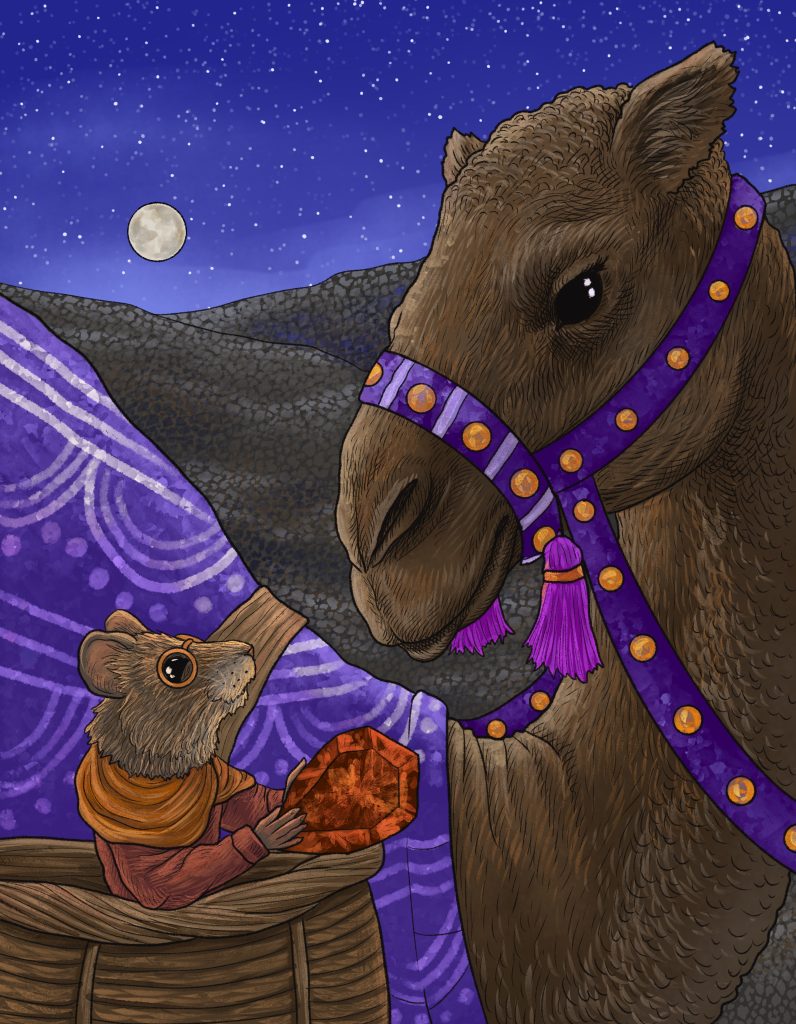
“Today,” said Mormor, “we are going to learn that Melchior’s camel, named Zhēnli, is seeking truth. As philosophers, we are going to ask the question, ‘What is truth?’ As scientists, we will compare the word truth to words like facts, laws, and theories.
“But first, let’s fast-forward to a scene that occurs in John chapter 18. There is a conversation between Pilate, who was somewhat like the Prime Minister of Rome, and Rome was the government in power over the Jewish people in Israel.”
“Pilate then went back inside the palace, summoned Jesus and asked him, ‘Are you the king of the Jews?’”
“Jesus said, ‘My kingdom is not of this world…’”
“‘You are a king, then!’ said Pilate.”
“Jesus answered, ‘You are right in saying I am a king. In fact, for this reason I was born, and for this I came into the world, to testify to the truth. Everyone on the side of truth listens to me.’”
“‘What is truth?’ Pilate asked” (John 18: 33, 36-38).
“That is the question we are going to explore today,” said Mormor. “Let’s check in with Ethan and see what he is finding out about this question.”
Being a Truth Seeker: What is Truth?
One of the things that Ethan loved about spending time with the three wise men is that they wanted to be continually learning about the world. They wanted to gain knowledge and to understand how the natural world worked. Like philosophers, they loved contemplating big questions such as how one can know if something is true or not.
It was a beautiful, star-filled night, and Ethan felt very relaxed as the steady rhythm of the camel’s footsteps were almost lulling him to sleep. When the path dipped suddenly and Ethan bounced forward, he opened his eyes. He was just in time to see starlight bounce off a stone in the path. It sparkled.
Ethan asked Jen the Camel, “Did you see that sparkling stone? I would like to save it as a reminder of this journey.”
Jen replied, “I did see it. I almost tripped on it! I’ll pick it up for you. It can be a reminder to me to watch where I’m going!”
Jen retrieved the stone and tossed it up behind her so Ethan could catch it and stow it in the saddle basket.
Now that he was wide awake, Ethan wanted to have some conversation. “Jen?” he asked.
“Yes, Young Librarian,” replied the camel. “What is it?”
“Your Chinese name Zhēnli means truth. Are you a seeker of truth?”
Jen answered, “Yes, I love accompanying Melchior on his journeys because he is also a seeker of truth. Have you heard of the great philosopher, Aristotle? He is a famous truth seeker.”
“Yes,” Ethan said. “He was Plato’s student.”
“Did you know,” continued Jen, “that about 350 years ago he observed that if meat got left out in the open for a few days, maggots appeared? He was very curious about this. One day the maggots weren’t there, and the next day they were. The only explanation he could come up with was that the meat, which was not alive, must have created the maggots, which were alive. He concluded it must be possible for life to arise from non-life. Since then, that is what people believe. They call it the Law of Spontaneous Generation. Scientists keep doing experiments to test if this is true, and so far, all of their results prove it is. Do you think they have found truth?”
Ethan, being a very well-read librarian, knew about Aristotle’s famous observation of the maggots and the meat. He said, “It is hard to believe that life could just magically appear out of nothingness without there being a mastermind behind it who has both an intelligent plan for what the life will be and how it will be designed, as well as the power to make it appear. Without a Creator, it sounds like it would be magic. With a Creator, it would be a miracle. I don’t believe in magic, but I do believe in miracles because I believe in God. I believe He has an intelligent plan and design for all that He creates, and I believe He has the power to create. I don’t have an explanation for Aristotle’s observation, but I keep thinking that someday there will be one. People are curious. They have questions and seek answers. They are explorers. The more they discover, the more they want to design new experiments and learn new things.”
“You are growing in wisdom, Young Librarian,” said the camel.
“This stone will be a reminder to me of truth,” said Ethan. “It is a zircon gemstone. It is called Jacinth in the ancient Scriptures. The Book of Exodus, chapter 28, verse 19, if I remember correctly. It was one of the twelve stones on the breastplate of the high priest. I think it represented the Tribe of Gad. Zircon is one of the oldest stones on Earth, and it will remind me of the truth about Creation, that God was the intelligent designer of the world.”
Mormor said, “Did you know that people continued to believe in spontaneous generation, the ability for a living thing to just magically appear out of thin air, or the ability of a nonliving thing to create a living thing, for almost 2000 years after Aristotle first saw maggots appear on meat? For hundreds of years, scientists kept designing and conducting new experiments to test this, and their results kept proving it was true. They actually thought that dust could create fleas, or that wheat could create a mouse!”
“What?” said Lukas. “People thought we were created from wheat? That is so crazy! It sounds like people weren’t very smart back then!”
“Well,” said Mormor, “it is not fair to compare them to us. Back when Aristotle was alive, the microscope hadn’t been invented yet. Without a microscope, they couldn’t see a cell, and so they didn’t even know what a cell was.”
“Mormor?” asked Astrid. “What is a cell?”
“Good question, Astrid.” Said Mormor. “Annika, do you want to explain?”
“Sure,” said Annika. “A cell is the smallest thing in the world that is considered alive. Every living thing in the world is made up of one or more cells. The cell contains everything it needs to grow, have energy, and survive. It even has DNA or RNA so it can reproduce. Almost every cell is microscopic which means it can’t be seen without a microscope.”
“Great explanation,” said Mormor. “People hadn’t even known about cells until 1655 when an English scientist named Robert Hooke was examining cork under a very simple microscope. Cork is dead tissue from the bark of oak trees, and he could see the outline of cells when he looked through the microscope. Around that same time, a Dutch scientist named Antonie van Leeuwenhoek invented a microscope that was capable of seeing a microscopic cell. This invention and discovery happened almost 2000 years after Aristotle! Imagine how hard it would have been to test whether microscopic life could magically appear out of nothingness when one didn’t even have the ability to see microscopic life because the microscope hadn’t been invented yet! The invention of the microscope changed everything!
“The microscope helped, but it was still almost 200 more years before people figured out the Law of Spontaneous Generation as wrong. In 1855, a German scientist named Rudolf Virchow was looking at blood cells under a microscope, and he concluded that all cells come from existing cells. This was the exact opposite of what the Law of Spontaneous Generation stated. Virchow’s discovery got added to the Cell Theory which says that all living things are made up of cells.
“A few years later, in 1859, a French scientist named Louis Pasteur designed an experiment which showed that not even microscopic life could spontaneously appear out of nothingness. His experiment was designed so well that no one disagreed with him. Finally, after almost 2000 years, people were convinced that the Law of Spontaneous Generation was wrong. It was not true that life could just appear out of nothingness! Non-living things could not create living things.”
“I have a question,” said Theo. “If the problem was not having a microscope, then why did it take another 200 years before they figured out that there is no such thing as spontaneous generation?”
“I am glad you asked, Theo!” said Mormor. “What the scientists did not know throughout those 2000 years was that their experiments were flawed! They were not designed well, so the results were not valid. That is an example of how people could believe something to be true for 2000 years when it wasn’t true at all! Their intentions were good. They were seeking truth, and they believed they had found truth that was supported by science, but they were completely wrong for a very long time.
“Today, scientists agree that their goal is not to find the truth about how the natural world works, but to come up with theories about it. Truth never changes, but theories can change. Science is a process that allows for change. It is a process of making observations, asking questions, designing and conducting experiments, analyzing the results, drawing conclusions, asking more questions, planning more experiments, and on and on. That process is called the ‘scientific method.’ Scientists want to know the truth, but they also know that they will never get there because the process of science keeps going. It never ends. There is always more to learn and discover.”
“But I thought philosophers are truth seekers!” said Linnea.
“I’m glad you mentioned that,” said Mormor. “Yesterday, we talked about what philosophy is. We learned that philosophers like to determine if something is true or not. Today we are going to define truth because words and their definitions are important. When we compare truth to a scientific theory, we will see that these words do not have the same meaning. Truth never changes. Scientific theories seem true because they are supported by evidence and are correct as far as we know, but they could always change in the future if the evidence changes.
“To help us understand the definition of truth, I want to explain the difference between a philosopher and a scientist. Both are like detectives who are trying to solve mysteries and answer difficult questions. But, they have different goals and use different methods.
“The goal of the scientist is to learn about how the natural world works. They do this through observation and experiments. Their methods include the use of logical reasoning and the scientific method. They design experiments that can produce results which can be measured or observed, and they repeat the experiments many times to make sure the same results happen each time.
“When scientists design an experiment, they are very careful to make sure they are only observing or measuring the effect of one thing. That one thing is called the ‘independent variable’ of the experiment. For example, if you bake two pies using the same recipe but you change two of the ingredients in the second pie, and you bake each pie at a different temperature, and the two pies don’t turn out the same, can you know for sure what one thing caused the difference?”
“No,” answered Linnea, “because you changed three things. Two ingredients and the baking temperature. It’s not possible to tell which one of those things caused the different results. If you want to know if the oven temperature makes a difference, then both pies should be made exactly the same way with the same ingredients so that the only thing being changed is the oven temperature. Then, if the pies come out differently, you know the cause of the change was the oven temperature.”
“Exactly, Linnea,” said Mormor. “You are a good scientist. This is why it is so important for an experiment to be designed well. If you have a question that you want to answer, like what would a good oven temperature be for baking the pie, then you need to make sure that is the only thing being changed when you make a few pies and compare them. And then you should repeat the experiment to make sure you get the same results!
“When scientists observe the same thing repeatedly, and there are no observations of something different, it will be considered a fact. For example, if a scientist observes one camel and sees that it only eats plants, the scientist can say that that one camel is an herbivore. Herbivores only eat plants. If the scientist observes 100 camels and sees that every single one of them only eats plants, the scientist could say it is a fact that all camels are herbivores. How can he do this? He hasn’t seen every camel in the entire world, so how can he say that all of them are herbivores?
“This is called inductive reasoning. If the scientist observes the same thing happening over and over again, with no exceptions, then he starts to see a pattern. He predicts the pattern will continue, and so he concludes that all camels are herbivores. Is it possible that someday a camel will be seen eating meat even though plants are available? Yes, but since no one has seen that yet, it continues to be an accepted fact that all camels are herbivores.
“We could explain the inductive reasoning like this:
We saw 100 camels, and they were all herbivores.
We did not see any camels that were not herbivores.
Therefore, all camels must be herbivores.
“Here’s another question,” said Mormor. “We might hear someone, even a scientist, say that facts are true. Do you agree with that or not?”
Theo raised his hand. “I think most people would probably agree with that, but it depends on how they are defining truth and facts. Let’s say both the scientist and the philosopher are talking about the kind of objective truth that is the same for everyone all the time no matter what, and they agree it is unchangeable. Then it depends on how they define a fact. Let’s say they agree to talk about facts that are determined by inductive reasoning. If something has been repeatedly observed the same way every single time, and it has never been observed differently, then there is no reason to think it will ever change. Then the question is: Even though all of the evidence predicts that it will always be the same, is it possible that one day the evidence will be different and prove it wrong? For example, is it possible that one day camels will start eating meat even though plants are available?
“If the answer is yes, the scientist might be comfortable saying that facts are considered true until they are proven otherwise. However, a philosopher might say that facts should never be considered truth if there is any chance at all that the evidence could change in the future. If the future is based on a prediction, then can it be 100% certain? The philosopher might see ‘will never change’ and ‘unlikely to change’ as two different things. The scientist might be okay with saying that ‘true forever’ and ‘true forever as far as we know now’ are the same thing for right now, in the present. This is why definitions and perspectives are so important.”
“Theo,” said Mormor, “you are a fantastic philosopher! Thank you for that explanation. In a moment we are going to see how truth compares to scientific theories, but first I want to explain what a scientific law is.
“Let’s start with another fact. It is a fact that water will boil at 100 degrees Celsius. A fact does not tell us why that happens. It just tells us that if you heat water to 100 degrees Celsius, it will boil. Scientists can use that fact, and other facts, to develop a law. A scientific law describes what will happen under specific conditions, and it often has a mathematical formula that can be used to predict exactly what will happen. The scientists will test it many times to make sure it happens as predicted every single time. But, neither the fact nor the law will explain why it is happening. If the scientist wants an explanation about how or why it is behaving in the way that it is, they need to start with a hypothesis, plan an experiment, and work on developing a scientific theory.
“A scientific theory gives an explanation about how and why the world works the way it does. Before it is called a theory, it gets tested over and over again, usually by many different scientists, and it must show the same results each time. The experiments need to be designed very well. For example, there should only be one independent variable! Lastly, there should not be any other experiments, also designed well, which are repeatedly giving results that disprove the theory.
“A theory will never become a fact or a law because they are answering different questions. A fact or a law answers the question of what will be observed in a specific situation, and a theory gives an explanation as to why or how. Saying that all camels are herbivores is a fact because it tells us what they do, not why they do it.
“Notice how the word truth hasn’t been used. Scientists are not looking for truth because according to philosophers, truth never changes. If scientists say they have discovered the truth, then they are saying it is not possible for anything different to be learned in the future. Once upon a time, people thought the world was flat. Then they learned it was round. Once upon a time, people thought that the planets revolved around the Earth. Then they learned the planets revolve around the sun. Once upon a time, people thought that living things could magically appear out of thin air. Then, after 2000 years, they found out they were wrong.
“So, when scientists come up with scientific theories that are based on many observations and many experiments which have all given the same results, they don’t call them truth. They say that they are correct so far as we know, but they might change in the future as new technology and new inventions allow people to design new experiments and learn new things.
“I have a question for you,” said Mormor. “Do you think there is truth about how nature works?”
Astrid had her hand up first. “Yes!”
“You are right, Astrid,” said Mormor. “Who do you think knows what that truth is?”
Linnea answered, “God knows.”
“Yes, Linnea,” said Mormor. “Only God knows exactly what the truth is, and that is because He is the one who designed all of creation. Okay, here is another question. Do you think scientists want to know the truth?”
“Of course,” Annika said. “Scientists want to know truth, but they also want to know that new things can be learned in the future. So instead of calling their conclusions truths, they call them theories, because those can change if the evidence changes, but truth doesn’t change. I’m sure they hope that their theories are coming closer and closer to the truth.”
“Great explanation, Annika,” said Mormor. “Let’s summarize. To a philosopher, truth never changes. To a scientist, there should be room for science to discover new things in the future, so they are comfortable with saying, ‘This is what we know as of now.’
“We’ve talked a lot about the goal of a scientist and the methods they use. Let’s talk about philosophers. What is their goal?”
Lukas raised his hand. “They are truth seekers!”
“Yes!” said Mormor. “That is one of their goals. But, the truth they are after is not about how the natural world works. They are concerned with bigger questions. Do you remember what some of those big questions are?”
“How do we know what we know?” said Theo.
“How can we tell if something is good or evil?” added Linea.
“How can we decide what is true, what is good, and what is beautiful for everyone, anytime and anywhere?” said Annika.
“How can we prove if something is true or not?” said Lukas.
“You are all right,” said Mormor. Today we are looking at their goal of seeking truth. When we talk about philosophers, we are talking about the transcendental kind of truth. As Annika said, this is truth that is the same for everyone, anytime and anywhere. We use words to describe it like universal and objective.
“As for their methods, philosophers believe there are two ways of knowing or proving truth, and Christian philosophers (or theologians) believe there is a third way. The first way is when we can observe or experience something ourselves. For example, it is true that I had a dog named Amos, and that I taught a class in biology, and that I lived in Alaska. I know those things are true because they happened to me.
“The second way of knowing truth is by using formal logic which was developed by Aristotle. It is a method that lets us prove if a statement is true or not. It uses deductive reasoning which sounds like inductive reasoning, but it is very different! One of the best ways to practice using deductive reasoning is to look at syllogisms.
“A syllogism is made up of 3 statements. The first two are called premises, and the third is the conclusion. The first premise is a general statement. The second statement gives a specific example. If the two premises are true, and if the logic used to write the conclusion is valid, then the syllogism is considered sound, and the conclusion is a ‘truth statement.’ Here are some examples:
Premise 1: All dogs are mortal.
Premise 2: Amos is a dog.
Conclusion: Therefore, Amos is mortal.
“Those two premises are true, and the logic is valid, so the conclusion is true. Amos is mortal. That means, sadly, that he will not live forever.
“Now listen to this example:
Premise 1: All dogs have four legs.
Premise 2: Amos is a dog.
Conclusion: Therefore, Amos has four legs.
“With this example, there is a problem with the first premise. Since some dogs might only have three legs for one reason or another, the first premise cannot be considered true. So, all we can say about that syllogism is that it is ‘not sound.’
“Here is one more example:
Premise 1: All dogs are mortal.
Premise 2: Amos is mortal.
Conclusion: Therefore, Amos is a dog.
“In this example, both premises are true, but the logic is faulty. Just because Amos has four legs does not mean he has to be a dog. He could be a cat or a fox or another animal with four legs. When the premises are true but the logic is faulty, it is called a fallacy.
“Syllogisms are a lot of fun. It is like solving a riddle to figure out if the two premises must always be true, and if the logic is valid. This is the kind of thinking that philosophers like to do. Would you like to try some?”
“Yes!” came five replies.
Mormor laughed. “Okay, here is the first example:
All penguins are birds.
Poppy is a penguin.
Therefore, Poppy is a bird.
“What do you think?”
Lukas raised his hand. “It is true that all penguins are birds. It is true that Poppy is a penguin. The logic is good, so it is true that Poppy is a bird.”
“Correct, Lukas,” said Mormor. “That was a sound syllogism. Here’s another one.
All penguins are birds.
Poppy is a bird.
Therefore, Poppy is a penguin.
“What do you think?”
This time Theo was the first with his hand up. “The two premises are true. But, the logic is faulty. Poppy could be a different kind of bird like a parrot. She doesn’t have to be a penguin. So that is a fallacy.”
“Great job!” said Mormor. “I haven’t been able to trick anyone yet! I do believe you are all great philosophers! Okay, here’s one last one:
All birds can fly.
A penguin is a bird.
Therefore, Penguins can fly.
“What do you think?”
Linnea raised her hand and said, “It is not true that all birds can fly, so the first premise is not true. That means the syllogism is not sound. We can’t draw a conclusion from those premises since they aren’t both true.”
“Well said, Linnea,” said Mormor. “Aren’t syllogisms fun? Now we have seen two ways that philosophers know something is true.
“A third way of knowing truth,” continued Mormor, “is to know that anything revealed to us by God is true, because God is truth.”
“Jesus answered, ‘I am the way and the truth and the life. No one comes to the Father except through me.’” (John 14:6).
“Jesus said, ‘If you hold to my teaching, you are really my disciples. 32Then you will know the truth, and the truth will set you free’” (John 8:31b-32).
“One way that God reveals truth to us is in the Bible because that is His Word, and His Word is truth.
“…your word is truth” (John 17:17b).
“The Book of John begins by talking about the Word, with a capital W, as though it is a person. It sounds a little confusing. Let’s look at three verses and see if you can figure out who the Word is? John 1: 1, 2, and 14.”
1“In the beginning was the Word, and the Word was with God, and the Word was God. 2He was with God in the beginning… 14The Word became flesh and made his dwelling among us. We have seen his glory, the glory of the One and Only, who came from the Father, full of grace and truth (John 1:1, 2, 14).”
“Did anyone figure it out?” asked Mormor.
Lukas raised his hand. “It says the Word was God.”
“But it sounds like the Word is Jesus,” said Linnea.
“You are both right,” said Mormor. “Do any of you know what the Trinity is?”
Annika answered, “The Trinity means God is a triune God. God has a three-in-oneness. The Father, the Son Jesus, and the Holy Spirit are three separate persons, not persons like humans but because they each have intellect, emotion, and will; and each one is God; yet there is only one God. It is hard to explain.”
“You are right, Annika,” said Mormor. “Many people have tried to explain the Trinity by comparing it to something else that has a three-in-oneness. Can any of you think of one?”
Theo said, “Water has three states. It can be in the form of ice which is a solid, running water which is a liquid, or steam or vapor, yet they are all water.”
Lukas said, “An apple has three parts. It has skin, flesh, and a core, but there is only one apple.”
Astrid said, “How about the three-leaf clover?”
“These are great examples of three-in-oneness,” said Mormor. “However, a big problem with these analogies is that they are made of matter, of stuff found on Earth, and God transcends Earth.
Annika added, “Isn’t it also a problem if the analogy describes how one thing is made up of three parts?”
“Yes,” said Mormor. “That is a problem because the Father, the Son, and the Spirit are not parts of God. Jesus, for example, is fully God. He is not a part of God. He is not the Father, who is also fully God; and He is not the Spirit, who is also fully God. So, each of these three are fully God on their own, yet there is only one God. You can see how hard it is to come up with a good analogy that lets us say, ‘Oh, now I get it!’”
Annika said, “I just read Dante’s poem, The Divine Comedy, and near the end he tries to come up with an analogy for the Trinity. He is in heaven, and he sees one circle made up of three layers. Each layer has its own color, but the colors don’t blend with each other. Each layer fills the entire circle, but the three distinct layers cannot be separated from each other. There is only one circle.”
“Thanks for sharing that, Annika,” said Mormor. “It makes me think of three suns occupying the same space but each one has its own distinct color. It is hard to visualize that!”
“Now I have another tricky question for you. Let’s look back at those verses from the first chapter of John. In verse 2 it says, ‘He was with God in the beginning.’ How could ‘he’ be referring to Jesus if this is talking about the beginning of the world? Wasn’t Jesus just being born in the New Testament?”
Theo said, “Well, since God doesn’t change, then He would have had to be the same at the beginning of the world as He is now. Since He is a three-in-oneness now, He could not have been a two-in-oneness back at the beginning of the world. He would have had to be a three-in-oneness then too. That means that Jesus must have been there at the beginning.”
“Good explanation, Theo,” said Mormor. “Jesus was there at the beginning, but He did not become flesh, as it says in verse 14, which means he did not take on a human form by being born as a baby, until later. So, when it says the Word was God, and we know that Jesus was fully God just as the Father and the Spirit were also fully God, together being one God, and we know from verse 14 that this chapter is talking about Jesus, we can say the Word was Jesus.
“Not only does God reveal truth through His Word, both as the Bible and as Jesus, but also through the Holy Spirit.”
Jesus said, “And I will ask the Father, and he will give you another Counselor to be with you forever – 17the Spirit of truth. The world cannot accept him, because it neither sees him nor knows him. But you know him, for he lives with you and will be in you” (John 14:16-17).
“Remember,” said Mormor, “that Counselor is another name for the Holy Spirit. So even after Jesus goes up to Heaven, He sends His Spirit to be with us. And we can trust Him because He, being fully God, is perfect truth.
“There is another way that God reveals truth to us. He reveals it through His creation.
‘For since the creation of the world God’s invisible qualities—his eternal power and divine nature—have been clearly seen, being understood from what has been made…’ (Romans 1:20).
‘The heavens declare the glory of God; the skies proclaim the work of his hands’ (Psalm 19:1).
“So, what have we learned today?” asked Mormor.
“Everyone wants to know the kind of truth that philosophers refer to as transcendental,” said Theo. “Scientists seek truth, but they use the word ‘theories’ to explain their current understanding of how the natural world works. They leave room for learning more.”
“Philosophers,” said Linnea, “use personal experience and logic to know truth.”
“Christians,” said Annika, “know that God is truth. He never changes.”
“This is a great summary,” said Mormor. “Now that we have learned that scientists and philosophers have different goals, do you think there is a conflict between science and the truth, or between science and a belief in God?”
“No,” said Theo. “Scientists are seeking the truth about how the natural world works. The natural world was designed and created by God, so if they do the science well, then what they will discover is the truth of God as revealed in His creation. If scientists want to find out how the world works, they are essentially looking to figure out what God’s design for the world is.”
“Well said, Theo,” said Mormor. “Stay tuned for tomorrow when we get to know one of the other camels!”
Application:
Why is truth important? It’s important because it is the only thing that can be trusted to never change. It will always be true, no matter what. The problem with lying to someone just one time, and then saying you are honest with them 99% of the time, is that from then on, that person will never know if what you’re telling them is part of the 99% or part of the 1%. In other words, they won’t be able to trust that you are telling them the truth, since your truth telling has not been 100% of the time. In order for us to trust, we need to know it is 100% of the time.
This is why it is so great to have a trustworthy God, and to know that His Word is trustworthy. God is truth. All the time, no matter what, no matter when, no matter where. God is the Word, and so the Word is 100% truth. When God says He loves us, that is 100% true, all the time, no matter what. Hebrews 13:8 says that Jesus Christ, who we know from John 1:1 is the Word, is ‘the same yesterday and today and forever.’ God never changes. His Truth never changes.
In our world today, it can be hard to know who is telling the truth. People say, ‘I’m telling you the truth! Don’t you trust me?” But, is what they are saying 100% true, or 90%, or 50%, or 5%? And if it is not 100%, then how do we know which part is true? People say things that are a combination of some truth and some lies. They say things that are ‘technically correct’ but very misleading.
If a friend is worried that we might be disappointed in them if we knew the truth, they may not be ‘completely honest’ with us, thinking that will save our friendship. They might think it’s okay if they are not ‘completely honest’ because they are being ‘mostly honest,’ but that is not truth. For something to be truth, 100% of it must be truth. It is not possible to figure out what part of something is truth and what part is not. So, instead of saving the friendship, it ends up harming the friendship because it breaks the trust, and rebuilding trust is one of the hardest things to do in the world.
When we hear the news of what is happening in the world, can we trust that it is true? Whoever is reporting or commenting on the news may be manipulating the facts, or blending lies with a few truths, or twisting the details, or intentionally using words with a very negative connotation or a very positive connotation depending on what spin he wants to put on it. These are all methods of deception. It is very hard to know what to believe.
In this world, not everyone values truth. Not everyone defines truth in the same way. Many people think that the only truth which exists is subjective, and that means everyone can define truth however they want to. Some people try to convince you that they are being truthful, but they are intentionally trying to deceive you or trick you. If we are deceived, it means that we think we know the truth but we don’t, and we are not aware that we don’t. How can we protect ourselves from lies and deceptions? What can we do?
Thankfully, we can trust God. We can trust His Word. God is transcendental truth, and God never changes. By seeking God, we are seeking truth. And the truth will set us free! (John 8:32). Our God is the one true God! (1 John 5:20).
Reading:
We know also that the Son of God has come and has given us understanding, so that we may know him who is true. And we are in him who is true – even in his Son Jesus Christ. He is the true God and eternal life” (1 John 5:20)
Hymn options:
Be Thou My Vision (verse 1)
The hymn’s lyrics are a translation of an ancient Irish poem thought to be written by 6th-century poet Dallán Forgaill. Scholars believe that the poem was revised in the 10th or 11th century. The English version that is sung today was translated in 1905 by Mary Elizabeth Byrne, and then arranged into verses by Eleanor Hull in 1912
Open My Eyes That I May See written by Clara H. Scott in 1895 (inspired by Psalm 119:18).
Immortal, Invisible, God Only Wise (verse 1) written by Walter Chalmers Smith, a Scottish minister and poet, in 1867 (inspired by 1 Timothy 1:17).
