
An Advent Storybook and Study: Seeking Truth, Goodness, and Beauty
Copyright 2025 by Lūminé Press, Written by Elsie Lungren, Illustrated by Nicoleta Dabija
Day 10
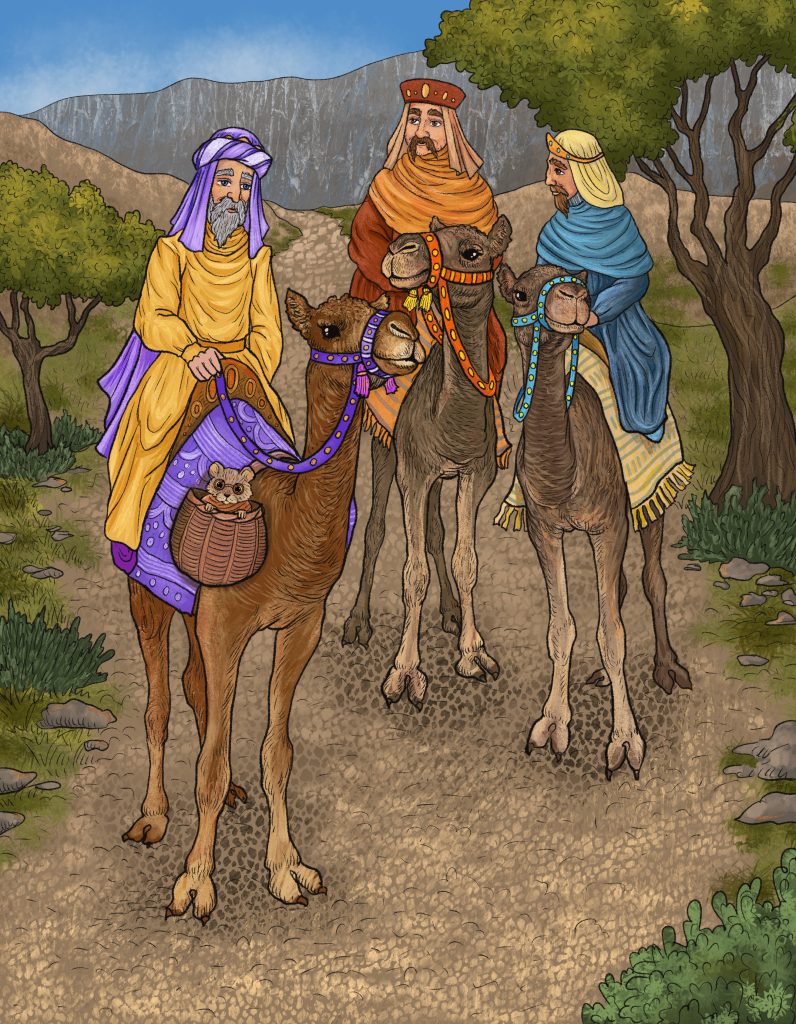
Mormor began, “The three kings, and our favorite librarian, have embarked on their journey to meet baby Jesus so they can worship Him, the long-expected King. Before we see how they are doing, I want to mention that the Bible does not tell us exactly when these three kings started their journey, how long it took them, or when they arrived.
“Often when the Christmas story is told, the three wise men are seen worshiping baby Jesus at the same time that the shepherds are there, and this is traditionally on Christmas Eve night or on Christmas Day, the day of Jesus’ birth. Our story will do that too, but since the Bible does not give us this information, it is possible that the three kings arrived later than the shepherds did. If the three kings did arrive at or near the same time as the shepherds, then they probably needed to start on their journey several months before Mary and Joseph even left Nazareth. That is possible, but we just don’t know.
“We also don’t know exactly where the three wise men were coming from other than it was ‘in the east,’ or if they all knew each other before they began their journey, or if they all began their journey from the same starting point, or if there were exactly three of them, or what their names were, or even if they were actual kings. The only reference in the Bible to the journey and arrival of the Magi, or “wise men,” is in Matthew 2:1-12. Some traditions have the three wise men arriving on the 12th Day of Christmas which is known as Three Kings Day.
“For our story, we are adding a fictional backstory for the wise men, but the most important part of their story is real. For example, the existence of scrolls that contained the Books of the Old Testament were real, and the words of the Bible, being God’s Word, are always real and true. The names Melchior, Caspar, and Balthazar first appeared in a 6th century document, so those may be fictional, but we are using them for the sake of tradition.
“Also for our story, the names of our camels are based on the Chinese language, as is our librarian, Yì Chén. These names are fictional. Is it possible that the wise men came from China? Some scholars believe it is. There is one manuscript from the 8th century that was recently found and translated, and it suggested that the wise men may have come from China via the Silk Road. Nevertheless, most scholars do not think that the wise men came from China. But since no one knows for sure where they came from, we can be creative with this part of our story. The only thing we do know for sure is what we read in Matthew 2:1-12. That means the wise men truly existed, but we do not know much about them. They are a mystery. Just as with any mystery, there’s always someone who wants to investigate, look for clues, and try to figure it out! When the events occurred thousands of years ago, these detectives might be archaeologists, experts in ancient manuscripts and ancient languages, historians, or anthropologists.
“In today’s part of the story,” continued Mormor, “we will be introduced to the camels, and I want you to remember something that Annika said yesterday. Does anyone remember what it was? After she said it, I said to stay tuned for today!”
Linnea had her hand up first. “Something about things that are true,” she said.
Lukas was next. “And things that are good,” he said.
And then Astrid remembered the last one. “And things that are beautiful,” she said.
“Yes!” said Mormor. “Remember that when you meet the camels!”
Meet the Camels: The True, the Good, and the Beautiful
Ethan was bouncing up and down in the saddlebag of Melchior’s camel. But instead of feeling camel-sick, he was beaming from ear to ear. This was his first big adventure! He looked around and noticed that Melchior, Caspar, and Balthazar had nodded off, but their camels continued to follow the star.
“Excuse me,” Ethan said to his camel. “I would like to introduce myself. My name is Yì Chén of the East, but you can call me Ethan. The kings sometimes just call me ‘Librarian.’ What is your name?”
“Greetings, young librarian,” said the camel. “My name is Zhēnli, but you can call me by my English nickname, Jen. Zhēnli means ‘truth’ in the Chinese language. My friends here are Shànliáng who goes by the English nickname, Shaun; and Měilì who we simply call May. In Chinese, Shànliáng means goodness, and Měilì means beauty. You know how much these three wise men like to study philosophy, and so they named us after the True, the Good, and the Beautiful that Plato and Aristotle talked about.”
Mormor paused and said, “Over the next three days, we will stay with the wise men and their camels. These three days are not written about in the Bible. That means they are an imagined, or fictional, part of the story. However, the things we hear about the True, the Good, and the Beautiful have applications to real life that are worth our time to think about. Thinking about things like that has a special name. Does anyone know what it is? It was mentioned by Melchior’s camel.”
“Oh! Oh! Oh! I can almost remember it!” said Theo. “I just remember it reminds me of our cousin, Phil.”
“Thanks for the tip!” said Annika. “Is it philosophy?”
“That’s it!” said Theo. “Fill-AH-so-phee! I knew it had something to do with Phil!”
Mormor chuckled. “Yes, it is philosophy. I want to explain to you what philosophy is. Astrid, this part might be hard to understand, and Lukas, this might seem a bit boring to you, but as you get older, you might find this interesting and easier to understand. After I explain what it means, you can tell me what part of it makes sense to you, okay?”
“Okay, Mormor!” the younger grandchildren said at the same time.
“Philosophy,” began Mormor, “literally means ‘love of wisdom.’ A philosopher is someone who likes to ask questions about life and then spend time thinking deeply about those questions. For example, how can we tell what is real versus not real, or good versus evil, or logical versus not logical? How can we tell if a statement is true or not? These questions are like mysteries, and so a philosopher is like a detective. However, their investigation is done in their mind by thinking deeply about it, and sometimes by having a debate with someone else. They use their ability to reason and think logically, and they do a lot of contemplating. To contemplate means to think deeply about something.
“About 400 years before the birth of Jesus, there was a Greek philosopher named Plato. He lived from roughly 428 BC to 348 BC. One of the things Plato liked to think about was if anything existed beyond, or transcended, the world of space, time, and matter. He called these transcendentals. Remember that he lived in a time and place where the people had not heard about God yet. He came to the conclusion that there were three things which existed independently of our world. He called them the True, the Good, and the Beautiful.
“When Plato talked about truth, goodness, and beauty, he was talking about them in a way that did not depend on what people thought about them. As soon as we look at something from a single person’s point of view, we say it is subjective. The expression “beauty is in the eye of the beholder” is a subjective view of beauty. It means that one person may find something beautiful, and another person might not. Plato wasn’t talking about that. He was talking about these qualities in an objective sense, which means they exist even if there are no people around to see them or have an opinion about them. He was saying that truth, goodness, and beauty did not have to be created because they existed before the world was created. They have always existed, and they are the source from which everything on Earth comes. They sound a lot like God, right?”
“Yes,” said Theo. “But Plato didn’t know God, right?”
“Correct,” said Mormor. “Plato did not know about God. So, when Plato thought about these things that he believed must have existed before the world or outside of the world, instead of wondering how God was revealing them in His creation and in Jesus, he wondered how people were able to recognize them.
“Plato’s student, a philosopher named Aristotle (384 – 322 BC), came up with three terms to describe what people are able to do. He called these logos, ethos, and pathos. Logos is the intellectual ability to reason. This allows people to know truth. It uses our mind and affects how we think. Ethos is the moral ability to discern right from wrong. This allows people to desire goodness. It uses our will and affects what we do and say. Pathos taps into one’s emotions and appreciation of aesthetics. This allows one to love beauty. It uses our heart, desires, and imagination, and affects how we feel in our heart.
“Let’s practice. I’ll give an example of something, and then you tell me two things. First, tell me if the example is in the category is truth, goodness, or beauty. Then second, say if it’s the transcendental kind that Plato is talking about, which has to be the same for everyone rather than just the opinion of one person; or if it is not the kind that Plato is talking about because it depends on personal opinion. Ready?”
“Ready!” all five kids said at the same time.
“First example,” said Mormor. “Since Suzie did not invite Laurie to her birthday party, Laurie believed that Suzie did not like her. Is this example in the category of truth, goodness, or beauty; and is it the transcendental kind or not? Remember, to be transcendental, it can’t depend on personal opinion or culture or time in history. It must be universal which means the same for everyone, anywhere and anytime. It does not depend on who, where, or when. Since transcendentals aren’t affected by a person’s point of view, we say they are objective. When different people view the same thing and see it in different ways or have different opinions about it, we say it is subjective because it depends on the person’s point of view.”
Annika answered. “That example about Laurie’s belief is not about goodness or beauty. It is just what she believes to be true. So, I think it is in the category of truth, but it’s not transcendental truth. It might seem true to Laurie, but it’s not going to be true for everyone. Since it is just Suzie’s personal opinion, it is subjective.”
“Exactly right!” said Mormor. “Second example: In John 3:16, it tells us that ‘God so loved the world.’ God loves each of us. What do you think?”
Astrid raised her hand, “I think that is true for everyone.”
“Absolutely!” said Mormor with a smile. “That is an example of transcendental truth. Okay, third example: If medicine will save a sick child’s life, but the parents don’t have the money to pay for the medicine, it is okay for them to steal it because their intentions are good. What do you think?”
Theo raised his hand. “That example is in the category of goodness because the person is trying to make a decision between right and wrong, or between good and evil, but different people or cultures might have different opinions about that. So, it is not the transcendental kind that Plato is talking about.”
“Correct!” said Mormor. “You are great at this! Okay, fourth example: Mark 12:31 says, ‘Love your neighbor as yourself.’ This is similar to what Jesus says in Matthew 7:12. ‘So in everything, do to others what you would have them do to you.’ This is known as the Golden Rule. What do you think?”
Lukas answered, “That is goodness for everyone.”
“Yes, Lukas!” said Mormor. “You are right! It is transcendental goodness. Okay, fifth example: Five-year-old Johnny works very hard on painting a portrait of his mom. When he asks her what she thinks about it, she tells him that it is beautiful. What she says to him is subjective truth because it’s her personal opinion; but I want you to tell me if this is objective beauty, which is transcendental; or subjective beauty, which is one person’s perspective. Do you think everyone in the world will agree that Johnny’s painting is beautiful?”
Astrid said, “Maybe only Johnny’s mommy thinks that.”
“That’s right, Astrid,” said Mormor. “That is an example of subjective beauty. You are being a great philosopher and thinking deeply about these things! Johnny’s painting is not the kind of transcendental beauty that Plato was talking about. Okay, last example: 1 Samuel l6:7 says this: ‘But the LORD said to Samuel, ‘Do not consider his appearance or his height, for I have rejected him. The LORD does not look at the things man looks at. Man looks at the outward appearance, but the LORD looks at the heart.’ What do you think?”
This time Annika spoke up. “That example depends on what God sees in the person’s heart. When God looks at someone’s heart, I think He is looking to see what their intentions are. Are they only being nice to someone else because it’s going to make them look good or they will get rewarded? Are they motivated by sin such as greed and selfishness? Or, are they being kind because they truly care about helping the other person even if no one else sees or notices? For example, are they trying to act like the Good Samaritan who helps someone in need even though there is no reward or recognition? If they are trying to act the way that Jesus would, or they are listening to the Holy Spirit’s encouragement to seek truth and goodness, then it shows that the intentions of their heart are pure rather than sinful. I think purity is beautiful. It is an inner beauty. I think people can look at someone’s act of kindness and say, ‘Wow, that’s beautiful!’”
“Well said, Annika,” Mormor said. “Understanding Plato’s meaning of beauty is not easy. When Plato described something as beautiful, he was looking at the part of it that makes it what it is. That is hard to define, but we might call it the essence, core, foundation, building blocks, design, or spirit of something. And if it draws us out of ourselves and toward something that is good and true, then it is attracting us. Plato would see that attractiveness as beauty. We might notice this beauty by hearing harmony, seeing radiance, or noticing things like symmetry and proportionality. Or, when we see evidence of a person’s virtues, self-control, and wisdom through their words and actions, we might say there is beauty in that person’s soul.
“Plato believed that as people sought the True, the Good, and the Beautiful in every part of life, they would find meaning and purpose. Truth allows people to see what is real; goodness allows it to have purpose; and beauty allows it to be appreciated. There is a three-in-oneness with the True, the Good, and the Beautiful because anything which is true is also good and beautiful; anything which is good is also true and beautiful; and anything which is beautiful is also true and good.
“Since Plato and Aristotle lived before the birth of Jesus, and lived in Greece, they did not know God, and so they did not realize that seeking the True, the Good, and the Beautiful was seeking God. However, many years after Jesus was on Earth, there came some Christian philosophers, such as Thomas Aquinas (1224 – 1274 AD) and C. S. Lewis (1898 – 1963 AD), who realized that the True, the Good, and the Beautiful are who God is. God is perfect Truth, perfect Goodness, and perfect Beauty.
This means that when we seek God, we are seeking that which is True, Good, and Beautiful. Truth can be found in the Bible because God’s Word is Truth. Jesus is Truth.
“Goodness can be found in the example set by Jesus’s words and actions. God is good. Notice that in the two commandments given to us by Jesus, both of them have to do with love:
“‘Love the Lord your God with all your heart and with all your soul and with all your strength and with all your mind,’ and ‘Love your neighbor as yourself.’ (Luke 10:27).
“We seek goodness because it helps us choose our words and actions. God wants our words and actions to be motivated by love. God is love, so goodness is love.
“And finally, we seek the Beautiful. When one’s heart is pure and filled with the Holy Spirit, we might see a glimpse of the glory and radiance and splendor of God beaming from that person’s sparkling eyes. We might feel pulled outside of ourselves and drawn to the goodness we are seeing or hearing in some way. The glory of God is beautiful. Righteousness, or having our hearts right with God, is beautiful.”
Mormor looked at her youngest grandchildren and said, “Astrid, Lukas, and Linnea, can you think of one thing you learned about philosophy today?”
Linnea spoke first. “Philosophy is thinking about things like how to tell what is right and what is wrong, or what is good and what is evil.”
“Yes,” said Mormor. “Thinking about those questions is one example of philosophy.”
Lukas chimed in. “Since God created the world, He existed before the world. God is perfect truth, perfect goodness, and perfect beauty, so those things also existed before the world was created.”
“That’s right!” said Mormor. “Philosophers call those three things ‘transcendentals.’”
Astrid added, “Being friends with Jesus means that we get to have the True, the Good, and the Beautiful in our lives!”
“Well said, Astrid! You are all great philosophers!” said Mormor. “When we are friends with someone, we want to spend time with them and get to know them even more. Being friends with Jesus means we are seeking to know Him more and more. We can do that by reading in our Bible (seeking truth), by singing songs of praise and thanksgiving (seeking beauty), and by praying and asking Him for guidance when we aren’t sure what to do (seeking goodness).
“In our story, the wise men and our friend Ethan are also seeking Jesus. They haven’t found Him yet, but they are following the star and they are determined to find him. By seeking Jesus, they are essentially seeking to find the True, the Good, and the Beautiful! Tomorrow, we will join them on this quest and see what they discover.”
Application: By seeking God, we seek truth which helps what we think; we seek goodness which helps what we do; and we seek beauty which helps how we feel in our heart.
Reading: Jeremiah 29:13, Matthew 6:33
Hymns:
He’s Everything to Me by Ralph Carmichael in 1964
Seek Ye First by Karen Lafferty in 1971
