
An Advent Storybook and Study: Seeking Truth, Goodness, and Beauty
Copyright 2025 by Lūminé Press, Written by Elsie Lungren, Illustrated by Nicoleta Dabija
Day 07
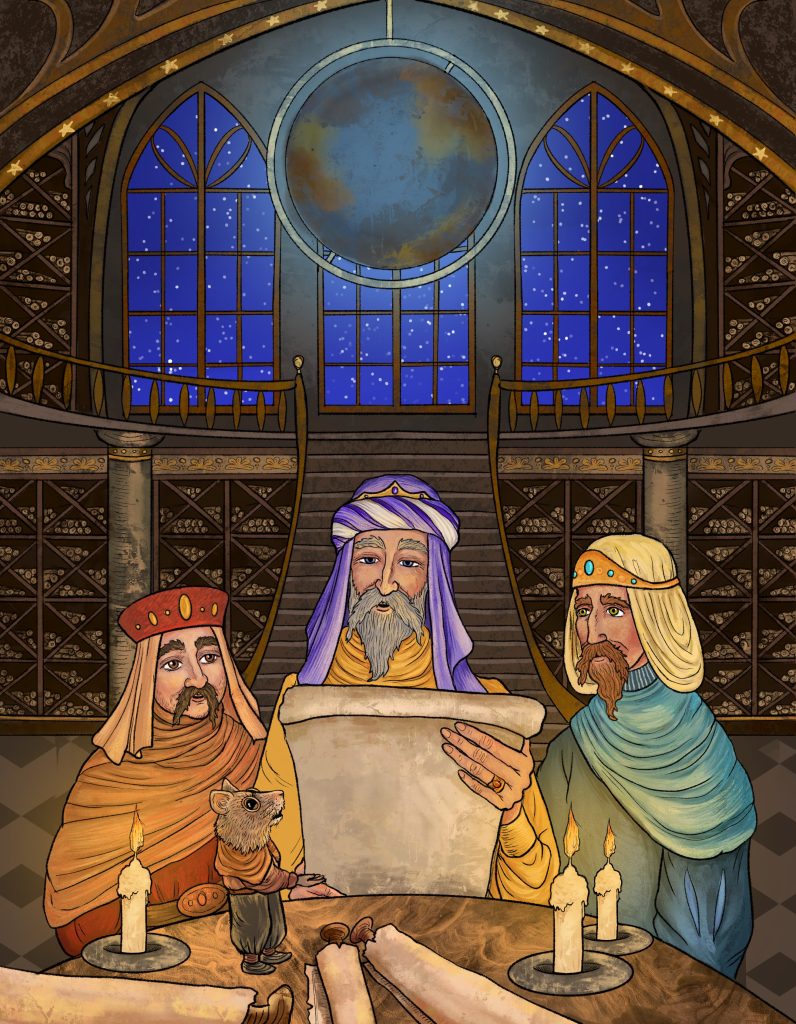
Mormor welcomed her five grandchildren and said, “This is our last day of the first week of Advent! Tomorrow, we will light the second candle on our Advent wreath! Today, we are returning to the library where the three wise men, and our ancestor Yì Chén of the East, are continuing to look at prophecies found in the Old Testament scrolls.
“Do you remember when Caspar said that a prophecy can be fulfilled more than once? For example, they found prophecies that were fulfilled first by Solomon becoming king, and then again by the coming of Jesus as King. Did you know that there are some prophecies that haven’t even had their final fulfillment yet? Some won’t be fulfilled until Jesus returns to earth! That is called his ‘second coming,’ and that hasn’t happened yet! That will be in our future!
“So, the study of prophecies is very interesting. It is like being a sleuth or detective. There are many verses that provide small hints or parts of a clue. A good prophecy detective will know the Bible so well that they can see how verses found in different parts of the Bible will go together like puzzle pieces that fit together and make the picture of a prophecy clearer. Knowing history can help, too. Let’s rejoin our three wise men and see how they are doing with their detective work.
The Library in the East Part 2
(a.k.a. The Mouse and Kings Detective Agency)
Yì Chén of the East, also known as Ethan Mouse the Librarian, was busy. He was searching for scrolls that could provide three kings with clues about where a mysterious new king could be found.
“Ethan!” shouted Melchior. “What scrolls have you found for us today?”
“I have three scrolls that I think might provide some clues for you. These scrolls are from the Books of Numbers, Micah, and Isaiah.
“Any chance we could drink some tea while looking at them?” asked Balthazar with a twinkle in his eye.
“I’m afraid not,” said Ethan. “It is against the rules. We do not want to risk any tea spilling on these ancient scrolls.”
“Don’t give our favorite librarian a hard time,” Caspar said. “We need him! In fact, we should take him with us on this trip. What do you think, Ethan? Could we convince you to join us?”
Ethan couldn’t believe his ears! He was being invited to accompany kings on an adventure! And, the entire trip had the potential of fulfilling an ancient prophecy! His mind was so busy thinking about how amazing this would be, that he forgot to say anything!”
“Ethan?” Melchior prompted.
“What?” asked Ethan. “Oh, oh… my apologies. I was thinking. Yes, I would be honored to accompany you! Let us look at these scrolls and see what hints they hold!”
Caspar, who had been looking at the scroll containing the Book of Micah, spoke up excitedly. “Listen to the words of God that Micah records in chapter 5, verse 2:
‘But you, Bethlehem Ephrathah,
though you are small among the clans of Judah,
out of you will come for me
one who will be ruler over Israel,
whose origins are from of old,
from ancient times’ (Micah 5:2).
Mormor paused and asked, “Does anyone remember where we have heard Micah 5:2 before?”
Linnea raised her hand and said, “Dottie the Donkey was telling Nettie Mouse about it.”
“Good memory, Linnea,” said Mormor. “Here’s a harder question. Do any of you know of another famous person who had already been born in Bethlehem, and who these three kings would have heard of? If you want a hint, check out 1 Samuel 16:1-13 and 17:12. And if you want another hint, remember what we learned yesterday about how Jesus is descending from the line of a certain king…”
Annika answered, “Was it David?”
“Yes,” said Mormor. “Great job, Annika! Bethlehem is where David was born and raised, and Jesus comes from the line of David. Bethlehem is where God sent Samuel to find David and anoint him as the one would become the next king of Israel after Saul. Remember that David, as a boy, was just a shepherd. He tended the sheep. This helps us know that Bethlehem was just a small town at that time, not a big city like Jerusalem.
“In Luke 2:4, 11, Bethlehem is referred to as ‘the town of David’ or ‘the city of David.’ In the Old Testament, the ‘City of David’ is the nickname for Jerusalem. We see that in 2 Samuel 5 (verses 7 and 9). But in the New Testament, it is a nickname for Bethlehem. Why do you think that might be?”
This time Theo raised his hand. “Well, David lived in both places, so either place could be known as the place he is from. I think they are both right.”
“I agree,” said Mormor. “They are both right. I think the reason that the New Testament is talking about Bethlehem as the place where David is from is because that is where he was born, and all the men, like Joseph, had to return to the place of their birth for the census. Also, look at what it says in verse 6 from the passage of Matthew 2:1-6:
‘But you, Bethlehem, in the land of Judah,
are by no means least among the rulers of Judah;
for out of you will come a ruler
who will be the shepherd of my people Israel’ (Matthew 2:6).
“Do you notice anything special about that verse?” asked Mormor.
Lukas raised his hand. “Isn’t that the same verse we just heard in Micah?”
“Yes, Lukas,” said Mormor. “That verse in Matthew repeats the verse from Micah 5:2. It does that to show us that the prophecy in Micah is fulfilled. It also reminds us that the birth of Jesus happens in Bethlehem, and I think this is another reason why the New Testament refers to Bethlehem as the Town or City of David.
“I have another question for you,” continued Mormor. “Who do you think is the ‘shepherd of my people Israel’ in that verse?”
Astrid spoke up. “I have a picture in my Bible of Jesus being a shepherd.”
“That’s right, Astrid!” said Mormor. “Isn’t it amazing that just as David, a shepherd, came from Bethlehem, so too does Jesus, who is also known as a Shepherd? This is an example of using a word in two different ways. With David, the word shepherd is used literally. That means it’s exactly as it sounds. A shepherd is someone who tends sheep, and that’s what David did. With Jesus, the word Shepherd is used figuratively. That means it’s not exactly as it sounds. Examples of figurative language include symbols, metaphors, and similes.
“With Jesus, the sheep he is tending to are us, the people who follow Him. In the verse it is the people of Israel. To use a simile, we are like sheep, and Jesus is like our Shepherd. He looks out for us, stays with us all the time, and looks for us if we get lost. That is what a shepherd does for his sheep.”
“Let’s go back to see if these three kings and Ethan are figuring out the clue from the Book of Micah.”
Melchior and Balthazar were fighting over the scroll that had the Book of Numbers. Ethan, in a panic, was waiving his arms and squeaking at the top of his lungs. “Stop! Be careful! These scrolls are very fragile!”
With a sigh, the two kings stepped back and apologized.
“We are sorry, young Librarian,” said Melchior. “We got carried away with excitement.”
“It is indeed exciting,” said Ethan, “but I think we should leave these other two scrolls for another day. We did get a big clue about Bethlehem. Do you know where Bethlehem is? Are we taking a boat? When should we leave?”
Balthazar laughed. “So many questions, Librarian. Let’s take them one by one.”
“We are to the east of Bethlehem,” said Caspar, “so we will be traveling west.”
“We will not go by boat,” said Melchior. “We will take camels, and we might consider taking the Silk Road.”
“We should leave as soon as possible,” added Balthazar. “It will be a long trip. It would help if we had something to guide us.”
“Like a star!” exclaimed Caspar. “Wouldn’t it be wonderful if we could just follow a star?”
Ethan laughed. “Funny you should mention that,” he said. “When we look at the Book of Numbers, we will read about such a star! But, let’s work on our packing list today, and we can look at more scrolls tomorrow.”
Mormor looked at her grandchildren with a sparkle in her eye. “We will have to wait and see what they find in the Book of Numbers!”
“Oh… do you have to stop?” “I’m not tired.” “Can’t you keep going?” came the replies of her grandchildren.
“It is fun to be prophecy detectives, isn’t it?” asked Mormor. “The better we know the words of the New Testament, the easier it is for us to find clues in the words of the Old Testament!”
“I’m just worried about the figurative language,” said Annika. “What if we think a word is a symbol or metaphor representing something else, and we’re wrong?”
“I’m glad you brought that up, Annika,” said Mormor. “It is true there is a lot of figurative language in the Bible. It’s one of the reasons that the language of the Bible is so beautiful. Some books of the Bible are written as poetry, and poems are known for having figurative language. It can make them rather mysterious and difficult to figure out. That’s why I love poems. I love the challenge of figuring out what their point is!
“With the Bible, we need to remember that God wants us to understand it. It is Him talking to us. My recommendation is that anytime you open your Bible to read it, begin by saying a simple prayer to God asking Him to let you hear and understand whatever it is that He wants you to hear and understand from what you are about to read. He will be happy to do that. He might help some people understand it at a deeper level, and some people at a simpler level. He knows what each person is ready and able to hear and understand. If you read the Bible each year of your life, then each year you might understand it at a little deeper level than you did the previous year! And each year, as you get older and as the words of the Bible become more familiar to you, you may notice more clues or patterns or symbols than you did before!”
Application: If the three wise men read Micah 5:2, they would find that the Bible was literally telling them where to go if they wanted to find the new King spoken of in the prophecies. Bethlehem. When we read the Bible, it tells us in a different way where we can go, or what we can do, that will let us seek, find, and be with Jesus. There are many, many examples, but here are a few:
Reading options: Jeremiah 29:13; Isaiah 40:31; Philippians 4:4-8; Proverbs 3:5-6; 16:3-4, 9, 24; Psalm 78:4; Matthew 7:7-8; Ephesians 4:32; 1 Timothy 4:12; Isaiah 12:4-6.
Hymn: We Three Kings of Orient Are (verse 1) written by John H. Hopkins, Jr. in 1857.
