
An Advent Storybook and Study: Seeking Truth, Goodness, and Beauty
Copyright 2025 by Lūminé Press, Written by Elsie Lungren, Illustrated by Nicoleta Dabija
Day 06
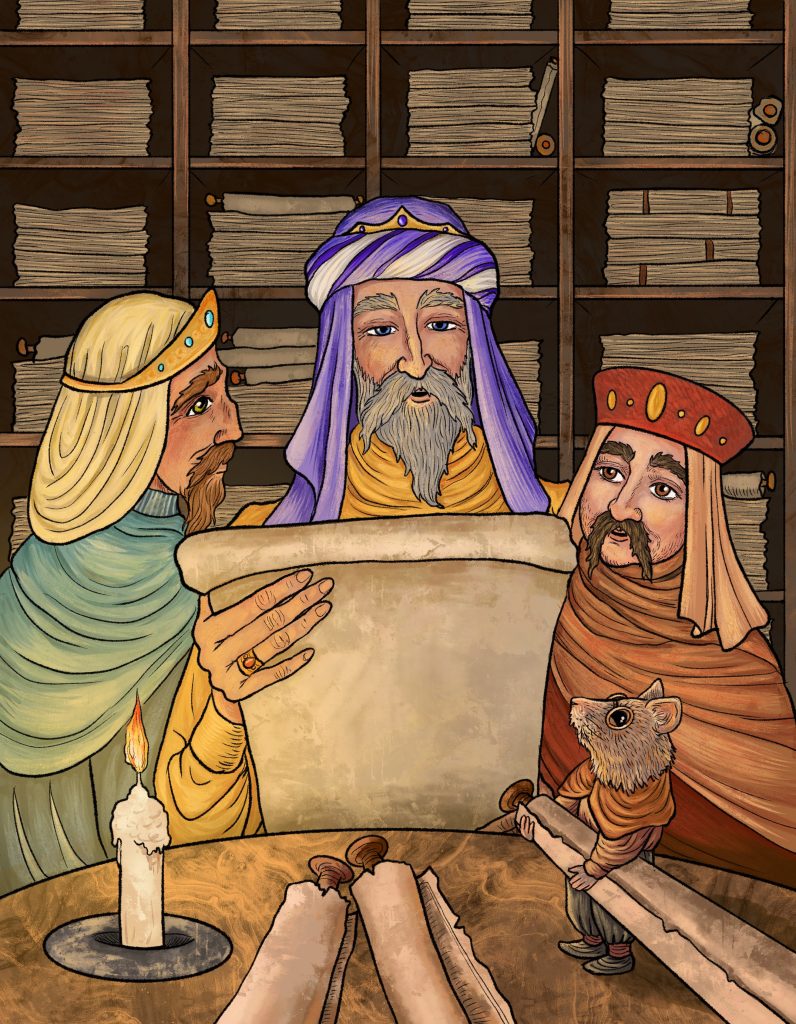
The Library in the East Part 1
“Rules!” Yì Chén of the East muttered to himself. “Doesn’t anyone remember the rules of being in the library?”
As the official librarian, Yì Chén spent much of his time showing wise, educated men where to find the scrolls they were seeking, or knowing the exact scroll on which a specific prophecy, record of history, passage from the Old Testament, or other ancient text would be written. He was also in charge of getting these important men to follow the rules of the library!
“No tea is allowed in the library! No running! No removing scrolls from the library! Keep your voices down! And whatever you do, please do not put the scrolls back yourself! If you make a mistake, we’ll never find it again!” Yì Chén, who was nicknamed Ethan, had had a long day of rescuing one scroll from tea spills after another.
“Ethan!” shouted a familiar voice. “We hear there is a prophecy about a father and a son, and about the son’s kingdom lasting forever, and about kings traveling from far away to bow down and pay tribute!”
“Melchior’s right,” said another king named Caspar. “We must learn more about this.”
“Yes!” boomed the voice of Balthazar. “We three kings must go see this new king.”
“Ethan,” Melchior said again. “Find us the prophecies!”
Ethan scurried around and soon had several scrolls on the table for these three wise men to look at. “There are several places in the Holy Scriptures that talk about the father and son, and the son’s kingdom,” said Ethan. Take a look at Jeremiah 23:5-6, 2 Samuel 7:11-13, and 1 Chronicles 17:13 and 22:10.”
Jeremiah 23:5-6 “The days are coming,” declares the Lord, “when I will raise up to David a righteous Branch, a King who will reign wisely and do what is just and right in the land. 6In his days Judah will be saved and Israel will live in safety. This is the name by which he will be called: The LORD Our Righteousness.”
2 Samuel 7:1, 11-13 That night the word of the LORD came to Nathan, saying: “Go and tell my servant David, ‘This is what the LORD says: …11The LORD declares to you that the LORD himself will establish a house for you: When your days are over and you rest with your fathers, I will raise up your offspring to succeed you, who will come from your own body, and I will establish his kingdom. He is the one who will build a house for my Name, and I will establish the throne of his kingdom forever. I will be his father, and he will be my son.’”
1 Chronicles 17:10b – 14. These verses repeat what was said in 2 Samuel 7:11-13.
1 Chronicles 22:7-10 “David said to Solomon, ‘My son, I had it in my heart to build a house for the Name of the LORD my God. 8But this word of the LORD came to me: …9‘You will have a son who will be a man of peace and rest, and I will give him rest from all his enemies on every side. His name will be Solomon… 10He is the one who will build a house for my Name. He will be my son, and I will be his father. And I will establish the throne of his kingdom over Israel forever.’”
“This is interesting,” began Caspar. “If we do not think about it too deeply, it sounds like it is simply referring to David’s son, Solomon, and that means the prophecies were fulfilled when Solomon became king. But, we must think more deeply. Jeremiah referred to the king as being called ‘The LORD of Righteousness.’ That is not a name that was used for Solomon.”
“And,” continued Balthazar, “notice that when God is speaking, He refers to the king as being His own son. Even in 1 Chronicles chapter 22, when God specifically identifies the king as Solomon, he then refers to Himself as being the father. He says to David, ‘You will have a son’ named Solomon, but then He adds ‘He will be my son, and I will be his father.’ That sounds mysterious, and we should ponder what it means. Is it talking about David’s son or God’s son?”
“These verses definitely refer to a king coming from the line of David,” said Melchior. And several times the LORD God says of this king, ‘I will be his father, and he will be my son.’ That means the king comes from David’s line, but that the king is the Son of God.”
The three wise men stopped talking so that they could ponder these puzzling words.
After some time, Caspar spoke. “It is possible for a prophecy to be fulfilled more than once. When talking about David’s son, that could mean Solomon in the short-term, but it could also mean a future king in the long-term. That future king could be a descendant of David, but somehow also be God’s own son so that he has the power to rule Israel forever. You are right, Balthazar, that this is very mysterious. I think these prophecies could be referring both to David’s son, Solomon, and to God’s own son who is not here yet, but who is coming to rule forever.”
Ethan cleared his throat. “I also brought the scroll that shows Psalm 72,” he said. “It is believed that this is a prayer said by Solomon. He is asking God to bless his reign as king. Would this be of interest?”
After reading it, Balthazar said, “Thank you, Librarian. This is indeed interesting. The author is wise because he knows that the ability to be a just and compassionate ruler or leader comes from God. Most of the words are likely talking about Solomon and what he will be like as king. But there are also some phrases that could not apply to a human. For example, it says, ‘He will endure as long as the sun, as long as the moon, through all generations’ (verse 5). And, ‘He will rule from sea to sea and from the River to the ends of the earth’ (verse 6).”
Caspar held up a hand and everyone fell silent. “I agree with your logic, Balthazar. Solomon, being human, could not endure through all generations, and he did not rule to the ends of the earth. It must be talking about someone as powerful as God, but who comes from the line of King David. I think this is also an example of the prophecy being fulfilled two times, once that has already happened through King Solomon, and once that hasn’t happened yet.
“If so,” said Melchior, “then let us look carefully at verses 10 and 11. It says, ‘The kings of Tarshish and of distant shores will bring tribute to him; the kings of Sheba and Seba will present him gifts. All kings will bow down to him and all nations will serve him.’ It is true that these kings traveled far to pay tribute to King Solomon. But, if this passage also refers to a future king who is God’s own son, then it needs to be fulfilled again. So, there should be kings who travel far to pay tribute to this future king. And, I believe that is us. What do you think, Caspar and Balthazar?”
“It is our duty,” said Caspar.
“It is an honor,” said Balthazar.
“Tomorrow,” said Melchior, “let us make plans. Ethan, we will have more research to do if we are to know what direction we should head in.”
“I will be ready with more scrolls,” said Ethan to the three wise kings.
Mormor said, “While today’s part of the story is not written about in the Bible, we can imagine the moment when those wise men first learned about the prophecies of the coming king. What did they do? They wanted to learn more, and they wanted to ponder what it meant. Even though they could not look at the New Testament like we can, because it hadn’t been written yet, they were able to use logical reasoning to figure out that those passages in the Old Testament could be fulfilled twice, once through Solomon, and once through a future King who God referred to as His own Son.
“By the way, prophecies that are fulfilled by Jesus’s birth and life on earth are often called “Messianic prophecies.” This is because the word Messiah is used in the Old Testament to mean the ‘chosen one’ who is coming as a savior, as a liberator, as the one who will free the Israelites from being ruled over by a foreign government, and who will become their new king. This is what the Israelites were excitedly waiting for, hoping for, expecting.
“As we will find out later, their expectations were not correct. Yes, Jesus was the Messiah. But, they thought the Messiah would be their king on earth. They didn’t realize He was coming to be the King and Lord of their heart! They thought the Messiah would be their savior from the oppressive rule of a foreign government. They didn’t realize He was coming to be their Savior from the consequences of sin. It’s easier for us to know that because we are living in their future. We already know what would happen with the birth, life, death, and resurrection of Jesus. For them, none of that had happened yet, so they didn’t know about it. They only had the Old Testament prophecies to ponder.
“Since we are living in their future, we can look at the New Testament and see how those Old Testament prophecies were fulfilled again, after Solomon, through the birth of God’s Son, Jesus. In Matthew 12:42, it says, “…and now one greater than Solomon is here.” It is talking about Jesus.
“We can also see how the same words are used in both the Old Testament and the New Testament to describe what Jesus, the new king and Son of God, will do. Let’s look at the New Testament first.
In Luke 1:31-33, the angel lets Mary know about Jesus. The angel said, ‘The Lord God will give him the throne of his father David, and he will reign over the house of Jacob forever; his kingdom will never end.’
In Matthew 16:18, Jesus says, ‘And I tell you that you are Peter, and on this rock I will build my church…’
While the church refers to all of those who believe that Jesus is God’s Son and follow Him, we can also think of a church as a type of house, and this house is for God to live in. We can say the church is a house for God’s name.
“Now let’s look at the words used in the Old Testament prophecies:
‘He is the one who will build a house for my Name, and I will establish the throne of his kingdom forever’ (2 Samuel 7:11-13)
‘He is the one who will build a house for me, and I will establish his throne forever’ (1 Chronicles 17:12).
‘He is the one who will build a house for my Name. He will be my son, and I will be his father. And I will establish the throne of his kingdom over Israel forever’ (1 Chronicles 22:10)
“When we compare the words used in the Old Testament prophecies to the words used in the New Testament, it helps us to see how those prophecies were fulfilled again through the birth of Jesus. He is the new king, and this king, while descended from David as the record shows in Matthew 1:1-17, is also the Son of God. In our imagining of that conversation in the library, the wise men figured that out through logical reasoning!
“Tomorrow, we will find out if the three wise men discover any clues in the library that will help them know how to plan their trip.”
Theo raised his hand and said, “I think we should title this part of the story ‘The Wise Men Detective Agency.’ They are very good at looking for clues and piecing them together!”
Lukas added, “Don’t forget Ethan! What would they do without the librarian?! We could call it ‘The Mouse and Kings Detective Agency!”
Everyone laughed.
Application: When we hear about something that we don’t have knowledge about, we are curious. We have a question. What do we do when we have a question about something? We do research. When we do research, it is best to read from primary sources if possible. After we do research, we need to use our critical thinking skills. We think about what we read. We use logical reasoning to see if it makes sense, to look for patterns and make connections, and even to come up with follow-up questions. This is what the wise men did.
Reading options: 2 Samuel 7:1, 11-13; 1 Chronicles 17:10b-14, 22:7-10; Psalm 72:5-11, Jeremiah 23:5-6.
Hymn: We’ve a Story to Tell to the Nations written in 1896 by Henry Ernest Nichol
